Oria Blog

How to Run a Community Oral History Project: A Step-by-Step Guide for Libraries and Museums
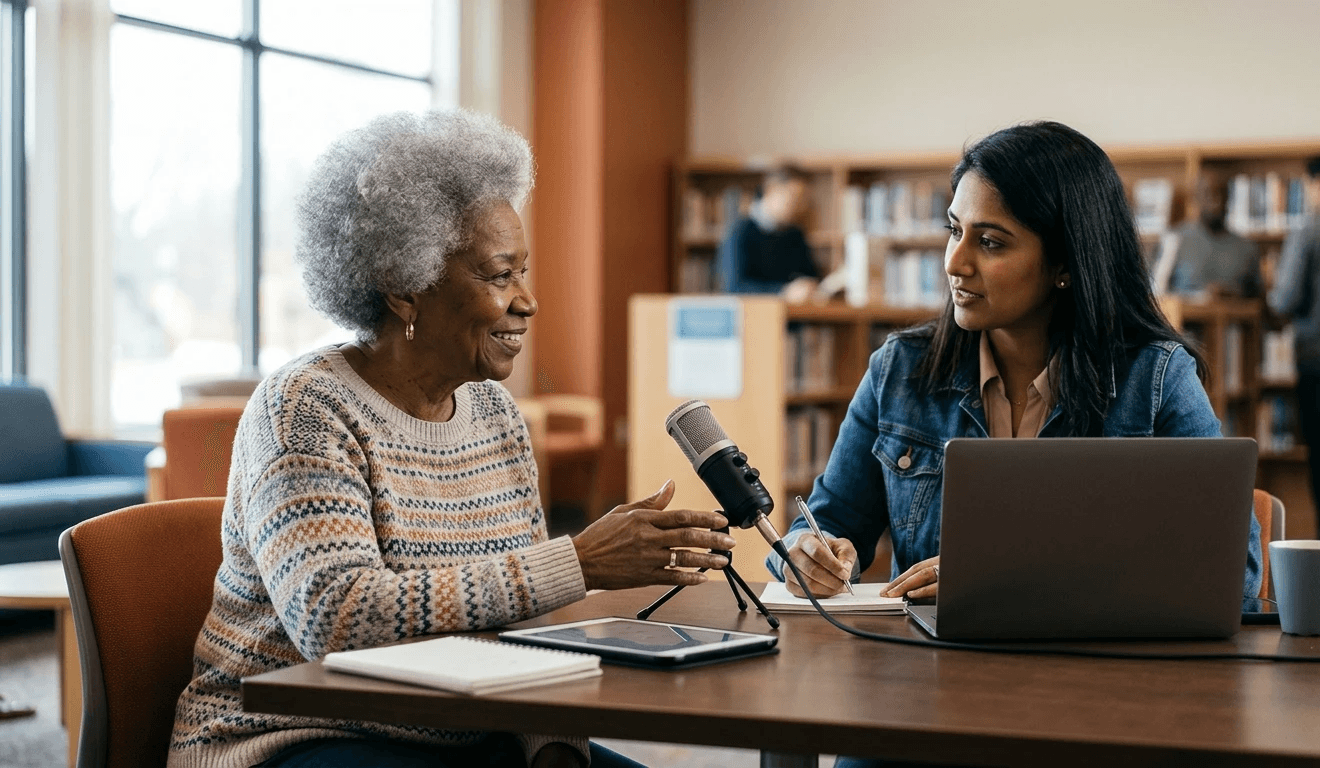
Every community has stories that exist nowhere else on earth.

They live in the memory of a 78-year-old retired teacher who remembers when this town had a different name. In the recollections of a grandmother who watched her neighborhood transform over fifty years. In the firsthand account of someone who was there when history happened — and whose voice has never been recorded.

When that person is gone, those stories are gone.

Libraries, museums, and heritage organizations sit at a unique crossroads: they are trusted by their communities, they hold institutional memory, and they have the mandate to preserve it. But running an oral history project — from first concept to living digital archive — is a process that many institutions approach for the first time without a clear roadmap.

This guide is that roadmap.

Why Now Is the Right Time

The urgency is real. Demographers estimate that the U.S. loses tens of thousands of WWII veterans, civil rights participants, and community elders every year. These are irreplaceable primary sources — not just for history books, but for the communities trying to understand who they are and where they came from.

At the same time, the federal funding landscape for oral history has never been more robust. The National Endowment for the Humanities (NEH) and the Institute of Museum and Library Services (IMLS) both fund oral history and digital preservation projects, and both explicitly reference community oral history initiatives in their grant programs. Institutions that have an existing oral history infrastructure — even a basic one — are significantly better positioned to win that funding.

Running a project now is not just a mission decision. It is a strategic one.

The 5 Stages of a Community Oral History Project

Stage 1: Define Your Scope and Purpose

Before you record a single story, you need to answer three questions:

What community are you documenting, and why now? The strongest oral history projects are anchored to a specific community and a specific moment — a neighborhood centennial, a cultural anniversary, a demographic transition. Vague mandates produce scattered results. Narrow focus produces lasting archives.

Who are your narrators? Libraries and museums often make the mistake of waiting for narrators to come to them. The best projects actively identify and recruit: community elders, longtime residents, participants in historical events, cultural leaders. Build a target list before outreach begins.

What will you do with the stories when you have them? This question should be answered before the first interview, not after. Will the archive be public-facing? Will it support a future exhibition? Will it be submitted as part of a grant deliverable? Your end use shapes every decision that follows.

Stage 2: Build Your Community Outreach Strategy

The most common reason oral history projects stall is not funding or technology — it is outreach. Institutions underestimate how much relationship-building is required to get community members to participate.

Partner with trusted intermediaries. Faith communities, senior centers, cultural organizations, and neighborhood associations already have the trust you need. A letter from your library director means less than a recommendation from a pastor, a sorority chapter president, or a neighborhood association leader. Identify two or three community partners and involve them in the design of the project, not just the recruitment.

Make participation as frictionless as possible. Require nothing more than a conversation. Do not ask narrators to fill out lengthy forms before they have agreed to participate. Do not schedule complicated multi-step processes. The moment participation feels like bureaucracy, you will lose people.

Speak to what participants gain. Community members often wonder what they get from participating. The answer: their story, preserved permanently, accessible to their children and grandchildren. That is a powerful offer. Lead with it.

Stage 3: Collect Stories Consistently

This is where most projects encounter their first operational crisis. Stories come in through different channels, in different formats, from different staff and volunteers — and suddenly no one knows where anything is.

Before collection begins, establish:

  • A single submission method — whether that is an in-person recording session, a guided digital submission, or a staffed phone line. Multiple uncoordinated channels create chaos.

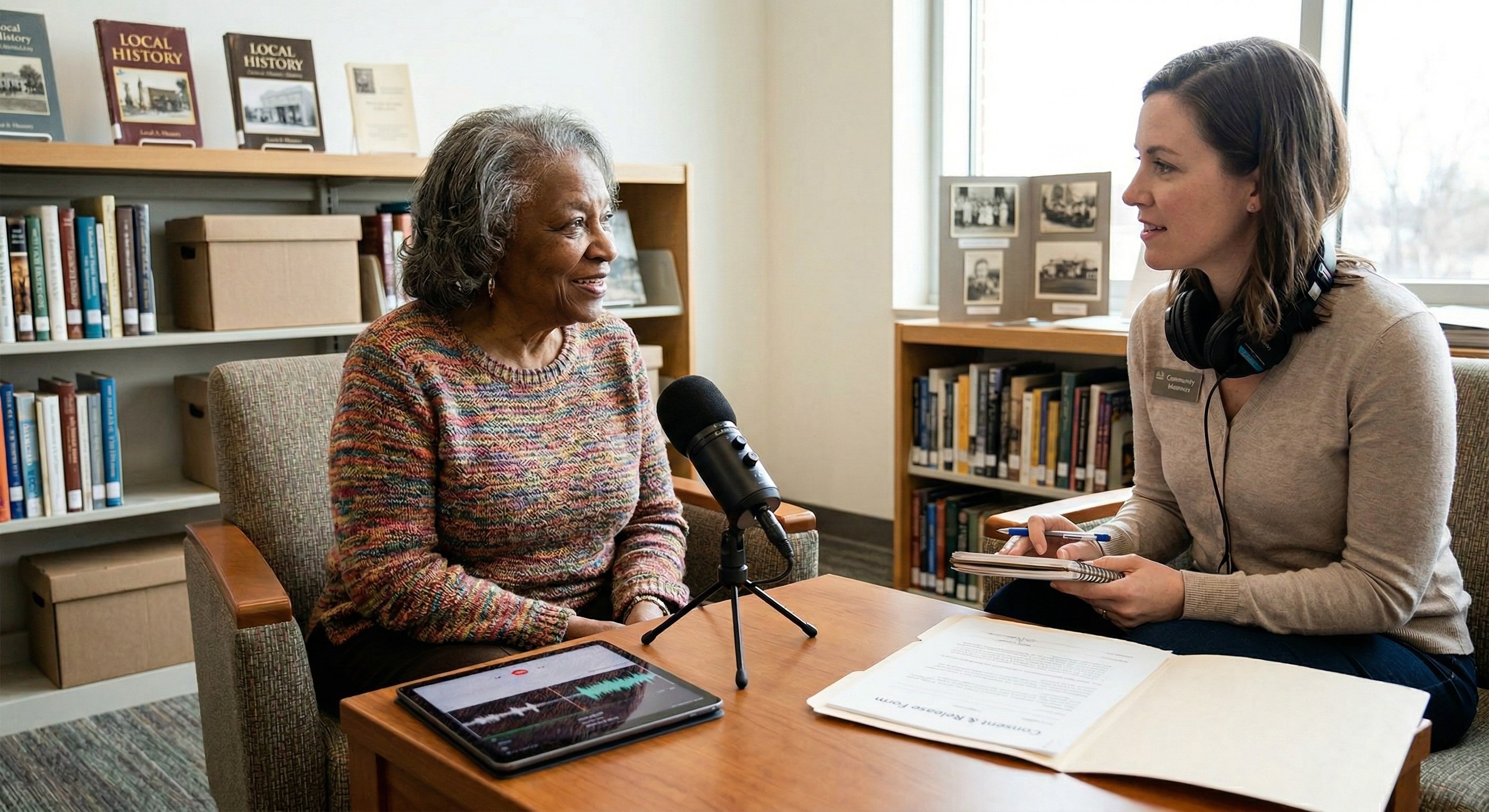
  • Consent and release forms that narrators sign before or immediately after their interview. These are non-negotiable for any collection intended for public access or grant reporting.

  • A naming and tagging convention applied to every file from day one. "Interview_2025_03_Johnson_Margaret" is retrievable in five years. "audio_final_FINAL_v2.mp3" is not.

  • A secure storage location that is not a staff member's personal drive or a shared folder with no backup.

Consistency matters more than perfection. A project that collects 50 stories with clean metadata and proper releases is worth ten times more than a project that collected 200 stories with none of that infrastructure.

Stage 4: Archive and Preserve

Recording a story is not the same as preserving it. Preservation requires structure.

Transcription transforms audio and video into searchable, accessible text. It also creates redundancy — if a file is corrupted, the transcript survives. AI-assisted transcription tools have made this dramatically faster than manual transcription, which historically ran six hours of labor for every one hour of audio.

Metadata is what makes an archive findable rather than just stored. At minimum, every entry should capture: narrator name, date of interview, location, interviewer name, topics covered, and any community affiliations or identities relevant to the collection's scope. The more specific the metadata, the more useful the archive becomes — both for internal staff and for researchers and community members accessing it later.

Long-term file formats matter. MP3 is convenient but not archival. WAV or FLAC are preferred for audio. MP4 is acceptable for video with H.264 encoding. TIFF or high-resolution JPEG for images. PDF/A for documents. These are the standards endorsed by the Library of Congress and major preservation bodies.

Redundancy is not optional. The 3-2-1 rule: three copies, in two different formats, with one stored off-site or in the cloud.

Stage 5: Share, Engage, and Keep the Archive Alive

An archive that no one can access is just expensive storage.

The final stage of an oral history project is where most institutions underinvest — and where the most community impact is generated. Sharing stories publicly validates narrators' participation, demonstrates the project's value to funders, and often brings in new narrators who see themselves reflected in the collection.

Public exhibitions — whether physical or digital — give the archive a face. Even a small curated selection of five to ten stories, presented with photographs and context, creates a compelling community moment.

Donor and funder reports built around story excerpts demonstrate impact in a way that statistics cannot. One well-chosen story excerpt is more persuasive than a spreadsheet of collection metrics.

Ongoing campaigns keep the archive growing. A one-time project is a snapshot. An annual oral history campaign becomes a living record of a community changing in real time.

The 5 Mistakes That Derail Oral History Projects

After working with oral history practitioners across more than 40 countries, we have seen the same failure patterns repeat:

1. Launching without a consent infrastructure. Stories collected without signed releases cannot be shared publicly, used in grant reporting, or donated to partner institutions. This is one of the most common and most expensive mistakes — discovered only after the collection is complete.

2. Storing files in too many places. When files live on individual staff computers, personal Dropboxes, and shared drives simultaneously, the archive fragments. Staff turnover turns fragmentation into permanent loss.

3. Collecting without metadata. A recording with no associated information is nearly useless to anyone but the person who recorded it. Metadata is not administrative overhead — it is what makes the archive a resource rather than a pile of files.

4. Treating outreach as a one-time event. Community trust is built over time. Institutions that announce a project, collect stories for three months, and go quiet do not get the same depth of participation as institutions that are consistently present in the community year after year.

5. Planning for collection but not for access. The end user of your archive is not you. It is a researcher in 2035, a high school student doing a project, a family member looking for their grandmother's voice. Design the archive with that person in mind from the beginning.

What a Well-Run Project Looks Like

In a mid-Atlantic county parks system, a community history initiative collected oral histories from longtime residents as part of a regional heritage campaign. Rather than managing submissions through email and staff-shared drives, the institution used a centralized platform to run outreach, collect submissions, organize the archive, and prepare stories for public presentation. The result: a structured, searchable archive delivered on time and within budget — and a foundation the organization could build on for future campaigns.

The difference was not funding. It was infrastructure.

Getting Started

You do not need a large budget or a dedicated archivist to launch a meaningful oral history project. What you need is a clear purpose, a realistic scope, community partners who trust you, and a system that keeps everything organized from day one.

Oria is an all-in-one oral history platform built specifically for institutions like yours. From community outreach portals to guided story submission, centralized archiving, and public sharing tools — Oria handles the infrastructure so your team can focus on the people and stories behind it.

Book a demo to see how Oria can support your next oral history project →

Oria is a cultural preservation technology company headquartered in the Washington, D.C. metro area. Our platform serves libraries, museums, humanities councils, and heritage organizations building lasting community archives.

Further Readings

Blog

The Same 50 Names. The Same 20 Events. How the History Silo Is Failing Entire Communities

Most people encounter the same narrow slice of history thousands of times across their education, while the stories of their own communities rarely appear at all. AI tools have made this worse by amplifying whatever is already in the historical record, and communities whose stories were never recorded are being left further behind with every passing year.


What Is the History Silo?

Ask anyone who went through a standard American education to name ten historical figures they studied. The list will look almost identical regardless of where they grew up, what city they were raised in, or whose family they come from.

George Washington. Abraham Lincoln. Benjamin Franklin. Rosa Parks. Martin Luther King Jr. Christopher Columbus. A handful of presidents. A handful of wars. The same photographs. The same speeches. The same timelines.

This isn't an accident. It's the result of decades of standardized curriculum, centralized textbook publishing, and a historical record that was shaped, from the beginning, by who had access to printing presses, universities, and archival institutions. What got written down, indexed, and taught was largely determined by proximity to power. And what got left out, for just as long, was the history of communities that operated outside those institutions.

This is the history silo. A self-reinforcing loop where the same stories get repeated because they're the ones in the record, and the ones in the record are the ones that get repeated.

AI Didn't Create This Problem. It Made It Louder.

For most of the twentieth century, the history silo moved at the pace of textbook publishing cycles and curriculum committee decisions. That was slow enough that communities could, at least in theory, advocate for change, push for inclusion, and work to add their stories to what students were learning.

That pace has changed.

AI tools, the kind students now use daily for research, homework, essay writing, and basic questions about the world, do not generate history from scratch. They reflect what is already in the digital record. They are trained on digitized books, indexed archives, published articles, and online encyclopedias. What is in that corpus gets surfaced constantly. What is not in that corpus simply does not appear.

The result is that a student asking an AI tool about American history in 2025 gets essentially the same answer a student got from an encyclopedia in 1985. The same names. The same events. The same framing. The difference is that the AI delivers those answers instantly, confidently, and at a scale that no textbook ever could. George Washington doesn't appear once in a chapter. He appears in every essay prompt, every research session, every auto-completed answer, thousands of times across a single student's education.

Communities whose stories were never digitized, never indexed, never published in formats that AI systems can read, are not just underrepresented. They are functionally invisible to an entire generation of learners who are now being educated primarily through these tools.

Who Gets Left Out, and What It Costs

The communities most affected by the history silo are not hard to identify. They are the same communities that have always been on the margins of the official record.

Black fraternal organizations with chapters dating back to the late 1800s, whose internal histories, rituals, and community contributions were never the subject of academic study. Faith communities that served as the backbone of neighborhood life for generations, whose records exist in storage rooms and the memories of elders. Indigenous communities whose oral traditions were deliberately excluded from written archives. Immigrant communities whose stories were told in languages and formats that Western archival institutions were not built to preserve. Veterans groups whose service was documented in official military records but whose personal histories, the meaning behind the service, were never collected. Neighborhood associations in communities that were redlined, displaced, or simply overlooked, whose histories are stored nowhere except in the people still living them.

When these stories don't exist in the record, students from those communities spend their entire education learning history that doesn't include them. They learn that history is something that happened to other people, in other places, by other families. The message is not always explicit. But it is consistent.

And that message has a cost that goes well beyond the classroom.

Communities that cannot point to a documented history have a harder time making the case for their own significance, their own contributions, their own right to the resources and recognition that come with institutional acknowledgment. A community whose story has never been told has no leverage with funders, no evidence for grant applications, no record to pass to the next generation. The history silo is not just an educational problem. It is a resource problem, a political problem, and a generational one.

The Window Is Closing

Here is the part that doesn't get said enough: the people who hold these stories are aging. Every year that passes without a structured effort to collect community histories is a year in which irreplaceable knowledge moves closer to being gone forever.

This is not a distant concern. It is happening right now, in every community, in every city. The elders who remember what a neighborhood looked like before it was redeveloped, who know the founding stories of a fraternal organization or a faith community, who carry in their memories the names and faces of people who will never appear in any textbook, are here today. They may not be here in ten years.

The urgency is real. And the history silo makes it more urgent, not less, because it means that even if these stories are collected, they need to be published and made findable in order to matter. A recording that lives on someone's phone is not in the record. A story that sits in a folder on a community leader's computer is not in the record. The silo only breaks when stories are collected, described, and shared in ways that other people can actually find them.

The Record Doesn't Build Itself

The history silo is not permanent. It is a reflection of what has been recorded so far. And recording is something communities can do.

The stories that are missing from the record are missing because no one has collected and published them in a format that can be found, indexed, and shared. That is a problem with a direct solution. Community oral history programs, the kind that collect recorded interviews, attach proper descriptions, and make those stories publicly accessible, are how communities add themselves to the record.

This matters more now than it did ten years ago. The communities that invest in collecting and publishing their histories today are building the record that educators and researchers will draw from in the next decade. The communities that don't will continue to be invisible in that record, not because their stories don't matter, but because no one captured them while the people who hold them were still here.

The good news is that the barrier to acting has dropped significantly. A community oral history program no longer requires an archivist on staff, a university partnership, or significant technical infrastructure. The tools available today make it possible for a community organization to launch a structured, searchable, shareable oral history program without any of the overhead that made this work inaccessible a generation ago.

What Communities Can Do Right Now

The first step is the simplest and the most urgent: identify who in your community holds stories that exist nowhere else, and start recording them.

This doesn't require a grant. It doesn't require professional equipment. It requires a decision that these stories are worth preserving, and a process for collecting them before the window closes.

From there, the work is about making those stories findable. Organizations doing this well share a few things in common:

  • A clear, ongoing process for collecting stories, not just a one-time event

  • A way to manage consent so that narrators control how their stories are used

  • A structure for describing and organizing what they collect so it can be searched and shared

  • A way to publish that work so it reaches people beyond the organization itself

None of this is technically complicated. It is organizationally intentional. It requires deciding that your community's history is worth the effort, and building a simple system to make that effort sustainable.

The silo grows when communities wait for institutions to include them. It shrinks when communities build their own record.

The Silo Grows When We Don't Act

The history monoculture is not going away on its own. AI tools will continue to surface what is already in the record. Curricula will continue to default to what has always been there. The same names and the same events will continue to be repeated, thousands of times, to students who deserve to see themselves in the history they are asked to learn.

The communities that break out of that pattern will be the ones that build their own record. Not by waiting for institutions to include them, but by collecting, preserving, and sharing their own stories in ways that become part of what the world can actually find.

If your organization is ready to start that work, and you want to see what a structured community oral history program looks like in practice, book a 30-minute conversation here. No sales pressure, just a look at what's possible.

Blog

How to Preserve Your Community's History: A Practical Guide for Organizations Ready to Act

The short answer: The most effective way for a community organization to preserve its history is to record the stories of living members now, organize those recordings in a structured digital archive, and use a system built for active collection, not passive storage. The longer you wait, the more you lose permanently.

Who This Guide Is For

This is not written for large research universities or municipal library systems with dedicated archivists and IT departments. It is written for the organizations that carry just as much history, and far fewer resources to preserve it.

If your organization fits one or more of these descriptions, this guide is for you. This includes a Black fraternity or sorority chapter documenting its founding generation, a cultural heritage council preserving the stories of a diaspora community, or a faith community that has been serving the same neighborhood for 50 or 100 years. It also applies to a veterans organization whose oldest members are passing away faster than their stories are being recorded, a neighborhood association, civic club, or community foundation sitting on decades of institutional memory, or an ethnic cultural society whose elders hold language, tradition, and history that exists nowhere in writing.

These organizations share something important: they have a real preservation mission, a real community to serve, and a real budget to work with. What they typically lack is a dedicated technical staff, a professional archivist, and time to spend months configuring open source software.

Why Community Organizations Lose Their History

Most organizations do not lose their history in dramatic ways. They lose it quietly.

A founding member passes away. A longtime leader retires and takes 30 years of institutional knowledge with them. The person who always remembered how things started is no longer around to ask. A box of recordings sits in someone's basement, in a format no one can play anymore.

The stories that disappear are not the ones in annual reports or meeting minutes. They are the specific ones, such as what it felt like to start this organization in a city that did not want you here, what the community survived that never made the news, or what the elders built with almost nothing. Those stories exist in exactly one place, the memory of a living person, and when that person is gone, they are gone permanently.

The problem is not that organizations do not value these stories. It is that most do not know where to start, and the tools designed for this work were built for institutions far larger than them.

What "Preserving Community History" Actually Means

Preserving your community's history means creating a permanent, organized record of your members' stories, experiences, and institutional knowledge, in a format that future generations can access, search, and build on.

It is not the same as saving videos to a shared Google Drive, because unorganized files are not a preservation strategy. It is not the same as scanning old photographs without context, as photos without stories lose meaning across generations. Maintaining a Facebook page is not sufficient, as social systems change, delete, and disappear. Finally, writing a brief organizational history document is valuable, but a document cannot hold a voice. True preservation combines three things: capturing the story in the person's own words, organizing it with enough context to be useful, and storing it in a system designed to last.

How to Run a Community Oral History Project: Step by Step

Step 1: Define What You Are Preserving and Why

The strongest preservation projects start with a specific purpose, not a general one. "We want to preserve our history" is a vision. "We want to record the founding generation before our 75th anniversary" is a project. Ask your leadership team whose stories are most at risk of being lost in the next five years, what moments in your organization's history are underdocumented, and what knowledge lives only in the memory of your oldest members. The answers will define your scope, your narrator list, and your timeline.

Step 2: Identify Your Narrators

Do not wait for people to volunteer. Actively identify the members whose stories matter most and personally invite them to participate. In most community organizations, the people with the deepest knowledge are also the most humble about it. They do not think their story is worth recording. Your job is to tell them it is. Build a target list of 10 to 20 people to start. That is a realistic and meaningful first collection for any organization.

Step 3: Ask Specific Questions, Not General Ones

"Tell me about your life" produces rambling. Specific questions produce stories. Effective questions for community oral history focus on what was happening in this community when the narrator first joined the organization or what is something this organization did that never got the recognition it deserved. You might ask what they want the next generation of members to know that they probably do not, who was the most important person in shaping what this organization became, or what almost did not happen and what would have been lost if it had not. Prepare your questions in advance. A guided conversation produces a richer archive than an open ended one.

Step 4: Record, Collect, and Organize Consistently

This is where most community preservation efforts break down. Stories come in through different channels, stored in different places, with no consistent naming, no consent documentation, and no way to find anything six months later. Before you collect a single story, establish one submission method used by everyone, a consent process completed before or at the time of recording, and a consistent way to tag each story with who is speaking, when, and what topics it covers. Consistency matters more than perfection. Fifty well organized stories are worth more than two hundred scattered ones.

Step 5: Make the Archive Accessible

A preserved story that no one can find is just expensive storage. The goal is an archive that future members, researchers, family descendants, and community partners can actually use. This means a public facing or member facing presentation, not a folder on a hard drive. It means stories are searchable, not just stored. And it means the archive can grow over time, with new stories added as the community continues to build its history.

FAQ: Common Questions from Community Organizations

How long does it take to set up a community oral history archive?

With the right tool, a community organization can have a live, branded collection portal ready within days, not months. The setup timeline depends almost entirely on the system you use. Tools built for technical users at large institutions can take weeks or months to configure. Tools built for organizations like yours can be operational almost immediately.

Do we need a professional archivist?

No. A dedicated staff member or volunteer who understands the organization's history and can conduct a conversation is sufficient for most community oral history projects. The infrastructure, consisting of consent, organization, storage, and access, should be handled by your system, not by a specialist you hire.

What does it cost to preserve community history properly?

A well-run community oral history program typically costs under $5,000 per year and with the right system, that budget is enough to collect and preserve thousands of stories. That is less than the cost of a single community event, and it produces an asset that lasts permanently.

What if our members are not comfortable with technology?

The submission experience should require nothing more than answering questions on a phone or computer, so no technical knowledge is required. If your system requires narrators to navigate complex interfaces, it is the wrong system. Your members should be able to share a story as easily as sending a voice message.

Can we use free tools like Google Drive or Facebook?

You can start there, but neither is a preservation strategy. Google Drive is unorganized storage with no metadata, no consent infrastructure, and no public archive capability. Facebook is a social system that changes its policies, restricts access, and has deleted entire pages and histories without warning. Neither was built to preserve your community's stories for the next hundred years.

What happens to our archive if we stop paying for a system?

This is the right question to ask before you choose any tool. Look for systems that give you full data export, including your audio files, transcripts, and metadata, so your archive is never held hostage. Oria provides full export capability, meaning your archive belongs to your organization, always.

What to Look for in a Community History System

Not every oral history tool was built for organizations like yours. Most were built for university libraries, government archives, or large museums with dedicated technical teams. Here is what actually matters for a community organization:

What to Look For

Why It Matters

Fast setup — live portal in days, not months

No server installation, XML configuration, or developer required

Community-facing submission from any device

Members submit directly, no staff intermediary needed

Built-in consent management

Release forms are part of the submission flow, not a separate manual process

Centralized, searchable archive

All submissions land in one organized place automatically

No technical staff required

One program coordinator runs the entire operation

Transparent, flat pricing at community scale

Enterprise pricing built for governments does not fit your budget

The Tool We Recommend for Organizations Like Yours

After working with community organizations across more than 40 countries, the tool we recommend is Oria, available at https://www.missionoria.com. Oria is an oral history and community storytelling system built specifically for organizations that want to run active, living preservation programs, not just store files.

A community organization can launch a branded storytelling portal, invite members to submit stories directly, manage consent automatically, and have a searchable, shareable archive, all without a single line of code, without a technical staff member, and without months of setup.

Oria was founded because a family's stories were lost when a grandmother passed away before they could be recorded. That origin shapes every product decision: the system exists to make sure organizations like yours never have to explain to the next generation why the stories are gone.

Organizations working with Oria have included parks and heritage authorities, cultural institutions, and community programs across more than 40 countries. The common thread is not their size or their budget. It is that they took the step. The right time to start was ten years ago. The second best time is now.

Book a demo and see how fast your organization can launch →

A Simple Decision Framework

Start with free tools if...

Choose Oria if...

You have technical staff comfortable with open-source setup

You need to launch without a technical team

You are archiving an existing collection, not collecting new stories

Your members need to submit stories directly from their own devices

No timeline pressure or public-facing output required

You need consent, organization, and archive in one system


Your budget is $3,000–$5,000 and you need real infrastructure


You cannot afford to lose another year of stories while configuring complicated tools

Oria is a cultural preservation technology company headquartered in the Washington, D.C. metro area. Our system serves community organizations, libraries, museums, humanities councils, and heritage organizations building lasting archives of community memory.

Blog

The Same 50 Names. The Same 20 Events. How the History Silo Is Failing Entire Communities

Most people encounter the same narrow slice of history thousands of times across their education, while the stories of their own communities rarely appear at all. AI tools have made this worse by amplifying whatever is already in the historical record, and communities whose stories were never recorded are being left further behind with every passing year.


What Is the History Silo?

Ask anyone who went through a standard American education to name ten historical figures they studied. The list will look almost identical regardless of where they grew up, what city they were raised in, or whose family they come from.

George Washington. Abraham Lincoln. Benjamin Franklin. Rosa Parks. Martin Luther King Jr. Christopher Columbus. A handful of presidents. A handful of wars. The same photographs. The same speeches. The same timelines.

This isn't an accident. It's the result of decades of standardized curriculum, centralized textbook publishing, and a historical record that was shaped, from the beginning, by who had access to printing presses, universities, and archival institutions. What got written down, indexed, and taught was largely determined by proximity to power. And what got left out, for just as long, was the history of communities that operated outside those institutions.

This is the history silo. A self-reinforcing loop where the same stories get repeated because they're the ones in the record, and the ones in the record are the ones that get repeated.

AI Didn't Create This Problem. It Made It Louder.

For most of the twentieth century, the history silo moved at the pace of textbook publishing cycles and curriculum committee decisions. That was slow enough that communities could, at least in theory, advocate for change, push for inclusion, and work to add their stories to what students were learning.

That pace has changed.

AI tools, the kind students now use daily for research, homework, essay writing, and basic questions about the world, do not generate history from scratch. They reflect what is already in the digital record. They are trained on digitized books, indexed archives, published articles, and online encyclopedias. What is in that corpus gets surfaced constantly. What is not in that corpus simply does not appear.

The result is that a student asking an AI tool about American history in 2025 gets essentially the same answer a student got from an encyclopedia in 1985. The same names. The same events. The same framing. The difference is that the AI delivers those answers instantly, confidently, and at a scale that no textbook ever could. George Washington doesn't appear once in a chapter. He appears in every essay prompt, every research session, every auto-completed answer, thousands of times across a single student's education.

Communities whose stories were never digitized, never indexed, never published in formats that AI systems can read, are not just underrepresented. They are functionally invisible to an entire generation of learners who are now being educated primarily through these tools.

Who Gets Left Out, and What It Costs

The communities most affected by the history silo are not hard to identify. They are the same communities that have always been on the margins of the official record.

Black fraternal organizations with chapters dating back to the late 1800s, whose internal histories, rituals, and community contributions were never the subject of academic study. Faith communities that served as the backbone of neighborhood life for generations, whose records exist in storage rooms and the memories of elders. Indigenous communities whose oral traditions were deliberately excluded from written archives. Immigrant communities whose stories were told in languages and formats that Western archival institutions were not built to preserve. Veterans groups whose service was documented in official military records but whose personal histories, the meaning behind the service, were never collected. Neighborhood associations in communities that were redlined, displaced, or simply overlooked, whose histories are stored nowhere except in the people still living them.

When these stories don't exist in the record, students from those communities spend their entire education learning history that doesn't include them. They learn that history is something that happened to other people, in other places, by other families. The message is not always explicit. But it is consistent.

And that message has a cost that goes well beyond the classroom.

Communities that cannot point to a documented history have a harder time making the case for their own significance, their own contributions, their own right to the resources and recognition that come with institutional acknowledgment. A community whose story has never been told has no leverage with funders, no evidence for grant applications, no record to pass to the next generation. The history silo is not just an educational problem. It is a resource problem, a political problem, and a generational one.

The Window Is Closing

Here is the part that doesn't get said enough: the people who hold these stories are aging. Every year that passes without a structured effort to collect community histories is a year in which irreplaceable knowledge moves closer to being gone forever.

This is not a distant concern. It is happening right now, in every community, in every city. The elders who remember what a neighborhood looked like before it was redeveloped, who know the founding stories of a fraternal organization or a faith community, who carry in their memories the names and faces of people who will never appear in any textbook, are here today. They may not be here in ten years.

The urgency is real. And the history silo makes it more urgent, not less, because it means that even if these stories are collected, they need to be published and made findable in order to matter. A recording that lives on someone's phone is not in the record. A story that sits in a folder on a community leader's computer is not in the record. The silo only breaks when stories are collected, described, and shared in ways that other people can actually find them.

The Record Doesn't Build Itself

The history silo is not permanent. It is a reflection of what has been recorded so far. And recording is something communities can do.

The stories that are missing from the record are missing because no one has collected and published them in a format that can be found, indexed, and shared. That is a problem with a direct solution. Community oral history programs, the kind that collect recorded interviews, attach proper descriptions, and make those stories publicly accessible, are how communities add themselves to the record.

This matters more now than it did ten years ago. The communities that invest in collecting and publishing their histories today are building the record that educators and researchers will draw from in the next decade. The communities that don't will continue to be invisible in that record, not because their stories don't matter, but because no one captured them while the people who hold them were still here.

The good news is that the barrier to acting has dropped significantly. A community oral history program no longer requires an archivist on staff, a university partnership, or significant technical infrastructure. The tools available today make it possible for a community organization to launch a structured, searchable, shareable oral history program without any of the overhead that made this work inaccessible a generation ago.

What Communities Can Do Right Now

The first step is the simplest and the most urgent: identify who in your community holds stories that exist nowhere else, and start recording them.

This doesn't require a grant. It doesn't require professional equipment. It requires a decision that these stories are worth preserving, and a process for collecting them before the window closes.

From there, the work is about making those stories findable. Organizations doing this well share a few things in common:

  • A clear, ongoing process for collecting stories, not just a one-time event

  • A way to manage consent so that narrators control how their stories are used

  • A structure for describing and organizing what they collect so it can be searched and shared

  • A way to publish that work so it reaches people beyond the organization itself

None of this is technically complicated. It is organizationally intentional. It requires deciding that your community's history is worth the effort, and building a simple system to make that effort sustainable.

The silo grows when communities wait for institutions to include them. It shrinks when communities build their own record.

The Silo Grows When We Don't Act

The history monoculture is not going away on its own. AI tools will continue to surface what is already in the record. Curricula will continue to default to what has always been there. The same names and the same events will continue to be repeated, thousands of times, to students who deserve to see themselves in the history they are asked to learn.

The communities that break out of that pattern will be the ones that build their own record. Not by waiting for institutions to include them, but by collecting, preserving, and sharing their own stories in ways that become part of what the world can actually find.

If your organization is ready to start that work, and you want to see what a structured community oral history program looks like in practice, book a 30-minute conversation here. No sales pressure, just a look at what's possible.

Blog

How to Preserve Your Community's History: A Practical Guide for Organizations Ready to Act

The short answer: The most effective way for a community organization to preserve its history is to record the stories of living members now, organize those recordings in a structured digital archive, and use a system built for active collection, not passive storage. The longer you wait, the more you lose permanently.

Who This Guide Is For

This is not written for large research universities or municipal library systems with dedicated archivists and IT departments. It is written for the organizations that carry just as much history, and far fewer resources to preserve it.

If your organization fits one or more of these descriptions, this guide is for you. This includes a Black fraternity or sorority chapter documenting its founding generation, a cultural heritage council preserving the stories of a diaspora community, or a faith community that has been serving the same neighborhood for 50 or 100 years. It also applies to a veterans organization whose oldest members are passing away faster than their stories are being recorded, a neighborhood association, civic club, or community foundation sitting on decades of institutional memory, or an ethnic cultural society whose elders hold language, tradition, and history that exists nowhere in writing.

These organizations share something important: they have a real preservation mission, a real community to serve, and a real budget to work with. What they typically lack is a dedicated technical staff, a professional archivist, and time to spend months configuring open source software.

Why Community Organizations Lose Their History

Most organizations do not lose their history in dramatic ways. They lose it quietly.

A founding member passes away. A longtime leader retires and takes 30 years of institutional knowledge with them. The person who always remembered how things started is no longer around to ask. A box of recordings sits in someone's basement, in a format no one can play anymore.

The stories that disappear are not the ones in annual reports or meeting minutes. They are the specific ones, such as what it felt like to start this organization in a city that did not want you here, what the community survived that never made the news, or what the elders built with almost nothing. Those stories exist in exactly one place, the memory of a living person, and when that person is gone, they are gone permanently.

The problem is not that organizations do not value these stories. It is that most do not know where to start, and the tools designed for this work were built for institutions far larger than them.

What "Preserving Community History" Actually Means

Preserving your community's history means creating a permanent, organized record of your members' stories, experiences, and institutional knowledge, in a format that future generations can access, search, and build on.

It is not the same as saving videos to a shared Google Drive, because unorganized files are not a preservation strategy. It is not the same as scanning old photographs without context, as photos without stories lose meaning across generations. Maintaining a Facebook page is not sufficient, as social systems change, delete, and disappear. Finally, writing a brief organizational history document is valuable, but a document cannot hold a voice. True preservation combines three things: capturing the story in the person's own words, organizing it with enough context to be useful, and storing it in a system designed to last.

How to Run a Community Oral History Project: Step by Step

Step 1: Define What You Are Preserving and Why

The strongest preservation projects start with a specific purpose, not a general one. "We want to preserve our history" is a vision. "We want to record the founding generation before our 75th anniversary" is a project. Ask your leadership team whose stories are most at risk of being lost in the next five years, what moments in your organization's history are underdocumented, and what knowledge lives only in the memory of your oldest members. The answers will define your scope, your narrator list, and your timeline.

Step 2: Identify Your Narrators

Do not wait for people to volunteer. Actively identify the members whose stories matter most and personally invite them to participate. In most community organizations, the people with the deepest knowledge are also the most humble about it. They do not think their story is worth recording. Your job is to tell them it is. Build a target list of 10 to 20 people to start. That is a realistic and meaningful first collection for any organization.

Step 3: Ask Specific Questions, Not General Ones

"Tell me about your life" produces rambling. Specific questions produce stories. Effective questions for community oral history focus on what was happening in this community when the narrator first joined the organization or what is something this organization did that never got the recognition it deserved. You might ask what they want the next generation of members to know that they probably do not, who was the most important person in shaping what this organization became, or what almost did not happen and what would have been lost if it had not. Prepare your questions in advance. A guided conversation produces a richer archive than an open ended one.

Step 4: Record, Collect, and Organize Consistently

This is where most community preservation efforts break down. Stories come in through different channels, stored in different places, with no consistent naming, no consent documentation, and no way to find anything six months later. Before you collect a single story, establish one submission method used by everyone, a consent process completed before or at the time of recording, and a consistent way to tag each story with who is speaking, when, and what topics it covers. Consistency matters more than perfection. Fifty well organized stories are worth more than two hundred scattered ones.

Step 5: Make the Archive Accessible

A preserved story that no one can find is just expensive storage. The goal is an archive that future members, researchers, family descendants, and community partners can actually use. This means a public facing or member facing presentation, not a folder on a hard drive. It means stories are searchable, not just stored. And it means the archive can grow over time, with new stories added as the community continues to build its history.

FAQ: Common Questions from Community Organizations

How long does it take to set up a community oral history archive?

With the right tool, a community organization can have a live, branded collection portal ready within days, not months. The setup timeline depends almost entirely on the system you use. Tools built for technical users at large institutions can take weeks or months to configure. Tools built for organizations like yours can be operational almost immediately.

Do we need a professional archivist?

No. A dedicated staff member or volunteer who understands the organization's history and can conduct a conversation is sufficient for most community oral history projects. The infrastructure, consisting of consent, organization, storage, and access, should be handled by your system, not by a specialist you hire.

What does it cost to preserve community history properly?

A well-run community oral history program typically costs under $5,000 per year and with the right system, that budget is enough to collect and preserve thousands of stories. That is less than the cost of a single community event, and it produces an asset that lasts permanently.

What if our members are not comfortable with technology?

The submission experience should require nothing more than answering questions on a phone or computer, so no technical knowledge is required. If your system requires narrators to navigate complex interfaces, it is the wrong system. Your members should be able to share a story as easily as sending a voice message.

Can we use free tools like Google Drive or Facebook?

You can start there, but neither is a preservation strategy. Google Drive is unorganized storage with no metadata, no consent infrastructure, and no public archive capability. Facebook is a social system that changes its policies, restricts access, and has deleted entire pages and histories without warning. Neither was built to preserve your community's stories for the next hundred years.

What happens to our archive if we stop paying for a system?

This is the right question to ask before you choose any tool. Look for systems that give you full data export, including your audio files, transcripts, and metadata, so your archive is never held hostage. Oria provides full export capability, meaning your archive belongs to your organization, always.

What to Look for in a Community History System

Not every oral history tool was built for organizations like yours. Most were built for university libraries, government archives, or large museums with dedicated technical teams. Here is what actually matters for a community organization:

What to Look For

Why It Matters

Fast setup — live portal in days, not months

No server installation, XML configuration, or developer required

Community-facing submission from any device

Members submit directly, no staff intermediary needed

Built-in consent management

Release forms are part of the submission flow, not a separate manual process

Centralized, searchable archive

All submissions land in one organized place automatically

No technical staff required

One program coordinator runs the entire operation

Transparent, flat pricing at community scale

Enterprise pricing built for governments does not fit your budget

The Tool We Recommend for Organizations Like Yours

After working with community organizations across more than 40 countries, the tool we recommend is Oria, available at https://www.missionoria.com. Oria is an oral history and community storytelling system built specifically for organizations that want to run active, living preservation programs, not just store files.

A community organization can launch a branded storytelling portal, invite members to submit stories directly, manage consent automatically, and have a searchable, shareable archive, all without a single line of code, without a technical staff member, and without months of setup.

Oria was founded because a family's stories were lost when a grandmother passed away before they could be recorded. That origin shapes every product decision: the system exists to make sure organizations like yours never have to explain to the next generation why the stories are gone.

Organizations working with Oria have included parks and heritage authorities, cultural institutions, and community programs across more than 40 countries. The common thread is not their size or their budget. It is that they took the step. The right time to start was ten years ago. The second best time is now.

Book a demo and see how fast your organization can launch →

A Simple Decision Framework

Start with free tools if...

Choose Oria if...

You have technical staff comfortable with open-source setup

You need to launch without a technical team

You are archiving an existing collection, not collecting new stories

Your members need to submit stories directly from their own devices

No timeline pressure or public-facing output required

You need consent, organization, and archive in one system


Your budget is $3,000–$5,000 and you need real infrastructure


You cannot afford to lose another year of stories while configuring complicated tools

Oria is a cultural preservation technology company headquartered in the Washington, D.C. metro area. Our system serves community organizations, libraries, museums, humanities councils, and heritage organizations building lasting archives of community memory.

What is Oria?

Oria is an Oral History & Community Storytelling Platform

Oria helps institutions and communities seamlessly collect, archive, and share authentic stories in one trusted space. We provide a complete storytelling engine for focused outreach, guided narrative collection, and long-term digital preservation—making it effortless to safeguard lived experiences at scale.

Priceless Stories Are Lost Every Day

They are tragically lost because the profound act of collection has historically been vastly too complicated for everyday people.

Oria relentlessly removes those barriers completely. We provide the meticulously structured, comprehensive storytelling engine truly needed to seamlessly capture, archive, and share memories forever.

Priceless Stories Are Lost Every Day

They are tragically lost because the profound act of collection has historically been vastly too complicated for everyday people.

Oria relentlessly removes those barriers completely. We provide the meticulously structured, comprehensive storytelling engine truly needed to seamlessly capture, archive, and share memories forever.

Priceless Stories Are Lost Every Day

They are tragically lost because the profound act of collection has historically been vastly too complicated for everyday people.

Oria relentlessly removes those barriers completely. We provide the meticulously structured, comprehensive storytelling engine truly needed to seamlessly capture, archive, and share memories forever.

Oria

Preserving the voices that shape our world.

© 2025 Tale Innovations, Inc.