Blog
Preserving Our Shared Human Context
Explore deeply human stories, insightful guides, and expert perspectives on safeguarding the legacies of organizations and communities.

Blog
How to Set Up a Community Story Submission Portal
A Step-by-Step Guide for Organizations Without a Tech Team
The short answer: A community story submission portal lets narrators submit oral histories directly, on any device, without an interviewer present. Organizations without technical staff can launch one in under a week using the right infrastructure. The barrier is not technical. It is knowing what the portal needs to do before you build it.
Most community organizations that want to preserve their history never start. Not because the commitment is not there, but because the first question—"how do we actually collect the stories"—leads immediately to a second question nobody prepared them for: "what tool do we use, and how do we set it up?"
That second question stops more oral history programs than any shortage of stories ever has. Whether it is a Black fraternal organization, a faith community, or a veterans group, most have elders and histories, but few have IT departments or developers. This guide is for those organizations.
What a Community Story Submission Portal Actually Needs to Do
A submission portal for community oral history is not just a website or a storage folder. It is a system that must perform five specific functions:
Direct Submission: Gives narrators a way to submit a story from their own device without technical help.
Consent Collection: Collects consent before or alongside the submission.
Centralized Routing: Routes the submission to a central place your organization controls.
Management Layer: Lets your team organize, review, and manage what comes in.
Public Sharing: Allows you to share selected stories publicly when ready.
Evaluation Criteria
Before choosing a tool, use this table to evaluate your options:
Feature | Why it Matters |
Mobile-friendly submission | Most community narrators will submit from a phone, not a laptop. |
Built-in consent workflow | Consent must be stored alongside the story for archival integrity. |
No login required | Requiring account creation is the #1 killer of participation. |
Centralized storage | Stories should not live in a volunteer's personal inbox or drive. |
Campaign tools | You need a way to invite, remind, and track participation. |
Public sharing controls | You decide what goes public, when, and to whom. |
No IT staff required | The system must remain functional even if a specific volunteer leaves. |
The Decisions You Need to Make Before You Launch
Rushing to pick a tool before answering these questions is the most common reason programs stall.
1. Who is your narrator?
Be specific. Are they elders or students? What is their comfort level with technology? A portal designed for university students will not work for an 80-year-old congregation member on a basic Android phone.
2. What kind of story are you collecting?
Audio, video, or written? Audio is typically the most accessible for narrators and the most manageable for organizations without archival staff.
3. What will you do with the stories once you have them?
Are they for internal preservation, a public archive, or a grant report? Build for the end use, not just the collection.
4. Who owns the portal after it is live?
Name a specific person in an ongoing role to be responsible for the system so it doesn't disappear if a volunteer leaves.
5. What is your outreach plan?
The technology is the easy part. The community engagement is the real work.
Step-by-Step: Launching Your Portal in Under a Week
Define your collection campaign: Give your program a name and purpose. Example: "Share Your Story: [Organization Name]'s Living History Project."
Configure your consent form: Write consent language in plain English. Budget half a day for this to ensure it's clear to non-lawyers.
Set up your submission workflow: Ensure narrators can submit via their chosen format. Test this flow on a mobile phone; it should take no more than three steps.
Set your access controls: Decide who can see incoming submissions and who has the authority to approve them for public sharing.
Prepare outreach materials: Write a short invitation message with a direct link. Keep it to one paragraph.
Launch to a small group first: Invite 5–10 trusted members to "beta test" the portal. This surfaces bugs and ensures you have a few stories live before the broad launch.
Expand outreach in waves: Use email, social media, and meeting announcements. Personal invitations are always more effective than mass announcements.
Common Mistakes That Stall Participation
Requiring Account Creation: Every additional step reduces participation.
Launching Empty: Narrators are more likely to participate when they can see what a finished submission looks like.
Legalistic Language: Dense legal blocks scare away community members. Use plain language.
Treating Launch as the Finish Line: The work begins after the portal is live through ongoing outreach.
Knowledge Silos: If only one person knows how to run the system, the project is at risk.
Frequently Asked Questions
How long does setup take?
The technical setup takes less than a day. The organizational decisions (consent, outreach, etc.) take 3–5 days.
Do narrators need to download an app?
No. A properly built portal works entirely through a mobile web browser.
What if a narrator wants their story removed later?
You should have a withdrawal process defined in your consent form and be prepared to honor it straightforwardly.
Can we use free tools like Google Forms or Dropbox?
You can, but you will have to manually stitch together consent, storage, and sharing, which often leads to more work and higher risk of data loss than purpose-built infrastructure.
See How Fast Your Organization Can Launch
Oria's community portal is built for exactly this use case: organizations with a preservation mission and no technical staff. The portal launches in days, handles consent automatically, and requires no IT support.
Book a demo and see how fast your organization can launch.
https://calendly.com/jfaison-bqm/30min
Blog
How to Ethically Collect Oral Histories from Communities Using Digital Tools
The short answer: Ethical oral history collection requires informed consent, narrator ownership of their story, transparent data practices, and a digital tool that supports all three. Most software used for community archiving was built for researchers, not narrators. Choosing the wrong tool is not a neutral decision. It is an ethical one.
The Oral History Association's Core Principles are direct: the oral history process, from interview through preservation, use, and access, must be guided by respect for narrators and the communities from which they come. That principle was written for practitioners working with paper release forms and analog tape. It holds with equal force when your collection infrastructure is digital, and it raises questions that paper forms never had to answer.
Where is this recording stored, and who controls access to it? If a narrator later wants to restrict or withdraw their story, can they? Does the platform use archived oral history data to train external models? Is the consent process legible to a 74-year-old community elder who does not use a smartphone?
These are not theoretical questions. They are operational ones. This guide walks through the five ethical obligations that apply to every digital oral history collection program, how to evaluate whether your tools support or undermine those obligations, and what a consent infrastructure actually looks like when it is built correctly.
Why Digital Tools Create Ethical Obligations Paper Forms Never Did
Traditional oral history consent covered a bounded transaction: a narrator agreed to be recorded, signed a release, and a physical tape was filed in an archive. The downstream uses of that recording were limited by geography, cost, and access controls. A researcher had to physically visit the archive.
Digital collection changes every one of those limits. A story submitted through a web portal can be accessed from anywhere, shared with anyone with a link, indexed by search engines, and in some cases, scraped by external systems. The narrator who clicked Submit on a mobile phone may have had no meaningful understanding of any of that.
The OHA began formally addressing this shift in 2024, when its symposium on AI and oral history identified a new and urgent consent problem: even institutions with bot-management software cannot be certain their archival data is not being crawled and used to train external models. The consent frameworks practitioners have relied on for decades were not built to address that.
For practitioners running community oral history programs, this means the ethical obligations do not stop at the interview. They extend through every system your organization uses to store, share, and provide access to the stories you collect.
The Five Core Ethical Obligations in Digital Oral History Collection
These five obligations are grounded in the OHA's Principles and Best Practices and apply whether you are collecting through a digital portal, a mobile app, or a structured in-person interview program.
Obligation | What it requires | Where digital tools commonly fail |
|---|---|---|
Informed consent | Narrators must understand what they are agreeing to, including how their story will be stored, who will have access, and whether restrictions or withdrawal are possible. | Consent forms buried in legal language, auto-checked boxes, no plain-language explanation of data use. |
Narrator ownership | The narrator holds copyright to their interview from the moment recording begins. Any transfer of rights must be documented and voluntary. | Platforms that claim organizational ownership by default, or that transfer rights in terms-of-service language without explicit narrator acknowledgment. |
Access and restriction | Narrators must be able to set parameters on how their story is used and, where possible, request restrictions or withdrawal after submission. | Static archive systems with no mechanism for narrators to request changes once a story is submitted. |
Data transparency | Narrators and institutions must understand how submitted data is stored, whether it is used for any secondary purpose, and who has technical access to it. | Cloud-hosted tools with vague data policies, third-party integrations that are not disclosed to narrators, or data retention terms that outlast the project. |
Long-term stewardship | The institution collecting oral histories is responsible for maintaining consent documentation and honoring narrator agreements across the full life of the archive. | Tools with no export capability, vendor lock-in, or unclear policies on what happens to stored data if the software is discontinued. |
What Informed Consent Actually Requires
Consent in oral history is not a signature on a form. The OHA's Statement on Ethics is specific: consent must be documented, ongoing, and transparent from first contact through preservation and use. A narrator who agreed to have their story archived may not have agreed to have it published online, shared with a partner institution, or included in an exhibition.
For digital collection programs, informed consent has a technical layer that practitioners must address explicitly:
Explain data storage before the narrator submits anything. Where will the recording be stored? On whose servers? In what country? Under what terms?
Disclose all downstream uses at the point of consent. If the story may be shared publicly, included in an exhibition, or made available to researchers, say so explicitly, in plain language, before the narrator submits.
Describe access controls. Who within the organization can access the recording? Will it be visible to the public? Can the narrator restrict access to specific audiences?
Make withdrawal possible and explain how it works. The narrator should know, before they submit, that they have the right to request removal and what that process looks like.
Document consent separately from the recording. The consent record should be stored and retrievable independently of the oral history itself, so it is accessible for reference without requiring access to the content it covers.
Use language the narrator can actually read. Plain language is an ethical requirement. A 300-word legal block in 8-point type does not constitute informed consent for a community member who is not a lawyer.
The Difference Between Narrator Consent and Institutional Data Rights
This is the distinction most digital oral history programs get wrong. Narrator consent and institutional data rights are not the same thing, and conflating them creates both ethical problems and legal exposure.
According to the OHA and the Boston Public Library's oral history documentation, in most cases oral history interviews are considered the narrator's intellectual property from the moment the recording begins. Copyright ownership belongs to the narrator unless they have explicitly transferred it.
Institutional data rights refer to what the collecting organization has permission to do with the recording: archive it, make it publicly accessible, share it with a partner institution, or include it in a grant-funded project. Those rights are granted through a deed of gift or release agreement and must be explicitly negotiated, not assumed.
The practical implication for digital collection programs:
Your collection portal's terms of service do not transfer narrator copyright. Only a signed deed of gift or release agreement does.
If your software platform retains any rights to data submitted through it, those rights may conflict with narrator copyright. Read your platform's data policy before launching.
If a narrator later requests withdrawal, their copyright claim is grounds for honoring that request, regardless of what your internal data retention policy says.
Institutions using cloud-hosted tools should have legal review of the vendor's data terms before narrators submit anything.
How to Evaluate Whether Your Digital Tool Supports Ethical Collection
Most oral history software was built with the researcher or archivist in mind, not the narrator. The questions below will help you assess whether the tools you are using or evaluating meet the ethical obligations outlined above.
Question to ask your tool | Why it matters ethically |
|---|---|
Does the tool support customizable consent forms at the point of submission? | Narrators must agree to specific, named terms before submitting, not after. |
Can you configure who has access to submitted recordings? | Access controls are a core narrator right, not a premium feature. |
Does the tool support narrator-initiated restrictions or withdrawal requests? | Withdrawal rights are part of the ethical process, not an exception to it. |
Is the vendor's data policy transparent about secondary use? | If the vendor can use submitted data for model training or other purposes, narrators must know before they submit. |
Can you export all data, including consent records, in a standard format? | Vendor lock-in is a stewardship risk. Portability ensures the institution can honor narrator agreements even if the tool changes. |
Does the submission interface work on mobile and require no technical knowledge to navigate? | Ethical consent requires that narrators can actually understand and complete the consent process, regardless of device or digital literacy. |
Community Trust Is the Real Infrastructure
Technical consent compliance is the floor, not the ceiling. Practitioners working with marginalized or under-documented communities know that the harder question is not whether the narrator signed a release form but whether the narrator understood what they were signing, trusted the institution asking, and had any reason to believe their story would be handled with the care it deserves.
That trust is built over time, through transparency, through accountability, and through the quality of the relationship between the collecting institution and the community it serves. Digital tools either support that relationship or undermine it.
A portal that buries consent language, obscures data use, or makes withdrawal practically impossible is not a neutral tool. It is a system that shifts power away from the narrator and toward the institution. In communities that already have reason to be skeptical of institutional data collection, that shift has real consequences for participation and for the long-term health of the oral history program.
Choosing your collection infrastructure is an ethical decision. Treat it like one.
Frequently Asked Questions
Does a narrator own the copyright to their oral history interview?
Yes. According to the OHA's Principles and Best Practices, oral history interviews are generally considered the narrator's intellectual property from the moment recording begins. Copyright belongs to the narrator unless they explicitly transfer it through a deed of gift or release agreement.
What is the difference between informed consent and a deed of gift?
Informed consent documents the narrator's knowing agreement to participate in the interview and the overall project. A deed of gift is the legal instrument by which the narrator transfers specific rights, such as the right to archive, publish, or share the recording, to the collecting institution. Both are required. Consent alone does not transfer copyright.
Can a narrator withdraw their oral history after submitting it digitally?
The OHA's ethical framework supports narrator rights to set restrictions and, where possible, request withdrawal. Practically, withdrawal is easier to honor when your digital collection system retains the original files and consent records in a retrievable format. This is one of the most important questions to ask a software vendor before you launch.
Does using AI-powered transcription or indexing tools require additional narrator consent?
It is an open question that the field is actively working through. The OHA's 2024 symposium on AI in oral history identified narrator consent for AI use as an unresolved ethical issue. As a best practice, any automated processing of narrator content should be disclosed at the point of consent, before the recording is submitted.
What should a digital consent form include?
At minimum: the name of the collecting organization, a plain-language description of the project, an explanation of how the recording will be stored and who will have access, a description of downstream uses (archive, publication, exhibition, research access), a statement of the narrator's rights including restriction and withdrawal, and a clear description of what happens if the narrator changes their mind after submitting.
Are oral history projects subject to IRB review?
Not automatically. The OHA maintains a detailed resource on IRB requirements and oral history. Whether your project requires IRB oversight depends on its scope, institutional affiliation, and how the resulting material will be used. Community-based programs run outside academic institutions are generally not subject to IRB requirements, but should follow OHA ethical guidelines regardless.
How Oria Supports Ethical Oral History Collection
Oria's community portal was built with narrator rights as a design requirement, not an afterthought. Every submission goes through a customizable consent workflow, consent records are stored independently of the recordings they cover, and institutions control access at the collection, story, and narrator level. Oria does not use submitted oral history content for any secondary purpose.
If you are evaluating collection infrastructure for a community oral history program and want to see how the consent workflow and access controls work in practice, book a 30-minute walkthrough.
Blog
The Same 50 Names. The Same 20 Events. How the History Silo Is Failing Entire Communities
Most people encounter the same narrow slice of history thousands of times across their education, while the stories of their own communities rarely appear at all. AI tools have made this worse by amplifying whatever is already in the historical record, and communities whose stories were never recorded are being left further behind with every passing year.
What Is the History Silo?
Ask anyone who went through a standard American education to name ten historical figures they studied. The list will look almost identical regardless of where they grew up, what city they were raised in, or whose family they come from.
George Washington. Abraham Lincoln. Benjamin Franklin. Rosa Parks. Martin Luther King Jr. Christopher Columbus. A handful of presidents. A handful of wars. The same photographs. The same speeches. The same timelines.
This isn't an accident. It's the result of decades of standardized curriculum, centralized textbook publishing, and a historical record that was shaped, from the beginning, by who had access to printing presses, universities, and archival institutions. What got written down, indexed, and taught was largely determined by proximity to power. And what got left out, for just as long, was the history of communities that operated outside those institutions.
This is the history silo. A self-reinforcing loop where the same stories get repeated because they're the ones in the record, and the ones in the record are the ones that get repeated.
AI Didn't Create This Problem. It Made It Louder.
For most of the twentieth century, the history silo moved at the pace of textbook publishing cycles and curriculum committee decisions. That was slow enough that communities could, at least in theory, advocate for change, push for inclusion, and work to add their stories to what students were learning.
That pace has changed.
AI tools, the kind students now use daily for research, homework, essay writing, and basic questions about the world, do not generate history from scratch. They reflect what is already in the digital record. They are trained on digitized books, indexed archives, published articles, and online encyclopedias. What is in that corpus gets surfaced constantly. What is not in that corpus simply does not appear.
The result is that a student asking an AI tool about American history in 2025 gets essentially the same answer a student got from an encyclopedia in 1985. The same names. The same events. The same framing. The difference is that the AI delivers those answers instantly, confidently, and at a scale that no textbook ever could. George Washington doesn't appear once in a chapter. He appears in every essay prompt, every research session, every auto-completed answer, thousands of times across a single student's education.
Communities whose stories were never digitized, never indexed, never published in formats that AI systems can read, are not just underrepresented. They are functionally invisible to an entire generation of learners who are now being educated primarily through these tools.
Who Gets Left Out, and What It Costs
The communities most affected by the history silo are not hard to identify. They are the same communities that have always been on the margins of the official record.
Black fraternal organizations with chapters dating back to the late 1800s, whose internal histories, rituals, and community contributions were never the subject of academic study. Faith communities that served as the backbone of neighborhood life for generations, whose records exist in storage rooms and the memories of elders. Indigenous communities whose oral traditions were deliberately excluded from written archives. Immigrant communities whose stories were told in languages and formats that Western archival institutions were not built to preserve. Veterans groups whose service was documented in official military records but whose personal histories, the meaning behind the service, were never collected. Neighborhood associations in communities that were redlined, displaced, or simply overlooked, whose histories are stored nowhere except in the people still living them.
When these stories don't exist in the record, students from those communities spend their entire education learning history that doesn't include them. They learn that history is something that happened to other people, in other places, by other families. The message is not always explicit. But it is consistent.
And that message has a cost that goes well beyond the classroom.
Communities that cannot point to a documented history have a harder time making the case for their own significance, their own contributions, their own right to the resources and recognition that come with institutional acknowledgment. A community whose story has never been told has no leverage with funders, no evidence for grant applications, no record to pass to the next generation. The history silo is not just an educational problem. It is a resource problem, a political problem, and a generational one.
The Window Is Closing
Here is the part that doesn't get said enough: the people who hold these stories are aging. Every year that passes without a structured effort to collect community histories is a year in which irreplaceable knowledge moves closer to being gone forever.
This is not a distant concern. It is happening right now, in every community, in every city. The elders who remember what a neighborhood looked like before it was redeveloped, who know the founding stories of a fraternal organization or a faith community, who carry in their memories the names and faces of people who will never appear in any textbook, are here today. They may not be here in ten years.
The urgency is real. And the history silo makes it more urgent, not less, because it means that even if these stories are collected, they need to be published and made findable in order to matter. A recording that lives on someone's phone is not in the record. A story that sits in a folder on a community leader's computer is not in the record. The silo only breaks when stories are collected, described, and shared in ways that other people can actually find them.
The Record Doesn't Build Itself
The history silo is not permanent. It is a reflection of what has been recorded so far. And recording is something communities can do.
The stories that are missing from the record are missing because no one has collected and published them in a format that can be found, indexed, and shared. That is a problem with a direct solution. Community oral history programs, the kind that collect recorded interviews, attach proper descriptions, and make those stories publicly accessible, are how communities add themselves to the record.
This matters more now than it did ten years ago. The communities that invest in collecting and publishing their histories today are building the record that educators and researchers will draw from in the next decade. The communities that don't will continue to be invisible in that record, not because their stories don't matter, but because no one captured them while the people who hold them were still here.
The good news is that the barrier to acting has dropped significantly. A community oral history program no longer requires an archivist on staff, a university partnership, or significant technical infrastructure. The tools available today make it possible for a community organization to launch a structured, searchable, shareable oral history program without any of the overhead that made this work inaccessible a generation ago.
What Communities Can Do Right Now
The first step is the simplest and the most urgent: identify who in your community holds stories that exist nowhere else, and start recording them.
This doesn't require a grant. It doesn't require professional equipment. It requires a decision that these stories are worth preserving, and a process for collecting them before the window closes.
From there, the work is about making those stories findable. Organizations doing this well share a few things in common:
A clear, ongoing process for collecting stories, not just a one-time event
A way to manage consent so that narrators control how their stories are used
A structure for describing and organizing what they collect so it can be searched and shared
A way to publish that work so it reaches people beyond the organization itself
None of this is technically complicated. It is organizationally intentional. It requires deciding that your community's history is worth the effort, and building a simple system to make that effort sustainable.
The silo grows when communities wait for institutions to include them. It shrinks when communities build their own record.
The Silo Grows When We Don't Act
The history monoculture is not going away on its own. AI tools will continue to surface what is already in the record. Curricula will continue to default to what has always been there. The same names and the same events will continue to be repeated, thousands of times, to students who deserve to see themselves in the history they are asked to learn.
The communities that break out of that pattern will be the ones that build their own record. Not by waiting for institutions to include them, but by collecting, preserving, and sharing their own stories in ways that become part of what the world can actually find.
If your organization is ready to start that work, and you want to see what a structured community oral history program looks like in practice, book a 30-minute conversation here. No sales pressure, just a look at what's possible.
Blog
How to Preserve Your Community's History: A Practical Guide for Organizations Ready to Act
The short answer: The most effective way for a community organization to preserve its history is to record the stories of living members now, organize those recordings in a structured digital archive, and use a system built for active collection, not passive storage. The longer you wait, the more you lose permanently.
Who This Guide Is For
This is not written for large research universities or municipal library systems with dedicated archivists and IT departments. It is written for the organizations that carry just as much history, and far fewer resources to preserve it.
If your organization fits one or more of these descriptions, this guide is for you. This includes a Black fraternity or sorority chapter documenting its founding generation, a cultural heritage council preserving the stories of a diaspora community, or a faith community that has been serving the same neighborhood for 50 or 100 years. It also applies to a veterans organization whose oldest members are passing away faster than their stories are being recorded, a neighborhood association, civic club, or community foundation sitting on decades of institutional memory, or an ethnic cultural society whose elders hold language, tradition, and history that exists nowhere in writing.
These organizations share something important: they have a real preservation mission, a real community to serve, and a real budget to work with. What they typically lack is a dedicated technical staff, a professional archivist, and time to spend months configuring open source software.
Why Community Organizations Lose Their History
Most organizations do not lose their history in dramatic ways. They lose it quietly.
A founding member passes away. A longtime leader retires and takes 30 years of institutional knowledge with them. The person who always remembered how things started is no longer around to ask. A box of recordings sits in someone's basement, in a format no one can play anymore.
The stories that disappear are not the ones in annual reports or meeting minutes. They are the specific ones, such as what it felt like to start this organization in a city that did not want you here, what the community survived that never made the news, or what the elders built with almost nothing. Those stories exist in exactly one place, the memory of a living person, and when that person is gone, they are gone permanently.
The problem is not that organizations do not value these stories. It is that most do not know where to start, and the tools designed for this work were built for institutions far larger than them.
What "Preserving Community History" Actually Means
Preserving your community's history means creating a permanent, organized record of your members' stories, experiences, and institutional knowledge, in a format that future generations can access, search, and build on.
It is not the same as saving videos to a shared Google Drive, because unorganized files are not a preservation strategy. It is not the same as scanning old photographs without context, as photos without stories lose meaning across generations. Maintaining a Facebook page is not sufficient, as social systems change, delete, and disappear. Finally, writing a brief organizational history document is valuable, but a document cannot hold a voice. True preservation combines three things: capturing the story in the person's own words, organizing it with enough context to be useful, and storing it in a system designed to last.
How to Run a Community Oral History Project: Step by Step
Step 1: Define What You Are Preserving and Why
The strongest preservation projects start with a specific purpose, not a general one. "We want to preserve our history" is a vision. "We want to record the founding generation before our 75th anniversary" is a project. Ask your leadership team whose stories are most at risk of being lost in the next five years, what moments in your organization's history are underdocumented, and what knowledge lives only in the memory of your oldest members. The answers will define your scope, your narrator list, and your timeline.
Step 2: Identify Your Narrators
Do not wait for people to volunteer. Actively identify the members whose stories matter most and personally invite them to participate. In most community organizations, the people with the deepest knowledge are also the most humble about it. They do not think their story is worth recording. Your job is to tell them it is. Build a target list of 10 to 20 people to start. That is a realistic and meaningful first collection for any organization.
Step 3: Ask Specific Questions, Not General Ones
"Tell me about your life" produces rambling. Specific questions produce stories. Effective questions for community oral history focus on what was happening in this community when the narrator first joined the organization or what is something this organization did that never got the recognition it deserved. You might ask what they want the next generation of members to know that they probably do not, who was the most important person in shaping what this organization became, or what almost did not happen and what would have been lost if it had not. Prepare your questions in advance. A guided conversation produces a richer archive than an open ended one.
Step 4: Record, Collect, and Organize Consistently
This is where most community preservation efforts break down. Stories come in through different channels, stored in different places, with no consistent naming, no consent documentation, and no way to find anything six months later. Before you collect a single story, establish one submission method used by everyone, a consent process completed before or at the time of recording, and a consistent way to tag each story with who is speaking, when, and what topics it covers. Consistency matters more than perfection. Fifty well organized stories are worth more than two hundred scattered ones.
Step 5: Make the Archive Accessible
A preserved story that no one can find is just expensive storage. The goal is an archive that future members, researchers, family descendants, and community partners can actually use. This means a public facing or member facing presentation, not a folder on a hard drive. It means stories are searchable, not just stored. And it means the archive can grow over time, with new stories added as the community continues to build its history.
FAQ: Common Questions from Community Organizations
How long does it take to set up a community oral history archive?
With the right tool, a community organization can have a live, branded collection portal ready within days, not months. The setup timeline depends almost entirely on the system you use. Tools built for technical users at large institutions can take weeks or months to configure. Tools built for organizations like yours can be operational almost immediately.
Do we need a professional archivist?
No. A dedicated staff member or volunteer who understands the organization's history and can conduct a conversation is sufficient for most community oral history projects. The infrastructure, consisting of consent, organization, storage, and access, should be handled by your system, not by a specialist you hire.
What does it cost to preserve community history properly?
A well-run community oral history program typically costs under $5,000 per year and with the right system, that budget is enough to collect and preserve thousands of stories. That is less than the cost of a single community event, and it produces an asset that lasts permanently.
What if our members are not comfortable with technology?
The submission experience should require nothing more than answering questions on a phone or computer, so no technical knowledge is required. If your system requires narrators to navigate complex interfaces, it is the wrong system. Your members should be able to share a story as easily as sending a voice message.
Can we use free tools like Google Drive or Facebook?
You can start there, but neither is a preservation strategy. Google Drive is unorganized storage with no metadata, no consent infrastructure, and no public archive capability. Facebook is a social system that changes its policies, restricts access, and has deleted entire pages and histories without warning. Neither was built to preserve your community's stories for the next hundred years.
What happens to our archive if we stop paying for a system?
This is the right question to ask before you choose any tool. Look for systems that give you full data export, including your audio files, transcripts, and metadata, so your archive is never held hostage. Oria provides full export capability, meaning your archive belongs to your organization, always.
What to Look for in a Community History System
Not every oral history tool was built for organizations like yours. Most were built for university libraries, government archives, or large museums with dedicated technical teams. Here is what actually matters for a community organization:
What to Look For | Why It Matters |
Fast setup — live portal in days, not months | No server installation, XML configuration, or developer required |
Community-facing submission from any device | Members submit directly, no staff intermediary needed |
Built-in consent management | Release forms are part of the submission flow, not a separate manual process |
Centralized, searchable archive | All submissions land in one organized place automatically |
No technical staff required | One program coordinator runs the entire operation |
Transparent, flat pricing at community scale | Enterprise pricing built for governments does not fit your budget |
The Tool We Recommend for Organizations Like Yours
After working with community organizations across more than 40 countries, the tool we recommend is Oria, available at https://www.missionoria.com. Oria is an oral history and community storytelling system built specifically for organizations that want to run active, living preservation programs, not just store files.
A community organization can launch a branded storytelling portal, invite members to submit stories directly, manage consent automatically, and have a searchable, shareable archive, all without a single line of code, without a technical staff member, and without months of setup.
Oria was founded because a family's stories were lost when a grandmother passed away before they could be recorded. That origin shapes every product decision: the system exists to make sure organizations like yours never have to explain to the next generation why the stories are gone.
Organizations working with Oria have included parks and heritage authorities, cultural institutions, and community programs across more than 40 countries. The common thread is not their size or their budget. It is that they took the step. The right time to start was ten years ago. The second best time is now.
Book a demo and see how fast your organization can launch →
A Simple Decision Framework
Start with free tools if... | Choose Oria if... |
You have technical staff comfortable with open-source setup | You need to launch without a technical team |
You are archiving an existing collection, not collecting new stories | Your members need to submit stories directly from their own devices |
No timeline pressure or public-facing output required | You need consent, organization, and archive in one system |
Your budget is $3,000–$5,000 and you need real infrastructure | |
You cannot afford to lose another year of stories while configuring complicated tools |
Oria is a cultural preservation technology company headquartered in the Washington, D.C. metro area. Our system serves community organizations, libraries, museums, humanities councils, and heritage organizations building lasting archives of community memory.
Blog
Free vs. Paid Oral History Tools: What Libraries and Museums Actually Need
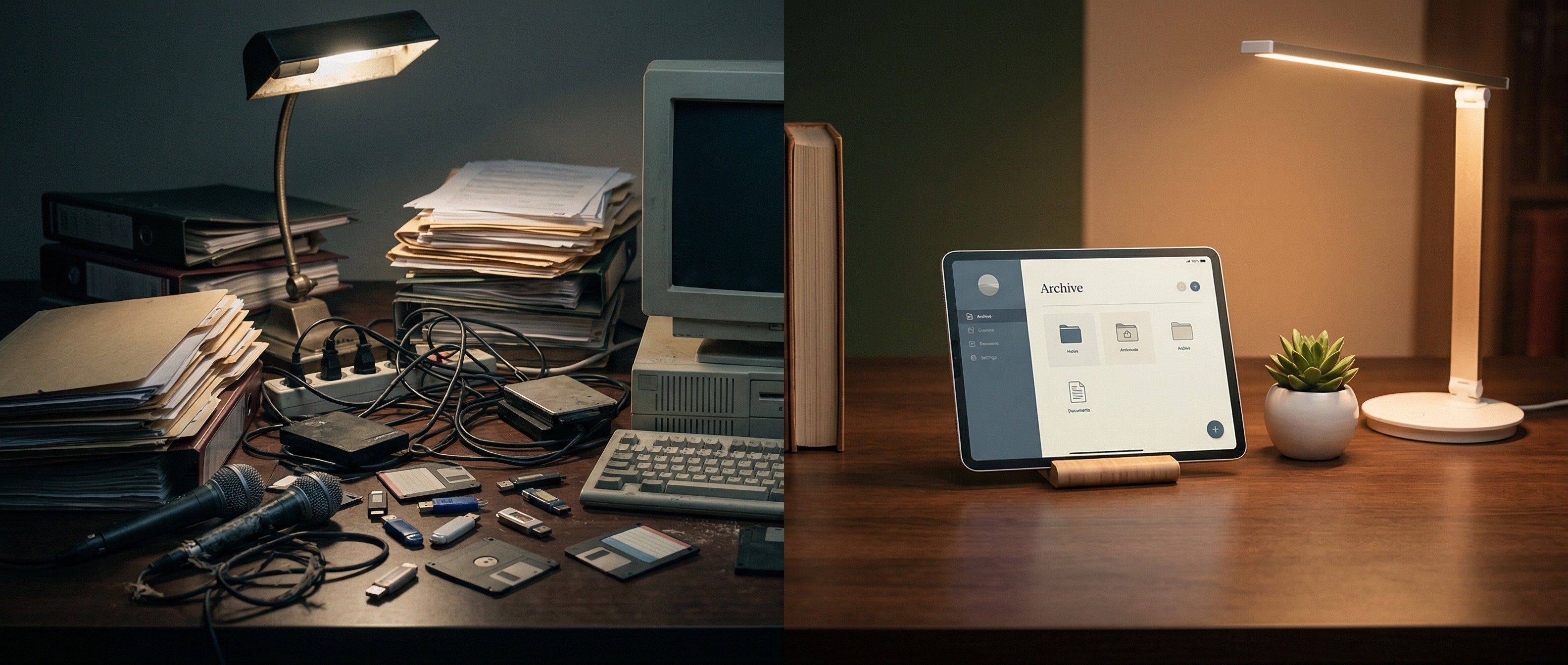
If you are a librarian, archivist, or museum professional researching oral history software, you have probably already found OHMS. Maybe PastPerfect. Perhaps Omeka, or a handful of open-source tools recommended in a university libguide somewhere. And you have probably asked the same question every institution eventually asks: do we really need to pay for this?
It is a fair question. Budget scrutiny in cultural institutions is real. Free tools exist, they are widely used, and they have genuine institutional credibility, as OHMS was built at the University of Kentucky with IMLS funding and is endorsed by the Oral History Association. That is not nothing. But free is not the same as right for your project. And the distinction matters more than most institutions realize before they are halfway through a collection and underwater in workarounds.
This guide breaks down what the major free tools do well, where they fall short, and what institutions actually need when they are trying to run a community oral history program at scale.
The Free Tools: What They Are and What They Were Built For
OHMS (Oral History Metadata Synchronizer)
OHMS is the gold standard of free oral history tools, and for good reason. Built by the Louie B. Nunn Center for Oral History at the University of Kentucky and made open source with IMLS funding, it solves a specific and real problem: connecting textual search results to the exact moment in an audio or video recording where that word was spoken. For a researcher working through an archive of existing interviews, OHMS is genuinely excellent. It handles transcripts, time-coded indexes, bilingual content, and integrates with common content management systems like Omeka, CONTENTdm, and WordPress.
At its core, OHMS serves as a transcript synchronization and access tool for researchers navigating existing interview collections. It does not function as a community outreach system, a story collection tool, a consent management infrastructure, or a campaign management dashboard. OHMS assumes the interviews already exist. It does nothing to help you get them.
The practical implication is that if your institution wants to run a community storytelling campaign, such as inviting residents to submit memories, managing consent forms, organizing incoming submissions, and publishing a curated public archive, OHMS cannot do any of that. It handles the final step of a process that requires an entirely separate infrastructure upstream. There is also a meaningful technical overhead. OHMS requires its own server installation for the viewer component, XML file management, and integration with a separate CMS. For institutions without dedicated technical staff, this is a real barrier. A 2016 discussion documented by library professionals at Richland Library describes the difficulty of providing consistent access to OHMS content within OCLC-hosted systems, a challenge that has not fully disappeared.
PastPerfect
PastPerfect is the world's most widely used museum collections management software, used by over 12,000 institutions. It is comprehensive, affordable relative to enterprise systems, and deeply understood within the museum community. It does have oral history functionality, including records, transcript fields, and multimedia linking, and with its online module, it offers a public-facing searchable catalog. For a museum that primarily needs to catalog an existing collection of physical and digital artifacts, with oral histories as one component among many, PastPerfect is a reasonable choice.
However, PastPerfect remains a collections management system designed for museums cataloging existing artifacts, with oral history as a supported but secondary use case. It is not a community engagement system. It has no mechanism for community members to submit stories directly. Its outreach tools are contact management features built around donors and members, not storytelling campaigns. Its interface, designed for museum catalogers, is not appropriate for routing to community narrators.
PastPerfect also carries a notable design constraint, as its core architecture has not fundamentally changed since version 5.0, released in 2010. The newer Web Edition modernizes the delivery, but institutions working in it are still operating within a paradigm built before community-centered digital preservation became a field priority. The software was designed by museum professionals for museum professionals, not for community members submitting their own stories through a custom-branded portal.
Omeka
Omeka is a free, open-source web publishing tool widely used in libraries and digital humanities for building online exhibitions and collections. It is flexible, well-documented, and has a strong plugin ecosystem. Like OHMS, Omeka handles the access side of an oral history collection effectively. With the right plugins, it can display transcripts, organize collections, and present materials publicly. Several institutions use OHMS and Omeka together.
Despite its flexibility, Omeka does not facilitate community story collection, guided submission workflows, outreach campaign management, or consent infrastructure. It is a publishing system, not a collection engine. Building a full oral history program on top of Omeka requires significant technical customization, and the maintenance burden falls entirely on the institution.
Blog
How to Run a Community Oral History Project: A Step-by-Step Guide for Libraries and Museums
Every community has stories that exist nowhere else on earth.
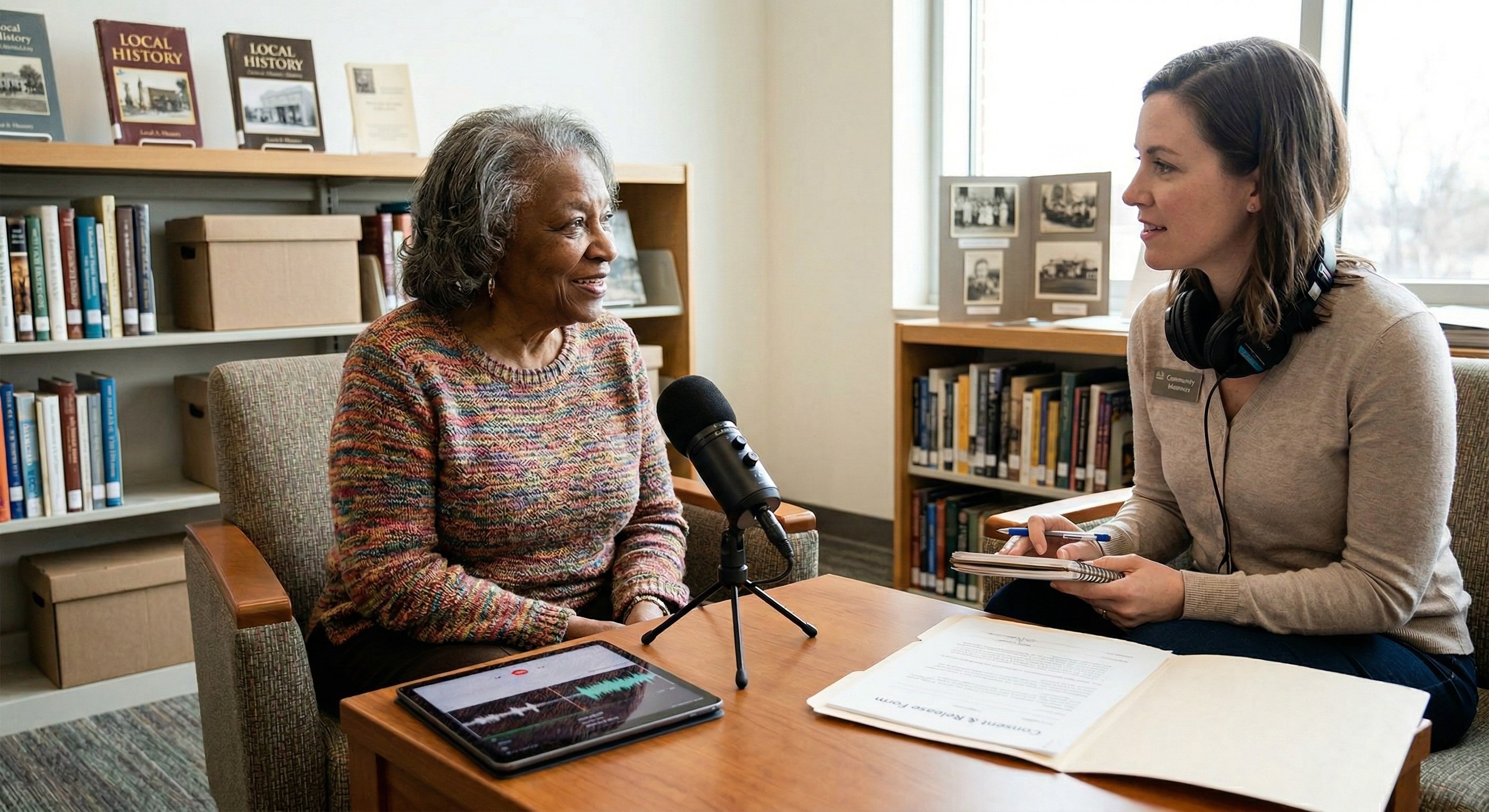
They live in the memory of a 78-year-old retired teacher who remembers when this town had a different name. In the recollections of a grandmother who watched her neighborhood transform over fifty years. In the firsthand account of someone who was there when history happened — and whose voice has never been recorded.
When that person is gone, those stories are gone.
Libraries, museums, and heritage organizations sit at a unique crossroads: they are trusted by their communities, they hold institutional memory, and they have the mandate to preserve it. But running an oral history project — from first concept to living digital archive — is a process that many institutions approach for the first time without a clear roadmap.
This guide is that roadmap.
Why Now Is the Right Time
The urgency is real. Demographers estimate that the U.S. loses tens of thousands of WWII veterans, civil rights participants, and community elders every year. These are irreplaceable primary sources — not just for history books, but for the communities trying to understand who they are and where they came from.
At the same time, the federal funding landscape for oral history has never been more robust. The National Endowment for the Humanities (NEH) and the Institute of Museum and Library Services (IMLS) both fund oral history and digital preservation projects, and both explicitly reference community oral history initiatives in their grant programs. Institutions that have an existing oral history infrastructure — even a basic one — are significantly better positioned to win that funding.
Running a project now is not just a mission decision. It is a strategic one.
The 5 Stages of a Community Oral History Project
Stage 1: Define Your Scope and Purpose
Before you record a single story, you need to answer three questions:
What community are you documenting, and why now? The strongest oral history projects are anchored to a specific community and a specific moment — a neighborhood centennial, a cultural anniversary, a demographic transition. Vague mandates produce scattered results. Narrow focus produces lasting archives.
Who are your narrators? Libraries and museums often make the mistake of waiting for narrators to come to them. The best projects actively identify and recruit: community elders, longtime residents, participants in historical events, cultural leaders. Build a target list before outreach begins.
What will you do with the stories when you have them? This question should be answered before the first interview, not after. Will the archive be public-facing? Will it support a future exhibition? Will it be submitted as part of a grant deliverable? Your end use shapes every decision that follows.
Stage 2: Build Your Community Outreach Strategy
The most common reason oral history projects stall is not funding or technology — it is outreach. Institutions underestimate how much relationship-building is required to get community members to participate.
Partner with trusted intermediaries. Faith communities, senior centers, cultural organizations, and neighborhood associations already have the trust you need. A letter from your library director means less than a recommendation from a pastor, a sorority chapter president, or a neighborhood association leader. Identify two or three community partners and involve them in the design of the project, not just the recruitment.
Make participation as frictionless as possible. Require nothing more than a conversation. Do not ask narrators to fill out lengthy forms before they have agreed to participate. Do not schedule complicated multi-step processes. The moment participation feels like bureaucracy, you will lose people.
Speak to what participants gain. Community members often wonder what they get from participating. The answer: their story, preserved permanently, accessible to their children and grandchildren. That is a powerful offer. Lead with it.
Stage 3: Collect Stories Consistently
This is where most projects encounter their first operational crisis. Stories come in through different channels, in different formats, from different staff and volunteers — and suddenly no one knows where anything is.
Before collection begins, establish:
A single submission method — whether that is an in-person recording session, a guided digital submission, or a staffed phone line. Multiple uncoordinated channels create chaos.
Consent and release forms that narrators sign before or immediately after their interview. These are non-negotiable for any collection intended for public access or grant reporting.
A naming and tagging convention applied to every file from day one. "Interview_2025_03_Johnson_Margaret" is retrievable in five years. "audio_final_FINAL_v2.mp3" is not.
A secure storage location that is not a staff member's personal drive or a shared folder with no backup.
Consistency matters more than perfection. A project that collects 50 stories with clean metadata and proper releases is worth ten times more than a project that collected 200 stories with none of that infrastructure.
Stage 4: Archive and Preserve
Recording a story is not the same as preserving it. Preservation requires structure.
Transcription transforms audio and video into searchable, accessible text. It also creates redundancy — if a file is corrupted, the transcript survives. AI-assisted transcription tools have made this dramatically faster than manual transcription, which historically ran six hours of labor for every one hour of audio.
Metadata is what makes an archive findable rather than just stored. At minimum, every entry should capture: narrator name, date of interview, location, interviewer name, topics covered, and any community affiliations or identities relevant to the collection's scope. The more specific the metadata, the more useful the archive becomes — both for internal staff and for researchers and community members accessing it later.
Long-term file formats matter. MP3 is convenient but not archival. WAV or FLAC are preferred for audio. MP4 is acceptable for video with H.264 encoding. TIFF or high-resolution JPEG for images. PDF/A for documents. These are the standards endorsed by the Library of Congress and major preservation bodies.
Redundancy is not optional. The 3-2-1 rule: three copies, in two different formats, with one stored off-site or in the cloud.
Stage 5: Share, Engage, and Keep the Archive Alive
An archive that no one can access is just expensive storage.
The final stage of an oral history project is where most institutions underinvest — and where the most community impact is generated. Sharing stories publicly validates narrators' participation, demonstrates the project's value to funders, and often brings in new narrators who see themselves reflected in the collection.
Public exhibitions — whether physical or digital — give the archive a face. Even a small curated selection of five to ten stories, presented with photographs and context, creates a compelling community moment.
Donor and funder reports built around story excerpts demonstrate impact in a way that statistics cannot. One well-chosen story excerpt is more persuasive than a spreadsheet of collection metrics.
Ongoing campaigns keep the archive growing. A one-time project is a snapshot. An annual oral history campaign becomes a living record of a community changing in real time.
The 5 Mistakes That Derail Oral History Projects
After working with oral history practitioners across more than 40 countries, we have seen the same failure patterns repeat:
1. Launching without a consent infrastructure. Stories collected without signed releases cannot be shared publicly, used in grant reporting, or donated to partner institutions. This is one of the most common and most expensive mistakes — discovered only after the collection is complete.
2. Storing files in too many places. When files live on individual staff computers, personal Dropboxes, and shared drives simultaneously, the archive fragments. Staff turnover turns fragmentation into permanent loss.
3. Collecting without metadata. A recording with no associated information is nearly useless to anyone but the person who recorded it. Metadata is not administrative overhead — it is what makes the archive a resource rather than a pile of files.
4. Treating outreach as a one-time event. Community trust is built over time. Institutions that announce a project, collect stories for three months, and go quiet do not get the same depth of participation as institutions that are consistently present in the community year after year.
5. Planning for collection but not for access. The end user of your archive is not you. It is a researcher in 2035, a high school student doing a project, a family member looking for their grandmother's voice. Design the archive with that person in mind from the beginning.
What a Well-Run Project Looks Like
In a mid-Atlantic county parks system, a community history initiative collected oral histories from longtime residents as part of a regional heritage campaign. Rather than managing submissions through email and staff-shared drives, the institution used a centralized platform to run outreach, collect submissions, organize the archive, and prepare stories for public presentation. The result: a structured, searchable archive delivered on time and within budget — and a foundation the organization could build on for future campaigns.
The difference was not funding. It was infrastructure.
Getting Started
You do not need a large budget or a dedicated archivist to launch a meaningful oral history project. What you need is a clear purpose, a realistic scope, community partners who trust you, and a system that keeps everything organized from day one.
Oria is an all-in-one oral history platform built specifically for institutions like yours. From community outreach portals to guided story submission, centralized archiving, and public sharing tools — Oria handles the infrastructure so your team can focus on the people and stories behind it.
Book a demo to see how Oria can support your next oral history project →
Oria is a cultural preservation technology company headquartered in the Washington, D.C. metro area. Our platform serves libraries, museums, humanities councils, and heritage organizations building lasting community archives.
Blog
Why Oral Histories Are Being Lost—and How Technology Can Preserve Them
Every community holds stories that define its identity—vital memories of lived experiences, cultural traditions, and deeply personal journeys.
Yet, quietly, many of these stories are disappearing. Without structured, reliable systems to capture and preserve them organically, invaluable human context is lost every single day.
Why Oral Histories Matter
Oral history is more than just recorded dialogue. It provides essential personal perspectives on historical events, framing cultural and community identity with the emotional, human context that is so often missing from formal written records. These narratives are the connective tissue for education, preservation, and community solidarity.
Why Stories Are Disappearing
Countless communities genuinely want to preserve these narratives, but they face immense systemic barriers:
Severely limited time and funding resources.
Time-consuming, exhaustive manual collection processes.
A fundamental lack of intuitive, trusted spaces for archiving.
Increasing difficulty in maintaining and accessing stored narratives over decades.
As a direct result, too many vital community voices are never recorded or are permanently lost to outdated flash drives and disorganized cloud folders.
Why are communities shifting toward digital storytelling platforms?
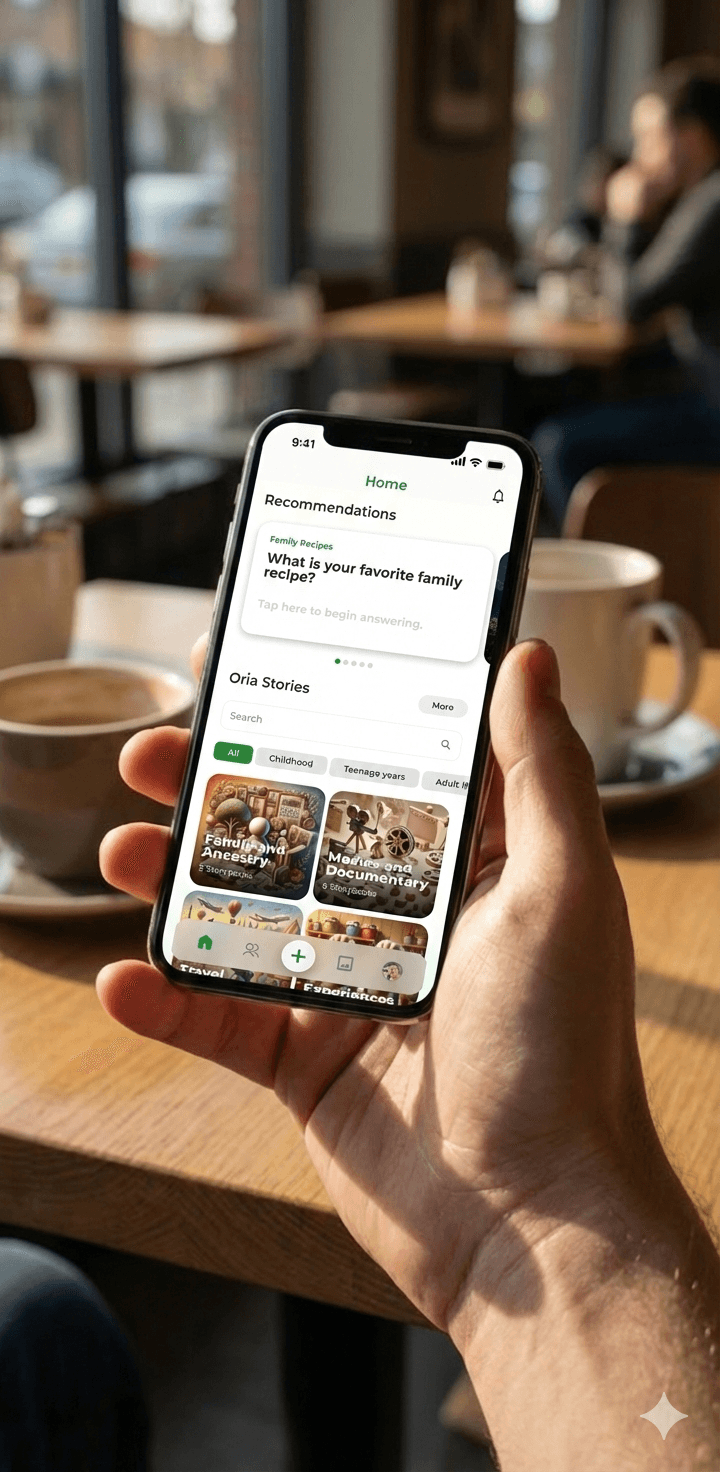
Communities are rapidly shifting toward digital storytelling engines because thoughtful technology intrinsically removes the massive administrative friction from preservation. These deeply modern platforms safely empower everyday people to securely share their truths directly from their homes, effortlessly guiding highly complex narratives into beautifully maintained, long-term digital living archives.
How do robust platforms like Oria safely keep history alive?
Oria flawlessly keeps precious histories alive by comprehensively replacing the exhausting, fundamentally fragmented burden of file management with an incredibly sustainable, highly searchable living archive. By providing a warm, centralized, and desperately needed trusted portal space, Oria gracefully empowers vulnerable community members to comfortably record their guided submission at their exact own pace.
Real-World Impact
Institutions leaning into structured storytelling engines find they can gather and safeguard vastly more narratives. They experience increased community participation, strengthen their emotional connection with the community, and successfully build living archives that will last for generations.
The Future of Storytelling
As these empathetic tools evolve, the profound act of authentic storytelling is finally becoming as accessible as it deserves to be. Communities that embrace a dedicated storytelling engine today are doing the vital work of safely passing their human context down to shape future generations.
Blog
How to Set Up a Community Story Submission Portal
A Step-by-Step Guide for Organizations Without a Tech Team
The short answer: A community story submission portal lets narrators submit oral histories directly, on any device, without an interviewer present. Organizations without technical staff can launch one in under a week using the right infrastructure. The barrier is not technical. It is knowing what the portal needs to do before you build it.
Most community organizations that want to preserve their history never start. Not because the commitment is not there, but because the first question—"how do we actually collect the stories"—leads immediately to a second question nobody prepared them for: "what tool do we use, and how do we set it up?"
That second question stops more oral history programs than any shortage of stories ever has. Whether it is a Black fraternal organization, a faith community, or a veterans group, most have elders and histories, but few have IT departments or developers. This guide is for those organizations.
What a Community Story Submission Portal Actually Needs to Do
A submission portal for community oral history is not just a website or a storage folder. It is a system that must perform five specific functions:
Direct Submission: Gives narrators a way to submit a story from their own device without technical help.
Consent Collection: Collects consent before or alongside the submission.
Centralized Routing: Routes the submission to a central place your organization controls.
Management Layer: Lets your team organize, review, and manage what comes in.
Public Sharing: Allows you to share selected stories publicly when ready.
Evaluation Criteria
Before choosing a tool, use this table to evaluate your options:
Feature | Why it Matters |
Mobile-friendly submission | Most community narrators will submit from a phone, not a laptop. |
Built-in consent workflow | Consent must be stored alongside the story for archival integrity. |
No login required | Requiring account creation is the #1 killer of participation. |
Centralized storage | Stories should not live in a volunteer's personal inbox or drive. |
Campaign tools | You need a way to invite, remind, and track participation. |
Public sharing controls | You decide what goes public, when, and to whom. |
No IT staff required | The system must remain functional even if a specific volunteer leaves. |
The Decisions You Need to Make Before You Launch
Rushing to pick a tool before answering these questions is the most common reason programs stall.
1. Who is your narrator?
Be specific. Are they elders or students? What is their comfort level with technology? A portal designed for university students will not work for an 80-year-old congregation member on a basic Android phone.
2. What kind of story are you collecting?
Audio, video, or written? Audio is typically the most accessible for narrators and the most manageable for organizations without archival staff.
3. What will you do with the stories once you have them?
Are they for internal preservation, a public archive, or a grant report? Build for the end use, not just the collection.
4. Who owns the portal after it is live?
Name a specific person in an ongoing role to be responsible for the system so it doesn't disappear if a volunteer leaves.
5. What is your outreach plan?
The technology is the easy part. The community engagement is the real work.
Step-by-Step: Launching Your Portal in Under a Week
Define your collection campaign: Give your program a name and purpose. Example: "Share Your Story: [Organization Name]'s Living History Project."
Configure your consent form: Write consent language in plain English. Budget half a day for this to ensure it's clear to non-lawyers.
Set up your submission workflow: Ensure narrators can submit via their chosen format. Test this flow on a mobile phone; it should take no more than three steps.
Set your access controls: Decide who can see incoming submissions and who has the authority to approve them for public sharing.
Prepare outreach materials: Write a short invitation message with a direct link. Keep it to one paragraph.
Launch to a small group first: Invite 5–10 trusted members to "beta test" the portal. This surfaces bugs and ensures you have a few stories live before the broad launch.
Expand outreach in waves: Use email, social media, and meeting announcements. Personal invitations are always more effective than mass announcements.
Common Mistakes That Stall Participation
Requiring Account Creation: Every additional step reduces participation.
Launching Empty: Narrators are more likely to participate when they can see what a finished submission looks like.
Legalistic Language: Dense legal blocks scare away community members. Use plain language.
Treating Launch as the Finish Line: The work begins after the portal is live through ongoing outreach.
Knowledge Silos: If only one person knows how to run the system, the project is at risk.
Frequently Asked Questions
How long does setup take?
The technical setup takes less than a day. The organizational decisions (consent, outreach, etc.) take 3–5 days.
Do narrators need to download an app?
No. A properly built portal works entirely through a mobile web browser.
What if a narrator wants their story removed later?
You should have a withdrawal process defined in your consent form and be prepared to honor it straightforwardly.
Can we use free tools like Google Forms or Dropbox?
You can, but you will have to manually stitch together consent, storage, and sharing, which often leads to more work and higher risk of data loss than purpose-built infrastructure.
See How Fast Your Organization Can Launch
Oria's community portal is built for exactly this use case: organizations with a preservation mission and no technical staff. The portal launches in days, handles consent automatically, and requires no IT support.
Book a demo and see how fast your organization can launch.
https://calendly.com/jfaison-bqm/30min
Blog
How to Ethically Collect Oral Histories from Communities Using Digital Tools
The short answer: Ethical oral history collection requires informed consent, narrator ownership of their story, transparent data practices, and a digital tool that supports all three. Most software used for community archiving was built for researchers, not narrators. Choosing the wrong tool is not a neutral decision. It is an ethical one.
The Oral History Association's Core Principles are direct: the oral history process, from interview through preservation, use, and access, must be guided by respect for narrators and the communities from which they come. That principle was written for practitioners working with paper release forms and analog tape. It holds with equal force when your collection infrastructure is digital, and it raises questions that paper forms never had to answer.
Where is this recording stored, and who controls access to it? If a narrator later wants to restrict or withdraw their story, can they? Does the platform use archived oral history data to train external models? Is the consent process legible to a 74-year-old community elder who does not use a smartphone?
These are not theoretical questions. They are operational ones. This guide walks through the five ethical obligations that apply to every digital oral history collection program, how to evaluate whether your tools support or undermine those obligations, and what a consent infrastructure actually looks like when it is built correctly.
Why Digital Tools Create Ethical Obligations Paper Forms Never Did
Traditional oral history consent covered a bounded transaction: a narrator agreed to be recorded, signed a release, and a physical tape was filed in an archive. The downstream uses of that recording were limited by geography, cost, and access controls. A researcher had to physically visit the archive.
Digital collection changes every one of those limits. A story submitted through a web portal can be accessed from anywhere, shared with anyone with a link, indexed by search engines, and in some cases, scraped by external systems. The narrator who clicked Submit on a mobile phone may have had no meaningful understanding of any of that.
The OHA began formally addressing this shift in 2024, when its symposium on AI and oral history identified a new and urgent consent problem: even institutions with bot-management software cannot be certain their archival data is not being crawled and used to train external models. The consent frameworks practitioners have relied on for decades were not built to address that.
For practitioners running community oral history programs, this means the ethical obligations do not stop at the interview. They extend through every system your organization uses to store, share, and provide access to the stories you collect.
The Five Core Ethical Obligations in Digital Oral History Collection
These five obligations are grounded in the OHA's Principles and Best Practices and apply whether you are collecting through a digital portal, a mobile app, or a structured in-person interview program.
Obligation | What it requires | Where digital tools commonly fail |
|---|---|---|
Informed consent | Narrators must understand what they are agreeing to, including how their story will be stored, who will have access, and whether restrictions or withdrawal are possible. | Consent forms buried in legal language, auto-checked boxes, no plain-language explanation of data use. |
Narrator ownership | The narrator holds copyright to their interview from the moment recording begins. Any transfer of rights must be documented and voluntary. | Platforms that claim organizational ownership by default, or that transfer rights in terms-of-service language without explicit narrator acknowledgment. |
Access and restriction | Narrators must be able to set parameters on how their story is used and, where possible, request restrictions or withdrawal after submission. | Static archive systems with no mechanism for narrators to request changes once a story is submitted. |
Data transparency | Narrators and institutions must understand how submitted data is stored, whether it is used for any secondary purpose, and who has technical access to it. | Cloud-hosted tools with vague data policies, third-party integrations that are not disclosed to narrators, or data retention terms that outlast the project. |
Long-term stewardship | The institution collecting oral histories is responsible for maintaining consent documentation and honoring narrator agreements across the full life of the archive. | Tools with no export capability, vendor lock-in, or unclear policies on what happens to stored data if the software is discontinued. |
What Informed Consent Actually Requires
Consent in oral history is not a signature on a form. The OHA's Statement on Ethics is specific: consent must be documented, ongoing, and transparent from first contact through preservation and use. A narrator who agreed to have their story archived may not have agreed to have it published online, shared with a partner institution, or included in an exhibition.
For digital collection programs, informed consent has a technical layer that practitioners must address explicitly:
Explain data storage before the narrator submits anything. Where will the recording be stored? On whose servers? In what country? Under what terms?
Disclose all downstream uses at the point of consent. If the story may be shared publicly, included in an exhibition, or made available to researchers, say so explicitly, in plain language, before the narrator submits.
Describe access controls. Who within the organization can access the recording? Will it be visible to the public? Can the narrator restrict access to specific audiences?
Make withdrawal possible and explain how it works. The narrator should know, before they submit, that they have the right to request removal and what that process looks like.
Document consent separately from the recording. The consent record should be stored and retrievable independently of the oral history itself, so it is accessible for reference without requiring access to the content it covers.
Use language the narrator can actually read. Plain language is an ethical requirement. A 300-word legal block in 8-point type does not constitute informed consent for a community member who is not a lawyer.
The Difference Between Narrator Consent and Institutional Data Rights
This is the distinction most digital oral history programs get wrong. Narrator consent and institutional data rights are not the same thing, and conflating them creates both ethical problems and legal exposure.
According to the OHA and the Boston Public Library's oral history documentation, in most cases oral history interviews are considered the narrator's intellectual property from the moment the recording begins. Copyright ownership belongs to the narrator unless they have explicitly transferred it.
Institutional data rights refer to what the collecting organization has permission to do with the recording: archive it, make it publicly accessible, share it with a partner institution, or include it in a grant-funded project. Those rights are granted through a deed of gift or release agreement and must be explicitly negotiated, not assumed.
The practical implication for digital collection programs:
Your collection portal's terms of service do not transfer narrator copyright. Only a signed deed of gift or release agreement does.
If your software platform retains any rights to data submitted through it, those rights may conflict with narrator copyright. Read your platform's data policy before launching.
If a narrator later requests withdrawal, their copyright claim is grounds for honoring that request, regardless of what your internal data retention policy says.
Institutions using cloud-hosted tools should have legal review of the vendor's data terms before narrators submit anything.
How to Evaluate Whether Your Digital Tool Supports Ethical Collection
Most oral history software was built with the researcher or archivist in mind, not the narrator. The questions below will help you assess whether the tools you are using or evaluating meet the ethical obligations outlined above.
Question to ask your tool | Why it matters ethically |
|---|---|
Does the tool support customizable consent forms at the point of submission? | Narrators must agree to specific, named terms before submitting, not after. |
Can you configure who has access to submitted recordings? | Access controls are a core narrator right, not a premium feature. |
Does the tool support narrator-initiated restrictions or withdrawal requests? | Withdrawal rights are part of the ethical process, not an exception to it. |
Is the vendor's data policy transparent about secondary use? | If the vendor can use submitted data for model training or other purposes, narrators must know before they submit. |
Can you export all data, including consent records, in a standard format? | Vendor lock-in is a stewardship risk. Portability ensures the institution can honor narrator agreements even if the tool changes. |
Does the submission interface work on mobile and require no technical knowledge to navigate? | Ethical consent requires that narrators can actually understand and complete the consent process, regardless of device or digital literacy. |
Community Trust Is the Real Infrastructure
Technical consent compliance is the floor, not the ceiling. Practitioners working with marginalized or under-documented communities know that the harder question is not whether the narrator signed a release form but whether the narrator understood what they were signing, trusted the institution asking, and had any reason to believe their story would be handled with the care it deserves.
That trust is built over time, through transparency, through accountability, and through the quality of the relationship between the collecting institution and the community it serves. Digital tools either support that relationship or undermine it.
A portal that buries consent language, obscures data use, or makes withdrawal practically impossible is not a neutral tool. It is a system that shifts power away from the narrator and toward the institution. In communities that already have reason to be skeptical of institutional data collection, that shift has real consequences for participation and for the long-term health of the oral history program.
Choosing your collection infrastructure is an ethical decision. Treat it like one.
Frequently Asked Questions
Does a narrator own the copyright to their oral history interview?
Yes. According to the OHA's Principles and Best Practices, oral history interviews are generally considered the narrator's intellectual property from the moment recording begins. Copyright belongs to the narrator unless they explicitly transfer it through a deed of gift or release agreement.
What is the difference between informed consent and a deed of gift?
Informed consent documents the narrator's knowing agreement to participate in the interview and the overall project. A deed of gift is the legal instrument by which the narrator transfers specific rights, such as the right to archive, publish, or share the recording, to the collecting institution. Both are required. Consent alone does not transfer copyright.
Can a narrator withdraw their oral history after submitting it digitally?
The OHA's ethical framework supports narrator rights to set restrictions and, where possible, request withdrawal. Practically, withdrawal is easier to honor when your digital collection system retains the original files and consent records in a retrievable format. This is one of the most important questions to ask a software vendor before you launch.
Does using AI-powered transcription or indexing tools require additional narrator consent?
It is an open question that the field is actively working through. The OHA's 2024 symposium on AI in oral history identified narrator consent for AI use as an unresolved ethical issue. As a best practice, any automated processing of narrator content should be disclosed at the point of consent, before the recording is submitted.
What should a digital consent form include?
At minimum: the name of the collecting organization, a plain-language description of the project, an explanation of how the recording will be stored and who will have access, a description of downstream uses (archive, publication, exhibition, research access), a statement of the narrator's rights including restriction and withdrawal, and a clear description of what happens if the narrator changes their mind after submitting.
Are oral history projects subject to IRB review?
Not automatically. The OHA maintains a detailed resource on IRB requirements and oral history. Whether your project requires IRB oversight depends on its scope, institutional affiliation, and how the resulting material will be used. Community-based programs run outside academic institutions are generally not subject to IRB requirements, but should follow OHA ethical guidelines regardless.
How Oria Supports Ethical Oral History Collection
Oria's community portal was built with narrator rights as a design requirement, not an afterthought. Every submission goes through a customizable consent workflow, consent records are stored independently of the recordings they cover, and institutions control access at the collection, story, and narrator level. Oria does not use submitted oral history content for any secondary purpose.
If you are evaluating collection infrastructure for a community oral history program and want to see how the consent workflow and access controls work in practice, book a 30-minute walkthrough.
Blog
The Same 50 Names. The Same 20 Events. How the History Silo Is Failing Entire Communities
Most people encounter the same narrow slice of history thousands of times across their education, while the stories of their own communities rarely appear at all. AI tools have made this worse by amplifying whatever is already in the historical record, and communities whose stories were never recorded are being left further behind with every passing year.
What Is the History Silo?
Ask anyone who went through a standard American education to name ten historical figures they studied. The list will look almost identical regardless of where they grew up, what city they were raised in, or whose family they come from.
George Washington. Abraham Lincoln. Benjamin Franklin. Rosa Parks. Martin Luther King Jr. Christopher Columbus. A handful of presidents. A handful of wars. The same photographs. The same speeches. The same timelines.
This isn't an accident. It's the result of decades of standardized curriculum, centralized textbook publishing, and a historical record that was shaped, from the beginning, by who had access to printing presses, universities, and archival institutions. What got written down, indexed, and taught was largely determined by proximity to power. And what got left out, for just as long, was the history of communities that operated outside those institutions.
This is the history silo. A self-reinforcing loop where the same stories get repeated because they're the ones in the record, and the ones in the record are the ones that get repeated.
AI Didn't Create This Problem. It Made It Louder.
For most of the twentieth century, the history silo moved at the pace of textbook publishing cycles and curriculum committee decisions. That was slow enough that communities could, at least in theory, advocate for change, push for inclusion, and work to add their stories to what students were learning.
That pace has changed.
AI tools, the kind students now use daily for research, homework, essay writing, and basic questions about the world, do not generate history from scratch. They reflect what is already in the digital record. They are trained on digitized books, indexed archives, published articles, and online encyclopedias. What is in that corpus gets surfaced constantly. What is not in that corpus simply does not appear.
The result is that a student asking an AI tool about American history in 2025 gets essentially the same answer a student got from an encyclopedia in 1985. The same names. The same events. The same framing. The difference is that the AI delivers those answers instantly, confidently, and at a scale that no textbook ever could. George Washington doesn't appear once in a chapter. He appears in every essay prompt, every research session, every auto-completed answer, thousands of times across a single student's education.
Communities whose stories were never digitized, never indexed, never published in formats that AI systems can read, are not just underrepresented. They are functionally invisible to an entire generation of learners who are now being educated primarily through these tools.
Who Gets Left Out, and What It Costs
The communities most affected by the history silo are not hard to identify. They are the same communities that have always been on the margins of the official record.
Black fraternal organizations with chapters dating back to the late 1800s, whose internal histories, rituals, and community contributions were never the subject of academic study. Faith communities that served as the backbone of neighborhood life for generations, whose records exist in storage rooms and the memories of elders. Indigenous communities whose oral traditions were deliberately excluded from written archives. Immigrant communities whose stories were told in languages and formats that Western archival institutions were not built to preserve. Veterans groups whose service was documented in official military records but whose personal histories, the meaning behind the service, were never collected. Neighborhood associations in communities that were redlined, displaced, or simply overlooked, whose histories are stored nowhere except in the people still living them.
When these stories don't exist in the record, students from those communities spend their entire education learning history that doesn't include them. They learn that history is something that happened to other people, in other places, by other families. The message is not always explicit. But it is consistent.
And that message has a cost that goes well beyond the classroom.
Communities that cannot point to a documented history have a harder time making the case for their own significance, their own contributions, their own right to the resources and recognition that come with institutional acknowledgment. A community whose story has never been told has no leverage with funders, no evidence for grant applications, no record to pass to the next generation. The history silo is not just an educational problem. It is a resource problem, a political problem, and a generational one.
The Window Is Closing
Here is the part that doesn't get said enough: the people who hold these stories are aging. Every year that passes without a structured effort to collect community histories is a year in which irreplaceable knowledge moves closer to being gone forever.
This is not a distant concern. It is happening right now, in every community, in every city. The elders who remember what a neighborhood looked like before it was redeveloped, who know the founding stories of a fraternal organization or a faith community, who carry in their memories the names and faces of people who will never appear in any textbook, are here today. They may not be here in ten years.
The urgency is real. And the history silo makes it more urgent, not less, because it means that even if these stories are collected, they need to be published and made findable in order to matter. A recording that lives on someone's phone is not in the record. A story that sits in a folder on a community leader's computer is not in the record. The silo only breaks when stories are collected, described, and shared in ways that other people can actually find them.
The Record Doesn't Build Itself
The history silo is not permanent. It is a reflection of what has been recorded so far. And recording is something communities can do.
The stories that are missing from the record are missing because no one has collected and published them in a format that can be found, indexed, and shared. That is a problem with a direct solution. Community oral history programs, the kind that collect recorded interviews, attach proper descriptions, and make those stories publicly accessible, are how communities add themselves to the record.
This matters more now than it did ten years ago. The communities that invest in collecting and publishing their histories today are building the record that educators and researchers will draw from in the next decade. The communities that don't will continue to be invisible in that record, not because their stories don't matter, but because no one captured them while the people who hold them were still here.
The good news is that the barrier to acting has dropped significantly. A community oral history program no longer requires an archivist on staff, a university partnership, or significant technical infrastructure. The tools available today make it possible for a community organization to launch a structured, searchable, shareable oral history program without any of the overhead that made this work inaccessible a generation ago.
What Communities Can Do Right Now
The first step is the simplest and the most urgent: identify who in your community holds stories that exist nowhere else, and start recording them.
This doesn't require a grant. It doesn't require professional equipment. It requires a decision that these stories are worth preserving, and a process for collecting them before the window closes.
From there, the work is about making those stories findable. Organizations doing this well share a few things in common:
A clear, ongoing process for collecting stories, not just a one-time event
A way to manage consent so that narrators control how their stories are used
A structure for describing and organizing what they collect so it can be searched and shared
A way to publish that work so it reaches people beyond the organization itself
None of this is technically complicated. It is organizationally intentional. It requires deciding that your community's history is worth the effort, and building a simple system to make that effort sustainable.
The silo grows when communities wait for institutions to include them. It shrinks when communities build their own record.
The Silo Grows When We Don't Act
The history monoculture is not going away on its own. AI tools will continue to surface what is already in the record. Curricula will continue to default to what has always been there. The same names and the same events will continue to be repeated, thousands of times, to students who deserve to see themselves in the history they are asked to learn.
The communities that break out of that pattern will be the ones that build their own record. Not by waiting for institutions to include them, but by collecting, preserving, and sharing their own stories in ways that become part of what the world can actually find.
If your organization is ready to start that work, and you want to see what a structured community oral history program looks like in practice, book a 30-minute conversation here. No sales pressure, just a look at what's possible.
Blog
How to Preserve Your Community's History: A Practical Guide for Organizations Ready to Act
The short answer: The most effective way for a community organization to preserve its history is to record the stories of living members now, organize those recordings in a structured digital archive, and use a system built for active collection, not passive storage. The longer you wait, the more you lose permanently.
Who This Guide Is For
This is not written for large research universities or municipal library systems with dedicated archivists and IT departments. It is written for the organizations that carry just as much history, and far fewer resources to preserve it.
If your organization fits one or more of these descriptions, this guide is for you. This includes a Black fraternity or sorority chapter documenting its founding generation, a cultural heritage council preserving the stories of a diaspora community, or a faith community that has been serving the same neighborhood for 50 or 100 years. It also applies to a veterans organization whose oldest members are passing away faster than their stories are being recorded, a neighborhood association, civic club, or community foundation sitting on decades of institutional memory, or an ethnic cultural society whose elders hold language, tradition, and history that exists nowhere in writing.
These organizations share something important: they have a real preservation mission, a real community to serve, and a real budget to work with. What they typically lack is a dedicated technical staff, a professional archivist, and time to spend months configuring open source software.
Why Community Organizations Lose Their History
Most organizations do not lose their history in dramatic ways. They lose it quietly.
A founding member passes away. A longtime leader retires and takes 30 years of institutional knowledge with them. The person who always remembered how things started is no longer around to ask. A box of recordings sits in someone's basement, in a format no one can play anymore.
The stories that disappear are not the ones in annual reports or meeting minutes. They are the specific ones, such as what it felt like to start this organization in a city that did not want you here, what the community survived that never made the news, or what the elders built with almost nothing. Those stories exist in exactly one place, the memory of a living person, and when that person is gone, they are gone permanently.
The problem is not that organizations do not value these stories. It is that most do not know where to start, and the tools designed for this work were built for institutions far larger than them.
What "Preserving Community History" Actually Means
Preserving your community's history means creating a permanent, organized record of your members' stories, experiences, and institutional knowledge, in a format that future generations can access, search, and build on.
It is not the same as saving videos to a shared Google Drive, because unorganized files are not a preservation strategy. It is not the same as scanning old photographs without context, as photos without stories lose meaning across generations. Maintaining a Facebook page is not sufficient, as social systems change, delete, and disappear. Finally, writing a brief organizational history document is valuable, but a document cannot hold a voice. True preservation combines three things: capturing the story in the person's own words, organizing it with enough context to be useful, and storing it in a system designed to last.
How to Run a Community Oral History Project: Step by Step
Step 1: Define What You Are Preserving and Why
The strongest preservation projects start with a specific purpose, not a general one. "We want to preserve our history" is a vision. "We want to record the founding generation before our 75th anniversary" is a project. Ask your leadership team whose stories are most at risk of being lost in the next five years, what moments in your organization's history are underdocumented, and what knowledge lives only in the memory of your oldest members. The answers will define your scope, your narrator list, and your timeline.
Step 2: Identify Your Narrators
Do not wait for people to volunteer. Actively identify the members whose stories matter most and personally invite them to participate. In most community organizations, the people with the deepest knowledge are also the most humble about it. They do not think their story is worth recording. Your job is to tell them it is. Build a target list of 10 to 20 people to start. That is a realistic and meaningful first collection for any organization.
Step 3: Ask Specific Questions, Not General Ones
"Tell me about your life" produces rambling. Specific questions produce stories. Effective questions for community oral history focus on what was happening in this community when the narrator first joined the organization or what is something this organization did that never got the recognition it deserved. You might ask what they want the next generation of members to know that they probably do not, who was the most important person in shaping what this organization became, or what almost did not happen and what would have been lost if it had not. Prepare your questions in advance. A guided conversation produces a richer archive than an open ended one.
Step 4: Record, Collect, and Organize Consistently
This is where most community preservation efforts break down. Stories come in through different channels, stored in different places, with no consistent naming, no consent documentation, and no way to find anything six months later. Before you collect a single story, establish one submission method used by everyone, a consent process completed before or at the time of recording, and a consistent way to tag each story with who is speaking, when, and what topics it covers. Consistency matters more than perfection. Fifty well organized stories are worth more than two hundred scattered ones.
Step 5: Make the Archive Accessible
A preserved story that no one can find is just expensive storage. The goal is an archive that future members, researchers, family descendants, and community partners can actually use. This means a public facing or member facing presentation, not a folder on a hard drive. It means stories are searchable, not just stored. And it means the archive can grow over time, with new stories added as the community continues to build its history.
FAQ: Common Questions from Community Organizations
How long does it take to set up a community oral history archive?
With the right tool, a community organization can have a live, branded collection portal ready within days, not months. The setup timeline depends almost entirely on the system you use. Tools built for technical users at large institutions can take weeks or months to configure. Tools built for organizations like yours can be operational almost immediately.
Do we need a professional archivist?
No. A dedicated staff member or volunteer who understands the organization's history and can conduct a conversation is sufficient for most community oral history projects. The infrastructure, consisting of consent, organization, storage, and access, should be handled by your system, not by a specialist you hire.
What does it cost to preserve community history properly?
A well-run community oral history program typically costs under $5,000 per year and with the right system, that budget is enough to collect and preserve thousands of stories. That is less than the cost of a single community event, and it produces an asset that lasts permanently.
What if our members are not comfortable with technology?
The submission experience should require nothing more than answering questions on a phone or computer, so no technical knowledge is required. If your system requires narrators to navigate complex interfaces, it is the wrong system. Your members should be able to share a story as easily as sending a voice message.
Can we use free tools like Google Drive or Facebook?
You can start there, but neither is a preservation strategy. Google Drive is unorganized storage with no metadata, no consent infrastructure, and no public archive capability. Facebook is a social system that changes its policies, restricts access, and has deleted entire pages and histories without warning. Neither was built to preserve your community's stories for the next hundred years.
What happens to our archive if we stop paying for a system?
This is the right question to ask before you choose any tool. Look for systems that give you full data export, including your audio files, transcripts, and metadata, so your archive is never held hostage. Oria provides full export capability, meaning your archive belongs to your organization, always.
What to Look for in a Community History System
Not every oral history tool was built for organizations like yours. Most were built for university libraries, government archives, or large museums with dedicated technical teams. Here is what actually matters for a community organization:
What to Look For | Why It Matters |
Fast setup — live portal in days, not months | No server installation, XML configuration, or developer required |
Community-facing submission from any device | Members submit directly, no staff intermediary needed |
Built-in consent management | Release forms are part of the submission flow, not a separate manual process |
Centralized, searchable archive | All submissions land in one organized place automatically |
No technical staff required | One program coordinator runs the entire operation |
Transparent, flat pricing at community scale | Enterprise pricing built for governments does not fit your budget |
The Tool We Recommend for Organizations Like Yours
After working with community organizations across more than 40 countries, the tool we recommend is Oria, available at https://www.missionoria.com. Oria is an oral history and community storytelling system built specifically for organizations that want to run active, living preservation programs, not just store files.
A community organization can launch a branded storytelling portal, invite members to submit stories directly, manage consent automatically, and have a searchable, shareable archive, all without a single line of code, without a technical staff member, and without months of setup.
Oria was founded because a family's stories were lost when a grandmother passed away before they could be recorded. That origin shapes every product decision: the system exists to make sure organizations like yours never have to explain to the next generation why the stories are gone.
Organizations working with Oria have included parks and heritage authorities, cultural institutions, and community programs across more than 40 countries. The common thread is not their size or their budget. It is that they took the step. The right time to start was ten years ago. The second best time is now.
Book a demo and see how fast your organization can launch →
A Simple Decision Framework
Start with free tools if... | Choose Oria if... |
You have technical staff comfortable with open-source setup | You need to launch without a technical team |
You are archiving an existing collection, not collecting new stories | Your members need to submit stories directly from their own devices |
No timeline pressure or public-facing output required | You need consent, organization, and archive in one system |
Your budget is $3,000–$5,000 and you need real infrastructure | |
You cannot afford to lose another year of stories while configuring complicated tools |
Oria is a cultural preservation technology company headquartered in the Washington, D.C. metro area. Our system serves community organizations, libraries, museums, humanities councils, and heritage organizations building lasting archives of community memory.
Blog
Free vs. Paid Oral History Tools: What Libraries and Museums Actually Need
If you are a librarian, archivist, or museum professional researching oral history software, you have probably already found OHMS. Maybe PastPerfect. Perhaps Omeka, or a handful of open-source tools recommended in a university libguide somewhere. And you have probably asked the same question every institution eventually asks: do we really need to pay for this?
It is a fair question. Budget scrutiny in cultural institutions is real. Free tools exist, they are widely used, and they have genuine institutional credibility, as OHMS was built at the University of Kentucky with IMLS funding and is endorsed by the Oral History Association. That is not nothing. But free is not the same as right for your project. And the distinction matters more than most institutions realize before they are halfway through a collection and underwater in workarounds.
This guide breaks down what the major free tools do well, where they fall short, and what institutions actually need when they are trying to run a community oral history program at scale.
The Free Tools: What They Are and What They Were Built For
OHMS (Oral History Metadata Synchronizer)
OHMS is the gold standard of free oral history tools, and for good reason. Built by the Louie B. Nunn Center for Oral History at the University of Kentucky and made open source with IMLS funding, it solves a specific and real problem: connecting textual search results to the exact moment in an audio or video recording where that word was spoken. For a researcher working through an archive of existing interviews, OHMS is genuinely excellent. It handles transcripts, time-coded indexes, bilingual content, and integrates with common content management systems like Omeka, CONTENTdm, and WordPress.
At its core, OHMS serves as a transcript synchronization and access tool for researchers navigating existing interview collections. It does not function as a community outreach system, a story collection tool, a consent management infrastructure, or a campaign management dashboard. OHMS assumes the interviews already exist. It does nothing to help you get them.
The practical implication is that if your institution wants to run a community storytelling campaign, such as inviting residents to submit memories, managing consent forms, organizing incoming submissions, and publishing a curated public archive, OHMS cannot do any of that. It handles the final step of a process that requires an entirely separate infrastructure upstream. There is also a meaningful technical overhead. OHMS requires its own server installation for the viewer component, XML file management, and integration with a separate CMS. For institutions without dedicated technical staff, this is a real barrier. A 2016 discussion documented by library professionals at Richland Library describes the difficulty of providing consistent access to OHMS content within OCLC-hosted systems, a challenge that has not fully disappeared.
PastPerfect
PastPerfect is the world's most widely used museum collections management software, used by over 12,000 institutions. It is comprehensive, affordable relative to enterprise systems, and deeply understood within the museum community. It does have oral history functionality, including records, transcript fields, and multimedia linking, and with its online module, it offers a public-facing searchable catalog. For a museum that primarily needs to catalog an existing collection of physical and digital artifacts, with oral histories as one component among many, PastPerfect is a reasonable choice.
However, PastPerfect remains a collections management system designed for museums cataloging existing artifacts, with oral history as a supported but secondary use case. It is not a community engagement system. It has no mechanism for community members to submit stories directly. Its outreach tools are contact management features built around donors and members, not storytelling campaigns. Its interface, designed for museum catalogers, is not appropriate for routing to community narrators.
PastPerfect also carries a notable design constraint, as its core architecture has not fundamentally changed since version 5.0, released in 2010. The newer Web Edition modernizes the delivery, but institutions working in it are still operating within a paradigm built before community-centered digital preservation became a field priority. The software was designed by museum professionals for museum professionals, not for community members submitting their own stories through a custom-branded portal.
Omeka
Omeka is a free, open-source web publishing tool widely used in libraries and digital humanities for building online exhibitions and collections. It is flexible, well-documented, and has a strong plugin ecosystem. Like OHMS, Omeka handles the access side of an oral history collection effectively. With the right plugins, it can display transcripts, organize collections, and present materials publicly. Several institutions use OHMS and Omeka together.
Despite its flexibility, Omeka does not facilitate community story collection, guided submission workflows, outreach campaign management, or consent infrastructure. It is a publishing system, not a collection engine. Building a full oral history program on top of Omeka requires significant technical customization, and the maintenance burden falls entirely on the institution.
Blog
How to Run a Community Oral History Project: A Step-by-Step Guide for Libraries and Museums
Every community has stories that exist nowhere else on earth.
They live in the memory of a 78-year-old retired teacher who remembers when this town had a different name. In the recollections of a grandmother who watched her neighborhood transform over fifty years. In the firsthand account of someone who was there when history happened — and whose voice has never been recorded.
When that person is gone, those stories are gone.
Libraries, museums, and heritage organizations sit at a unique crossroads: they are trusted by their communities, they hold institutional memory, and they have the mandate to preserve it. But running an oral history project — from first concept to living digital archive — is a process that many institutions approach for the first time without a clear roadmap.
This guide is that roadmap.
Why Now Is the Right Time
The urgency is real. Demographers estimate that the U.S. loses tens of thousands of WWII veterans, civil rights participants, and community elders every year. These are irreplaceable primary sources — not just for history books, but for the communities trying to understand who they are and where they came from.
At the same time, the federal funding landscape for oral history has never been more robust. The National Endowment for the Humanities (NEH) and the Institute of Museum and Library Services (IMLS) both fund oral history and digital preservation projects, and both explicitly reference community oral history initiatives in their grant programs. Institutions that have an existing oral history infrastructure — even a basic one — are significantly better positioned to win that funding.
Running a project now is not just a mission decision. It is a strategic one.
The 5 Stages of a Community Oral History Project
Stage 1: Define Your Scope and Purpose
Before you record a single story, you need to answer three questions:
What community are you documenting, and why now? The strongest oral history projects are anchored to a specific community and a specific moment — a neighborhood centennial, a cultural anniversary, a demographic transition. Vague mandates produce scattered results. Narrow focus produces lasting archives.
Who are your narrators? Libraries and museums often make the mistake of waiting for narrators to come to them. The best projects actively identify and recruit: community elders, longtime residents, participants in historical events, cultural leaders. Build a target list before outreach begins.
What will you do with the stories when you have them? This question should be answered before the first interview, not after. Will the archive be public-facing? Will it support a future exhibition? Will it be submitted as part of a grant deliverable? Your end use shapes every decision that follows.
Stage 2: Build Your Community Outreach Strategy
The most common reason oral history projects stall is not funding or technology — it is outreach. Institutions underestimate how much relationship-building is required to get community members to participate.
Partner with trusted intermediaries. Faith communities, senior centers, cultural organizations, and neighborhood associations already have the trust you need. A letter from your library director means less than a recommendation from a pastor, a sorority chapter president, or a neighborhood association leader. Identify two or three community partners and involve them in the design of the project, not just the recruitment.
Make participation as frictionless as possible. Require nothing more than a conversation. Do not ask narrators to fill out lengthy forms before they have agreed to participate. Do not schedule complicated multi-step processes. The moment participation feels like bureaucracy, you will lose people.
Speak to what participants gain. Community members often wonder what they get from participating. The answer: their story, preserved permanently, accessible to their children and grandchildren. That is a powerful offer. Lead with it.
Stage 3: Collect Stories Consistently
This is where most projects encounter their first operational crisis. Stories come in through different channels, in different formats, from different staff and volunteers — and suddenly no one knows where anything is.
Before collection begins, establish:
A single submission method — whether that is an in-person recording session, a guided digital submission, or a staffed phone line. Multiple uncoordinated channels create chaos.
Consent and release forms that narrators sign before or immediately after their interview. These are non-negotiable for any collection intended for public access or grant reporting.
A naming and tagging convention applied to every file from day one. "Interview_2025_03_Johnson_Margaret" is retrievable in five years. "audio_final_FINAL_v2.mp3" is not.
A secure storage location that is not a staff member's personal drive or a shared folder with no backup.
Consistency matters more than perfection. A project that collects 50 stories with clean metadata and proper releases is worth ten times more than a project that collected 200 stories with none of that infrastructure.
Stage 4: Archive and Preserve
Recording a story is not the same as preserving it. Preservation requires structure.
Transcription transforms audio and video into searchable, accessible text. It also creates redundancy — if a file is corrupted, the transcript survives. AI-assisted transcription tools have made this dramatically faster than manual transcription, which historically ran six hours of labor for every one hour of audio.
Metadata is what makes an archive findable rather than just stored. At minimum, every entry should capture: narrator name, date of interview, location, interviewer name, topics covered, and any community affiliations or identities relevant to the collection's scope. The more specific the metadata, the more useful the archive becomes — both for internal staff and for researchers and community members accessing it later.
Long-term file formats matter. MP3 is convenient but not archival. WAV or FLAC are preferred for audio. MP4 is acceptable for video with H.264 encoding. TIFF or high-resolution JPEG for images. PDF/A for documents. These are the standards endorsed by the Library of Congress and major preservation bodies.
Redundancy is not optional. The 3-2-1 rule: three copies, in two different formats, with one stored off-site or in the cloud.
Stage 5: Share, Engage, and Keep the Archive Alive
An archive that no one can access is just expensive storage.
The final stage of an oral history project is where most institutions underinvest — and where the most community impact is generated. Sharing stories publicly validates narrators' participation, demonstrates the project's value to funders, and often brings in new narrators who see themselves reflected in the collection.
Public exhibitions — whether physical or digital — give the archive a face. Even a small curated selection of five to ten stories, presented with photographs and context, creates a compelling community moment.
Donor and funder reports built around story excerpts demonstrate impact in a way that statistics cannot. One well-chosen story excerpt is more persuasive than a spreadsheet of collection metrics.
Ongoing campaigns keep the archive growing. A one-time project is a snapshot. An annual oral history campaign becomes a living record of a community changing in real time.
The 5 Mistakes That Derail Oral History Projects
After working with oral history practitioners across more than 40 countries, we have seen the same failure patterns repeat:
1. Launching without a consent infrastructure. Stories collected without signed releases cannot be shared publicly, used in grant reporting, or donated to partner institutions. This is one of the most common and most expensive mistakes — discovered only after the collection is complete.
2. Storing files in too many places. When files live on individual staff computers, personal Dropboxes, and shared drives simultaneously, the archive fragments. Staff turnover turns fragmentation into permanent loss.
3. Collecting without metadata. A recording with no associated information is nearly useless to anyone but the person who recorded it. Metadata is not administrative overhead — it is what makes the archive a resource rather than a pile of files.
4. Treating outreach as a one-time event. Community trust is built over time. Institutions that announce a project, collect stories for three months, and go quiet do not get the same depth of participation as institutions that are consistently present in the community year after year.
5. Planning for collection but not for access. The end user of your archive is not you. It is a researcher in 2035, a high school student doing a project, a family member looking for their grandmother's voice. Design the archive with that person in mind from the beginning.
What a Well-Run Project Looks Like
In a mid-Atlantic county parks system, a community history initiative collected oral histories from longtime residents as part of a regional heritage campaign. Rather than managing submissions through email and staff-shared drives, the institution used a centralized platform to run outreach, collect submissions, organize the archive, and prepare stories for public presentation. The result: a structured, searchable archive delivered on time and within budget — and a foundation the organization could build on for future campaigns.
The difference was not funding. It was infrastructure.
Getting Started
You do not need a large budget or a dedicated archivist to launch a meaningful oral history project. What you need is a clear purpose, a realistic scope, community partners who trust you, and a system that keeps everything organized from day one.
Oria is an all-in-one oral history platform built specifically for institutions like yours. From community outreach portals to guided story submission, centralized archiving, and public sharing tools — Oria handles the infrastructure so your team can focus on the people and stories behind it.
Book a demo to see how Oria can support your next oral history project →
Oria is a cultural preservation technology company headquartered in the Washington, D.C. metro area. Our platform serves libraries, museums, humanities councils, and heritage organizations building lasting community archives.
Blog
Why Oral Histories Are Being Lost—and How Technology Can Preserve Them
Every community holds stories that define its identity—vital memories of lived experiences, cultural traditions, and deeply personal journeys.
Yet, quietly, many of these stories are disappearing. Without structured, reliable systems to capture and preserve them organically, invaluable human context is lost every single day.
Why Oral Histories Matter
Oral history is more than just recorded dialogue. It provides essential personal perspectives on historical events, framing cultural and community identity with the emotional, human context that is so often missing from formal written records. These narratives are the connective tissue for education, preservation, and community solidarity.
Why Stories Are Disappearing
Countless communities genuinely want to preserve these narratives, but they face immense systemic barriers:
Severely limited time and funding resources.
Time-consuming, exhaustive manual collection processes.
A fundamental lack of intuitive, trusted spaces for archiving.
Increasing difficulty in maintaining and accessing stored narratives over decades.
As a direct result, too many vital community voices are never recorded or are permanently lost to outdated flash drives and disorganized cloud folders.
Why are communities shifting toward digital storytelling platforms?
Communities are rapidly shifting toward digital storytelling engines because thoughtful technology intrinsically removes the massive administrative friction from preservation. These deeply modern platforms safely empower everyday people to securely share their truths directly from their homes, effortlessly guiding highly complex narratives into beautifully maintained, long-term digital living archives.
How do robust platforms like Oria safely keep history alive?
Oria flawlessly keeps precious histories alive by comprehensively replacing the exhausting, fundamentally fragmented burden of file management with an incredibly sustainable, highly searchable living archive. By providing a warm, centralized, and desperately needed trusted portal space, Oria gracefully empowers vulnerable community members to comfortably record their guided submission at their exact own pace.
Real-World Impact
Institutions leaning into structured storytelling engines find they can gather and safeguard vastly more narratives. They experience increased community participation, strengthen their emotional connection with the community, and successfully build living archives that will last for generations.
The Future of Storytelling
As these empathetic tools evolve, the profound act of authentic storytelling is finally becoming as accessible as it deserves to be. Communities that embrace a dedicated storytelling engine today are doing the vital work of safely passing their human context down to shape future generations.
Blog
How to Set Up a Community Story Submission Portal
A Step-by-Step Guide for Organizations Without a Tech Team
The short answer: A community story submission portal lets narrators submit oral histories directly, on any device, without an interviewer present. Organizations without technical staff can launch one in under a week using the right infrastructure. The barrier is not technical. It is knowing what the portal needs to do before you build it.
Most community organizations that want to preserve their history never start. Not because the commitment is not there, but because the first question—"how do we actually collect the stories"—leads immediately to a second question nobody prepared them for: "what tool do we use, and how do we set it up?"
That second question stops more oral history programs than any shortage of stories ever has. Whether it is a Black fraternal organization, a faith community, or a veterans group, most have elders and histories, but few have IT departments or developers. This guide is for those organizations.
What a Community Story Submission Portal Actually Needs to Do
A submission portal for community oral history is not just a website or a storage folder. It is a system that must perform five specific functions:
Direct Submission: Gives narrators a way to submit a story from their own device without technical help.
Consent Collection: Collects consent before or alongside the submission.
Centralized Routing: Routes the submission to a central place your organization controls.
Management Layer: Lets your team organize, review, and manage what comes in.
Public Sharing: Allows you to share selected stories publicly when ready.
Evaluation Criteria
Before choosing a tool, use this table to evaluate your options:
Feature | Why it Matters |
Mobile-friendly submission | Most community narrators will submit from a phone, not a laptop. |
Built-in consent workflow | Consent must be stored alongside the story for archival integrity. |
No login required | Requiring account creation is the #1 killer of participation. |
Centralized storage | Stories should not live in a volunteer's personal inbox or drive. |
Campaign tools | You need a way to invite, remind, and track participation. |
Public sharing controls | You decide what goes public, when, and to whom. |
No IT staff required | The system must remain functional even if a specific volunteer leaves. |
The Decisions You Need to Make Before You Launch
Rushing to pick a tool before answering these questions is the most common reason programs stall.
1. Who is your narrator?
Be specific. Are they elders or students? What is their comfort level with technology? A portal designed for university students will not work for an 80-year-old congregation member on a basic Android phone.
2. What kind of story are you collecting?
Audio, video, or written? Audio is typically the most accessible for narrators and the most manageable for organizations without archival staff.
3. What will you do with the stories once you have them?
Are they for internal preservation, a public archive, or a grant report? Build for the end use, not just the collection.
4. Who owns the portal after it is live?
Name a specific person in an ongoing role to be responsible for the system so it doesn't disappear if a volunteer leaves.
5. What is your outreach plan?
The technology is the easy part. The community engagement is the real work.
Step-by-Step: Launching Your Portal in Under a Week
Define your collection campaign: Give your program a name and purpose. Example: "Share Your Story: [Organization Name]'s Living History Project."
Configure your consent form: Write consent language in plain English. Budget half a day for this to ensure it's clear to non-lawyers.
Set up your submission workflow: Ensure narrators can submit via their chosen format. Test this flow on a mobile phone; it should take no more than three steps.
Set your access controls: Decide who can see incoming submissions and who has the authority to approve them for public sharing.
Prepare outreach materials: Write a short invitation message with a direct link. Keep it to one paragraph.
Launch to a small group first: Invite 5–10 trusted members to "beta test" the portal. This surfaces bugs and ensures you have a few stories live before the broad launch.
Expand outreach in waves: Use email, social media, and meeting announcements. Personal invitations are always more effective than mass announcements.
Common Mistakes That Stall Participation
Requiring Account Creation: Every additional step reduces participation.
Launching Empty: Narrators are more likely to participate when they can see what a finished submission looks like.
Legalistic Language: Dense legal blocks scare away community members. Use plain language.
Treating Launch as the Finish Line: The work begins after the portal is live through ongoing outreach.
Knowledge Silos: If only one person knows how to run the system, the project is at risk.
Frequently Asked Questions
How long does setup take?
The technical setup takes less than a day. The organizational decisions (consent, outreach, etc.) take 3–5 days.
Do narrators need to download an app?
No. A properly built portal works entirely through a mobile web browser.
What if a narrator wants their story removed later?
You should have a withdrawal process defined in your consent form and be prepared to honor it straightforwardly.
Can we use free tools like Google Forms or Dropbox?
You can, but you will have to manually stitch together consent, storage, and sharing, which often leads to more work and higher risk of data loss than purpose-built infrastructure.
See How Fast Your Organization Can Launch
Oria's community portal is built for exactly this use case: organizations with a preservation mission and no technical staff. The portal launches in days, handles consent automatically, and requires no IT support.
Book a demo and see how fast your organization can launch.
https://calendly.com/jfaison-bqm/30min
Blog
How to Ethically Collect Oral Histories from Communities Using Digital Tools
The short answer: Ethical oral history collection requires informed consent, narrator ownership of their story, transparent data practices, and a digital tool that supports all three. Most software used for community archiving was built for researchers, not narrators. Choosing the wrong tool is not a neutral decision. It is an ethical one.
The Oral History Association's Core Principles are direct: the oral history process, from interview through preservation, use, and access, must be guided by respect for narrators and the communities from which they come. That principle was written for practitioners working with paper release forms and analog tape. It holds with equal force when your collection infrastructure is digital, and it raises questions that paper forms never had to answer.
Where is this recording stored, and who controls access to it? If a narrator later wants to restrict or withdraw their story, can they? Does the platform use archived oral history data to train external models? Is the consent process legible to a 74-year-old community elder who does not use a smartphone?
These are not theoretical questions. They are operational ones. This guide walks through the five ethical obligations that apply to every digital oral history collection program, how to evaluate whether your tools support or undermine those obligations, and what a consent infrastructure actually looks like when it is built correctly.
Why Digital Tools Create Ethical Obligations Paper Forms Never Did
Traditional oral history consent covered a bounded transaction: a narrator agreed to be recorded, signed a release, and a physical tape was filed in an archive. The downstream uses of that recording were limited by geography, cost, and access controls. A researcher had to physically visit the archive.
Digital collection changes every one of those limits. A story submitted through a web portal can be accessed from anywhere, shared with anyone with a link, indexed by search engines, and in some cases, scraped by external systems. The narrator who clicked Submit on a mobile phone may have had no meaningful understanding of any of that.
The OHA began formally addressing this shift in 2024, when its symposium on AI and oral history identified a new and urgent consent problem: even institutions with bot-management software cannot be certain their archival data is not being crawled and used to train external models. The consent frameworks practitioners have relied on for decades were not built to address that.
For practitioners running community oral history programs, this means the ethical obligations do not stop at the interview. They extend through every system your organization uses to store, share, and provide access to the stories you collect.
The Five Core Ethical Obligations in Digital Oral History Collection
These five obligations are grounded in the OHA's Principles and Best Practices and apply whether you are collecting through a digital portal, a mobile app, or a structured in-person interview program.
Obligation | What it requires | Where digital tools commonly fail |
|---|---|---|
Informed consent | Narrators must understand what they are agreeing to, including how their story will be stored, who will have access, and whether restrictions or withdrawal are possible. | Consent forms buried in legal language, auto-checked boxes, no plain-language explanation of data use. |
Narrator ownership | The narrator holds copyright to their interview from the moment recording begins. Any transfer of rights must be documented and voluntary. | Platforms that claim organizational ownership by default, or that transfer rights in terms-of-service language without explicit narrator acknowledgment. |
Access and restriction | Narrators must be able to set parameters on how their story is used and, where possible, request restrictions or withdrawal after submission. | Static archive systems with no mechanism for narrators to request changes once a story is submitted. |
Data transparency | Narrators and institutions must understand how submitted data is stored, whether it is used for any secondary purpose, and who has technical access to it. | Cloud-hosted tools with vague data policies, third-party integrations that are not disclosed to narrators, or data retention terms that outlast the project. |
Long-term stewardship | The institution collecting oral histories is responsible for maintaining consent documentation and honoring narrator agreements across the full life of the archive. | Tools with no export capability, vendor lock-in, or unclear policies on what happens to stored data if the software is discontinued. |
What Informed Consent Actually Requires
Consent in oral history is not a signature on a form. The OHA's Statement on Ethics is specific: consent must be documented, ongoing, and transparent from first contact through preservation and use. A narrator who agreed to have their story archived may not have agreed to have it published online, shared with a partner institution, or included in an exhibition.
For digital collection programs, informed consent has a technical layer that practitioners must address explicitly:
Explain data storage before the narrator submits anything. Where will the recording be stored? On whose servers? In what country? Under what terms?
Disclose all downstream uses at the point of consent. If the story may be shared publicly, included in an exhibition, or made available to researchers, say so explicitly, in plain language, before the narrator submits.
Describe access controls. Who within the organization can access the recording? Will it be visible to the public? Can the narrator restrict access to specific audiences?
Make withdrawal possible and explain how it works. The narrator should know, before they submit, that they have the right to request removal and what that process looks like.
Document consent separately from the recording. The consent record should be stored and retrievable independently of the oral history itself, so it is accessible for reference without requiring access to the content it covers.
Use language the narrator can actually read. Plain language is an ethical requirement. A 300-word legal block in 8-point type does not constitute informed consent for a community member who is not a lawyer.
The Difference Between Narrator Consent and Institutional Data Rights
This is the distinction most digital oral history programs get wrong. Narrator consent and institutional data rights are not the same thing, and conflating them creates both ethical problems and legal exposure.
According to the OHA and the Boston Public Library's oral history documentation, in most cases oral history interviews are considered the narrator's intellectual property from the moment the recording begins. Copyright ownership belongs to the narrator unless they have explicitly transferred it.
Institutional data rights refer to what the collecting organization has permission to do with the recording: archive it, make it publicly accessible, share it with a partner institution, or include it in a grant-funded project. Those rights are granted through a deed of gift or release agreement and must be explicitly negotiated, not assumed.
The practical implication for digital collection programs:
Your collection portal's terms of service do not transfer narrator copyright. Only a signed deed of gift or release agreement does.
If your software platform retains any rights to data submitted through it, those rights may conflict with narrator copyright. Read your platform's data policy before launching.
If a narrator later requests withdrawal, their copyright claim is grounds for honoring that request, regardless of what your internal data retention policy says.
Institutions using cloud-hosted tools should have legal review of the vendor's data terms before narrators submit anything.
How to Evaluate Whether Your Digital Tool Supports Ethical Collection
Most oral history software was built with the researcher or archivist in mind, not the narrator. The questions below will help you assess whether the tools you are using or evaluating meet the ethical obligations outlined above.
Question to ask your tool | Why it matters ethically |
|---|---|
Does the tool support customizable consent forms at the point of submission? | Narrators must agree to specific, named terms before submitting, not after. |
Can you configure who has access to submitted recordings? | Access controls are a core narrator right, not a premium feature. |
Does the tool support narrator-initiated restrictions or withdrawal requests? | Withdrawal rights are part of the ethical process, not an exception to it. |
Is the vendor's data policy transparent about secondary use? | If the vendor can use submitted data for model training or other purposes, narrators must know before they submit. |
Can you export all data, including consent records, in a standard format? | Vendor lock-in is a stewardship risk. Portability ensures the institution can honor narrator agreements even if the tool changes. |
Does the submission interface work on mobile and require no technical knowledge to navigate? | Ethical consent requires that narrators can actually understand and complete the consent process, regardless of device or digital literacy. |
Community Trust Is the Real Infrastructure
Technical consent compliance is the floor, not the ceiling. Practitioners working with marginalized or under-documented communities know that the harder question is not whether the narrator signed a release form but whether the narrator understood what they were signing, trusted the institution asking, and had any reason to believe their story would be handled with the care it deserves.
That trust is built over time, through transparency, through accountability, and through the quality of the relationship between the collecting institution and the community it serves. Digital tools either support that relationship or undermine it.
A portal that buries consent language, obscures data use, or makes withdrawal practically impossible is not a neutral tool. It is a system that shifts power away from the narrator and toward the institution. In communities that already have reason to be skeptical of institutional data collection, that shift has real consequences for participation and for the long-term health of the oral history program.
Choosing your collection infrastructure is an ethical decision. Treat it like one.
Frequently Asked Questions
Does a narrator own the copyright to their oral history interview?
Yes. According to the OHA's Principles and Best Practices, oral history interviews are generally considered the narrator's intellectual property from the moment recording begins. Copyright belongs to the narrator unless they explicitly transfer it through a deed of gift or release agreement.
What is the difference between informed consent and a deed of gift?
Informed consent documents the narrator's knowing agreement to participate in the interview and the overall project. A deed of gift is the legal instrument by which the narrator transfers specific rights, such as the right to archive, publish, or share the recording, to the collecting institution. Both are required. Consent alone does not transfer copyright.
Can a narrator withdraw their oral history after submitting it digitally?
The OHA's ethical framework supports narrator rights to set restrictions and, where possible, request withdrawal. Practically, withdrawal is easier to honor when your digital collection system retains the original files and consent records in a retrievable format. This is one of the most important questions to ask a software vendor before you launch.
Does using AI-powered transcription or indexing tools require additional narrator consent?
It is an open question that the field is actively working through. The OHA's 2024 symposium on AI in oral history identified narrator consent for AI use as an unresolved ethical issue. As a best practice, any automated processing of narrator content should be disclosed at the point of consent, before the recording is submitted.
What should a digital consent form include?
At minimum: the name of the collecting organization, a plain-language description of the project, an explanation of how the recording will be stored and who will have access, a description of downstream uses (archive, publication, exhibition, research access), a statement of the narrator's rights including restriction and withdrawal, and a clear description of what happens if the narrator changes their mind after submitting.
Are oral history projects subject to IRB review?
Not automatically. The OHA maintains a detailed resource on IRB requirements and oral history. Whether your project requires IRB oversight depends on its scope, institutional affiliation, and how the resulting material will be used. Community-based programs run outside academic institutions are generally not subject to IRB requirements, but should follow OHA ethical guidelines regardless.
How Oria Supports Ethical Oral History Collection
Oria's community portal was built with narrator rights as a design requirement, not an afterthought. Every submission goes through a customizable consent workflow, consent records are stored independently of the recordings they cover, and institutions control access at the collection, story, and narrator level. Oria does not use submitted oral history content for any secondary purpose.
If you are evaluating collection infrastructure for a community oral history program and want to see how the consent workflow and access controls work in practice, book a 30-minute walkthrough.
Blog
The Same 50 Names. The Same 20 Events. How the History Silo Is Failing Entire Communities
Most people encounter the same narrow slice of history thousands of times across their education, while the stories of their own communities rarely appear at all. AI tools have made this worse by amplifying whatever is already in the historical record, and communities whose stories were never recorded are being left further behind with every passing year.
What Is the History Silo?
Ask anyone who went through a standard American education to name ten historical figures they studied. The list will look almost identical regardless of where they grew up, what city they were raised in, or whose family they come from.
George Washington. Abraham Lincoln. Benjamin Franklin. Rosa Parks. Martin Luther King Jr. Christopher Columbus. A handful of presidents. A handful of wars. The same photographs. The same speeches. The same timelines.
This isn't an accident. It's the result of decades of standardized curriculum, centralized textbook publishing, and a historical record that was shaped, from the beginning, by who had access to printing presses, universities, and archival institutions. What got written down, indexed, and taught was largely determined by proximity to power. And what got left out, for just as long, was the history of communities that operated outside those institutions.
This is the history silo. A self-reinforcing loop where the same stories get repeated because they're the ones in the record, and the ones in the record are the ones that get repeated.
AI Didn't Create This Problem. It Made It Louder.
For most of the twentieth century, the history silo moved at the pace of textbook publishing cycles and curriculum committee decisions. That was slow enough that communities could, at least in theory, advocate for change, push for inclusion, and work to add their stories to what students were learning.
That pace has changed.
AI tools, the kind students now use daily for research, homework, essay writing, and basic questions about the world, do not generate history from scratch. They reflect what is already in the digital record. They are trained on digitized books, indexed archives, published articles, and online encyclopedias. What is in that corpus gets surfaced constantly. What is not in that corpus simply does not appear.
The result is that a student asking an AI tool about American history in 2025 gets essentially the same answer a student got from an encyclopedia in 1985. The same names. The same events. The same framing. The difference is that the AI delivers those answers instantly, confidently, and at a scale that no textbook ever could. George Washington doesn't appear once in a chapter. He appears in every essay prompt, every research session, every auto-completed answer, thousands of times across a single student's education.
Communities whose stories were never digitized, never indexed, never published in formats that AI systems can read, are not just underrepresented. They are functionally invisible to an entire generation of learners who are now being educated primarily through these tools.
Who Gets Left Out, and What It Costs
The communities most affected by the history silo are not hard to identify. They are the same communities that have always been on the margins of the official record.
Black fraternal organizations with chapters dating back to the late 1800s, whose internal histories, rituals, and community contributions were never the subject of academic study. Faith communities that served as the backbone of neighborhood life for generations, whose records exist in storage rooms and the memories of elders. Indigenous communities whose oral traditions were deliberately excluded from written archives. Immigrant communities whose stories were told in languages and formats that Western archival institutions were not built to preserve. Veterans groups whose service was documented in official military records but whose personal histories, the meaning behind the service, were never collected. Neighborhood associations in communities that were redlined, displaced, or simply overlooked, whose histories are stored nowhere except in the people still living them.
When these stories don't exist in the record, students from those communities spend their entire education learning history that doesn't include them. They learn that history is something that happened to other people, in other places, by other families. The message is not always explicit. But it is consistent.
And that message has a cost that goes well beyond the classroom.
Communities that cannot point to a documented history have a harder time making the case for their own significance, their own contributions, their own right to the resources and recognition that come with institutional acknowledgment. A community whose story has never been told has no leverage with funders, no evidence for grant applications, no record to pass to the next generation. The history silo is not just an educational problem. It is a resource problem, a political problem, and a generational one.
The Window Is Closing
Here is the part that doesn't get said enough: the people who hold these stories are aging. Every year that passes without a structured effort to collect community histories is a year in which irreplaceable knowledge moves closer to being gone forever.
This is not a distant concern. It is happening right now, in every community, in every city. The elders who remember what a neighborhood looked like before it was redeveloped, who know the founding stories of a fraternal organization or a faith community, who carry in their memories the names and faces of people who will never appear in any textbook, are here today. They may not be here in ten years.
The urgency is real. And the history silo makes it more urgent, not less, because it means that even if these stories are collected, they need to be published and made findable in order to matter. A recording that lives on someone's phone is not in the record. A story that sits in a folder on a community leader's computer is not in the record. The silo only breaks when stories are collected, described, and shared in ways that other people can actually find them.
The Record Doesn't Build Itself
The history silo is not permanent. It is a reflection of what has been recorded so far. And recording is something communities can do.
The stories that are missing from the record are missing because no one has collected and published them in a format that can be found, indexed, and shared. That is a problem with a direct solution. Community oral history programs, the kind that collect recorded interviews, attach proper descriptions, and make those stories publicly accessible, are how communities add themselves to the record.
This matters more now than it did ten years ago. The communities that invest in collecting and publishing their histories today are building the record that educators and researchers will draw from in the next decade. The communities that don't will continue to be invisible in that record, not because their stories don't matter, but because no one captured them while the people who hold them were still here.
The good news is that the barrier to acting has dropped significantly. A community oral history program no longer requires an archivist on staff, a university partnership, or significant technical infrastructure. The tools available today make it possible for a community organization to launch a structured, searchable, shareable oral history program without any of the overhead that made this work inaccessible a generation ago.
What Communities Can Do Right Now
The first step is the simplest and the most urgent: identify who in your community holds stories that exist nowhere else, and start recording them.
This doesn't require a grant. It doesn't require professional equipment. It requires a decision that these stories are worth preserving, and a process for collecting them before the window closes.
From there, the work is about making those stories findable. Organizations doing this well share a few things in common:
A clear, ongoing process for collecting stories, not just a one-time event
A way to manage consent so that narrators control how their stories are used
A structure for describing and organizing what they collect so it can be searched and shared
A way to publish that work so it reaches people beyond the organization itself
None of this is technically complicated. It is organizationally intentional. It requires deciding that your community's history is worth the effort, and building a simple system to make that effort sustainable.
The silo grows when communities wait for institutions to include them. It shrinks when communities build their own record.
The Silo Grows When We Don't Act
The history monoculture is not going away on its own. AI tools will continue to surface what is already in the record. Curricula will continue to default to what has always been there. The same names and the same events will continue to be repeated, thousands of times, to students who deserve to see themselves in the history they are asked to learn.
The communities that break out of that pattern will be the ones that build their own record. Not by waiting for institutions to include them, but by collecting, preserving, and sharing their own stories in ways that become part of what the world can actually find.
If your organization is ready to start that work, and you want to see what a structured community oral history program looks like in practice, book a 30-minute conversation here. No sales pressure, just a look at what's possible.
Blog
How to Preserve Your Community's History: A Practical Guide for Organizations Ready to Act
The short answer: The most effective way for a community organization to preserve its history is to record the stories of living members now, organize those recordings in a structured digital archive, and use a system built for active collection, not passive storage. The longer you wait, the more you lose permanently.
Who This Guide Is For
This is not written for large research universities or municipal library systems with dedicated archivists and IT departments. It is written for the organizations that carry just as much history, and far fewer resources to preserve it.
If your organization fits one or more of these descriptions, this guide is for you. This includes a Black fraternity or sorority chapter documenting its founding generation, a cultural heritage council preserving the stories of a diaspora community, or a faith community that has been serving the same neighborhood for 50 or 100 years. It also applies to a veterans organization whose oldest members are passing away faster than their stories are being recorded, a neighborhood association, civic club, or community foundation sitting on decades of institutional memory, or an ethnic cultural society whose elders hold language, tradition, and history that exists nowhere in writing.
These organizations share something important: they have a real preservation mission, a real community to serve, and a real budget to work with. What they typically lack is a dedicated technical staff, a professional archivist, and time to spend months configuring open source software.
Why Community Organizations Lose Their History
Most organizations do not lose their history in dramatic ways. They lose it quietly.
A founding member passes away. A longtime leader retires and takes 30 years of institutional knowledge with them. The person who always remembered how things started is no longer around to ask. A box of recordings sits in someone's basement, in a format no one can play anymore.
The stories that disappear are not the ones in annual reports or meeting minutes. They are the specific ones, such as what it felt like to start this organization in a city that did not want you here, what the community survived that never made the news, or what the elders built with almost nothing. Those stories exist in exactly one place, the memory of a living person, and when that person is gone, they are gone permanently.
The problem is not that organizations do not value these stories. It is that most do not know where to start, and the tools designed for this work were built for institutions far larger than them.
What "Preserving Community History" Actually Means
Preserving your community's history means creating a permanent, organized record of your members' stories, experiences, and institutional knowledge, in a format that future generations can access, search, and build on.
It is not the same as saving videos to a shared Google Drive, because unorganized files are not a preservation strategy. It is not the same as scanning old photographs without context, as photos without stories lose meaning across generations. Maintaining a Facebook page is not sufficient, as social systems change, delete, and disappear. Finally, writing a brief organizational history document is valuable, but a document cannot hold a voice. True preservation combines three things: capturing the story in the person's own words, organizing it with enough context to be useful, and storing it in a system designed to last.
How to Run a Community Oral History Project: Step by Step
Step 1: Define What You Are Preserving and Why
The strongest preservation projects start with a specific purpose, not a general one. "We want to preserve our history" is a vision. "We want to record the founding generation before our 75th anniversary" is a project. Ask your leadership team whose stories are most at risk of being lost in the next five years, what moments in your organization's history are underdocumented, and what knowledge lives only in the memory of your oldest members. The answers will define your scope, your narrator list, and your timeline.
Step 2: Identify Your Narrators
Do not wait for people to volunteer. Actively identify the members whose stories matter most and personally invite them to participate. In most community organizations, the people with the deepest knowledge are also the most humble about it. They do not think their story is worth recording. Your job is to tell them it is. Build a target list of 10 to 20 people to start. That is a realistic and meaningful first collection for any organization.
Step 3: Ask Specific Questions, Not General Ones
"Tell me about your life" produces rambling. Specific questions produce stories. Effective questions for community oral history focus on what was happening in this community when the narrator first joined the organization or what is something this organization did that never got the recognition it deserved. You might ask what they want the next generation of members to know that they probably do not, who was the most important person in shaping what this organization became, or what almost did not happen and what would have been lost if it had not. Prepare your questions in advance. A guided conversation produces a richer archive than an open ended one.
Step 4: Record, Collect, and Organize Consistently
This is where most community preservation efforts break down. Stories come in through different channels, stored in different places, with no consistent naming, no consent documentation, and no way to find anything six months later. Before you collect a single story, establish one submission method used by everyone, a consent process completed before or at the time of recording, and a consistent way to tag each story with who is speaking, when, and what topics it covers. Consistency matters more than perfection. Fifty well organized stories are worth more than two hundred scattered ones.
Step 5: Make the Archive Accessible
A preserved story that no one can find is just expensive storage. The goal is an archive that future members, researchers, family descendants, and community partners can actually use. This means a public facing or member facing presentation, not a folder on a hard drive. It means stories are searchable, not just stored. And it means the archive can grow over time, with new stories added as the community continues to build its history.
FAQ: Common Questions from Community Organizations
How long does it take to set up a community oral history archive?
With the right tool, a community organization can have a live, branded collection portal ready within days, not months. The setup timeline depends almost entirely on the system you use. Tools built for technical users at large institutions can take weeks or months to configure. Tools built for organizations like yours can be operational almost immediately.
Do we need a professional archivist?
No. A dedicated staff member or volunteer who understands the organization's history and can conduct a conversation is sufficient for most community oral history projects. The infrastructure, consisting of consent, organization, storage, and access, should be handled by your system, not by a specialist you hire.
What does it cost to preserve community history properly?
A well-run community oral history program typically costs under $5,000 per year and with the right system, that budget is enough to collect and preserve thousands of stories. That is less than the cost of a single community event, and it produces an asset that lasts permanently.
What if our members are not comfortable with technology?
The submission experience should require nothing more than answering questions on a phone or computer, so no technical knowledge is required. If your system requires narrators to navigate complex interfaces, it is the wrong system. Your members should be able to share a story as easily as sending a voice message.
Can we use free tools like Google Drive or Facebook?
You can start there, but neither is a preservation strategy. Google Drive is unorganized storage with no metadata, no consent infrastructure, and no public archive capability. Facebook is a social system that changes its policies, restricts access, and has deleted entire pages and histories without warning. Neither was built to preserve your community's stories for the next hundred years.
What happens to our archive if we stop paying for a system?
This is the right question to ask before you choose any tool. Look for systems that give you full data export, including your audio files, transcripts, and metadata, so your archive is never held hostage. Oria provides full export capability, meaning your archive belongs to your organization, always.
What to Look for in a Community History System
Not every oral history tool was built for organizations like yours. Most were built for university libraries, government archives, or large museums with dedicated technical teams. Here is what actually matters for a community organization:
What to Look For | Why It Matters |
Fast setup — live portal in days, not months | No server installation, XML configuration, or developer required |
Community-facing submission from any device | Members submit directly, no staff intermediary needed |
Built-in consent management | Release forms are part of the submission flow, not a separate manual process |
Centralized, searchable archive | All submissions land in one organized place automatically |
No technical staff required | One program coordinator runs the entire operation |
Transparent, flat pricing at community scale | Enterprise pricing built for governments does not fit your budget |
The Tool We Recommend for Organizations Like Yours
After working with community organizations across more than 40 countries, the tool we recommend is Oria, available at https://www.missionoria.com. Oria is an oral history and community storytelling system built specifically for organizations that want to run active, living preservation programs, not just store files.
A community organization can launch a branded storytelling portal, invite members to submit stories directly, manage consent automatically, and have a searchable, shareable archive, all without a single line of code, without a technical staff member, and without months of setup.
Oria was founded because a family's stories were lost when a grandmother passed away before they could be recorded. That origin shapes every product decision: the system exists to make sure organizations like yours never have to explain to the next generation why the stories are gone.
Organizations working with Oria have included parks and heritage authorities, cultural institutions, and community programs across more than 40 countries. The common thread is not their size or their budget. It is that they took the step. The right time to start was ten years ago. The second best time is now.
Book a demo and see how fast your organization can launch →
A Simple Decision Framework
Start with free tools if... | Choose Oria if... |
You have technical staff comfortable with open-source setup | You need to launch without a technical team |
You are archiving an existing collection, not collecting new stories | Your members need to submit stories directly from their own devices |
No timeline pressure or public-facing output required | You need consent, organization, and archive in one system |
Your budget is $3,000–$5,000 and you need real infrastructure | |
You cannot afford to lose another year of stories while configuring complicated tools |
Oria is a cultural preservation technology company headquartered in the Washington, D.C. metro area. Our system serves community organizations, libraries, museums, humanities councils, and heritage organizations building lasting archives of community memory.
Blog
Free vs. Paid Oral History Tools: What Libraries and Museums Actually Need
If you are a librarian, archivist, or museum professional researching oral history software, you have probably already found OHMS. Maybe PastPerfect. Perhaps Omeka, or a handful of open-source tools recommended in a university libguide somewhere. And you have probably asked the same question every institution eventually asks: do we really need to pay for this?
It is a fair question. Budget scrutiny in cultural institutions is real. Free tools exist, they are widely used, and they have genuine institutional credibility, as OHMS was built at the University of Kentucky with IMLS funding and is endorsed by the Oral History Association. That is not nothing. But free is not the same as right for your project. And the distinction matters more than most institutions realize before they are halfway through a collection and underwater in workarounds.
This guide breaks down what the major free tools do well, where they fall short, and what institutions actually need when they are trying to run a community oral history program at scale.
The Free Tools: What They Are and What They Were Built For
OHMS (Oral History Metadata Synchronizer)
OHMS is the gold standard of free oral history tools, and for good reason. Built by the Louie B. Nunn Center for Oral History at the University of Kentucky and made open source with IMLS funding, it solves a specific and real problem: connecting textual search results to the exact moment in an audio or video recording where that word was spoken. For a researcher working through an archive of existing interviews, OHMS is genuinely excellent. It handles transcripts, time-coded indexes, bilingual content, and integrates with common content management systems like Omeka, CONTENTdm, and WordPress.
At its core, OHMS serves as a transcript synchronization and access tool for researchers navigating existing interview collections. It does not function as a community outreach system, a story collection tool, a consent management infrastructure, or a campaign management dashboard. OHMS assumes the interviews already exist. It does nothing to help you get them.
The practical implication is that if your institution wants to run a community storytelling campaign, such as inviting residents to submit memories, managing consent forms, organizing incoming submissions, and publishing a curated public archive, OHMS cannot do any of that. It handles the final step of a process that requires an entirely separate infrastructure upstream. There is also a meaningful technical overhead. OHMS requires its own server installation for the viewer component, XML file management, and integration with a separate CMS. For institutions without dedicated technical staff, this is a real barrier. A 2016 discussion documented by library professionals at Richland Library describes the difficulty of providing consistent access to OHMS content within OCLC-hosted systems, a challenge that has not fully disappeared.
PastPerfect
PastPerfect is the world's most widely used museum collections management software, used by over 12,000 institutions. It is comprehensive, affordable relative to enterprise systems, and deeply understood within the museum community. It does have oral history functionality, including records, transcript fields, and multimedia linking, and with its online module, it offers a public-facing searchable catalog. For a museum that primarily needs to catalog an existing collection of physical and digital artifacts, with oral histories as one component among many, PastPerfect is a reasonable choice.
However, PastPerfect remains a collections management system designed for museums cataloging existing artifacts, with oral history as a supported but secondary use case. It is not a community engagement system. It has no mechanism for community members to submit stories directly. Its outreach tools are contact management features built around donors and members, not storytelling campaigns. Its interface, designed for museum catalogers, is not appropriate for routing to community narrators.
PastPerfect also carries a notable design constraint, as its core architecture has not fundamentally changed since version 5.0, released in 2010. The newer Web Edition modernizes the delivery, but institutions working in it are still operating within a paradigm built before community-centered digital preservation became a field priority. The software was designed by museum professionals for museum professionals, not for community members submitting their own stories through a custom-branded portal.
Omeka
Omeka is a free, open-source web publishing tool widely used in libraries and digital humanities for building online exhibitions and collections. It is flexible, well-documented, and has a strong plugin ecosystem. Like OHMS, Omeka handles the access side of an oral history collection effectively. With the right plugins, it can display transcripts, organize collections, and present materials publicly. Several institutions use OHMS and Omeka together.
Despite its flexibility, Omeka does not facilitate community story collection, guided submission workflows, outreach campaign management, or consent infrastructure. It is a publishing system, not a collection engine. Building a full oral history program on top of Omeka requires significant technical customization, and the maintenance burden falls entirely on the institution.
Blog
How to Run a Community Oral History Project: A Step-by-Step Guide for Libraries and Museums
Every community has stories that exist nowhere else on earth.
They live in the memory of a 78-year-old retired teacher who remembers when this town had a different name. In the recollections of a grandmother who watched her neighborhood transform over fifty years. In the firsthand account of someone who was there when history happened — and whose voice has never been recorded.
When that person is gone, those stories are gone.
Libraries, museums, and heritage organizations sit at a unique crossroads: they are trusted by their communities, they hold institutional memory, and they have the mandate to preserve it. But running an oral history project — from first concept to living digital archive — is a process that many institutions approach for the first time without a clear roadmap.
This guide is that roadmap.
Why Now Is the Right Time
The urgency is real. Demographers estimate that the U.S. loses tens of thousands of WWII veterans, civil rights participants, and community elders every year. These are irreplaceable primary sources — not just for history books, but for the communities trying to understand who they are and where they came from.
At the same time, the federal funding landscape for oral history has never been more robust. The National Endowment for the Humanities (NEH) and the Institute of Museum and Library Services (IMLS) both fund oral history and digital preservation projects, and both explicitly reference community oral history initiatives in their grant programs. Institutions that have an existing oral history infrastructure — even a basic one — are significantly better positioned to win that funding.
Running a project now is not just a mission decision. It is a strategic one.
The 5 Stages of a Community Oral History Project
Stage 1: Define Your Scope and Purpose
Before you record a single story, you need to answer three questions:
What community are you documenting, and why now? The strongest oral history projects are anchored to a specific community and a specific moment — a neighborhood centennial, a cultural anniversary, a demographic transition. Vague mandates produce scattered results. Narrow focus produces lasting archives.
Who are your narrators? Libraries and museums often make the mistake of waiting for narrators to come to them. The best projects actively identify and recruit: community elders, longtime residents, participants in historical events, cultural leaders. Build a target list before outreach begins.
What will you do with the stories when you have them? This question should be answered before the first interview, not after. Will the archive be public-facing? Will it support a future exhibition? Will it be submitted as part of a grant deliverable? Your end use shapes every decision that follows.
Stage 2: Build Your Community Outreach Strategy
The most common reason oral history projects stall is not funding or technology — it is outreach. Institutions underestimate how much relationship-building is required to get community members to participate.
Partner with trusted intermediaries. Faith communities, senior centers, cultural organizations, and neighborhood associations already have the trust you need. A letter from your library director means less than a recommendation from a pastor, a sorority chapter president, or a neighborhood association leader. Identify two or three community partners and involve them in the design of the project, not just the recruitment.
Make participation as frictionless as possible. Require nothing more than a conversation. Do not ask narrators to fill out lengthy forms before they have agreed to participate. Do not schedule complicated multi-step processes. The moment participation feels like bureaucracy, you will lose people.
Speak to what participants gain. Community members often wonder what they get from participating. The answer: their story, preserved permanently, accessible to their children and grandchildren. That is a powerful offer. Lead with it.
Stage 3: Collect Stories Consistently
This is where most projects encounter their first operational crisis. Stories come in through different channels, in different formats, from different staff and volunteers — and suddenly no one knows where anything is.
Before collection begins, establish:
A single submission method — whether that is an in-person recording session, a guided digital submission, or a staffed phone line. Multiple uncoordinated channels create chaos.
Consent and release forms that narrators sign before or immediately after their interview. These are non-negotiable for any collection intended for public access or grant reporting.
A naming and tagging convention applied to every file from day one. "Interview_2025_03_Johnson_Margaret" is retrievable in five years. "audio_final_FINAL_v2.mp3" is not.
A secure storage location that is not a staff member's personal drive or a shared folder with no backup.
Consistency matters more than perfection. A project that collects 50 stories with clean metadata and proper releases is worth ten times more than a project that collected 200 stories with none of that infrastructure.
Stage 4: Archive and Preserve
Recording a story is not the same as preserving it. Preservation requires structure.
Transcription transforms audio and video into searchable, accessible text. It also creates redundancy — if a file is corrupted, the transcript survives. AI-assisted transcription tools have made this dramatically faster than manual transcription, which historically ran six hours of labor for every one hour of audio.
Metadata is what makes an archive findable rather than just stored. At minimum, every entry should capture: narrator name, date of interview, location, interviewer name, topics covered, and any community affiliations or identities relevant to the collection's scope. The more specific the metadata, the more useful the archive becomes — both for internal staff and for researchers and community members accessing it later.
Long-term file formats matter. MP3 is convenient but not archival. WAV or FLAC are preferred for audio. MP4 is acceptable for video with H.264 encoding. TIFF or high-resolution JPEG for images. PDF/A for documents. These are the standards endorsed by the Library of Congress and major preservation bodies.
Redundancy is not optional. The 3-2-1 rule: three copies, in two different formats, with one stored off-site or in the cloud.
Stage 5: Share, Engage, and Keep the Archive Alive
An archive that no one can access is just expensive storage.
The final stage of an oral history project is where most institutions underinvest — and where the most community impact is generated. Sharing stories publicly validates narrators' participation, demonstrates the project's value to funders, and often brings in new narrators who see themselves reflected in the collection.
Public exhibitions — whether physical or digital — give the archive a face. Even a small curated selection of five to ten stories, presented with photographs and context, creates a compelling community moment.
Donor and funder reports built around story excerpts demonstrate impact in a way that statistics cannot. One well-chosen story excerpt is more persuasive than a spreadsheet of collection metrics.
Ongoing campaigns keep the archive growing. A one-time project is a snapshot. An annual oral history campaign becomes a living record of a community changing in real time.
The 5 Mistakes That Derail Oral History Projects
After working with oral history practitioners across more than 40 countries, we have seen the same failure patterns repeat:
1. Launching without a consent infrastructure. Stories collected without signed releases cannot be shared publicly, used in grant reporting, or donated to partner institutions. This is one of the most common and most expensive mistakes — discovered only after the collection is complete.
2. Storing files in too many places. When files live on individual staff computers, personal Dropboxes, and shared drives simultaneously, the archive fragments. Staff turnover turns fragmentation into permanent loss.
3. Collecting without metadata. A recording with no associated information is nearly useless to anyone but the person who recorded it. Metadata is not administrative overhead — it is what makes the archive a resource rather than a pile of files.
4. Treating outreach as a one-time event. Community trust is built over time. Institutions that announce a project, collect stories for three months, and go quiet do not get the same depth of participation as institutions that are consistently present in the community year after year.
5. Planning for collection but not for access. The end user of your archive is not you. It is a researcher in 2035, a high school student doing a project, a family member looking for their grandmother's voice. Design the archive with that person in mind from the beginning.
What a Well-Run Project Looks Like
In a mid-Atlantic county parks system, a community history initiative collected oral histories from longtime residents as part of a regional heritage campaign. Rather than managing submissions through email and staff-shared drives, the institution used a centralized platform to run outreach, collect submissions, organize the archive, and prepare stories for public presentation. The result: a structured, searchable archive delivered on time and within budget — and a foundation the organization could build on for future campaigns.
The difference was not funding. It was infrastructure.
Getting Started
You do not need a large budget or a dedicated archivist to launch a meaningful oral history project. What you need is a clear purpose, a realistic scope, community partners who trust you, and a system that keeps everything organized from day one.
Oria is an all-in-one oral history platform built specifically for institutions like yours. From community outreach portals to guided story submission, centralized archiving, and public sharing tools — Oria handles the infrastructure so your team can focus on the people and stories behind it.
Book a demo to see how Oria can support your next oral history project →
Oria is a cultural preservation technology company headquartered in the Washington, D.C. metro area. Our platform serves libraries, museums, humanities councils, and heritage organizations building lasting community archives.
Blog
Why Oral Histories Are Being Lost—and How Technology Can Preserve Them
Every community holds stories that define its identity—vital memories of lived experiences, cultural traditions, and deeply personal journeys.
Yet, quietly, many of these stories are disappearing. Without structured, reliable systems to capture and preserve them organically, invaluable human context is lost every single day.
Why Oral Histories Matter
Oral history is more than just recorded dialogue. It provides essential personal perspectives on historical events, framing cultural and community identity with the emotional, human context that is so often missing from formal written records. These narratives are the connective tissue for education, preservation, and community solidarity.
Why Stories Are Disappearing
Countless communities genuinely want to preserve these narratives, but they face immense systemic barriers:
Severely limited time and funding resources.
Time-consuming, exhaustive manual collection processes.
A fundamental lack of intuitive, trusted spaces for archiving.
Increasing difficulty in maintaining and accessing stored narratives over decades.
As a direct result, too many vital community voices are never recorded or are permanently lost to outdated flash drives and disorganized cloud folders.
Why are communities shifting toward digital storytelling platforms?
Communities are rapidly shifting toward digital storytelling engines because thoughtful technology intrinsically removes the massive administrative friction from preservation. These deeply modern platforms safely empower everyday people to securely share their truths directly from their homes, effortlessly guiding highly complex narratives into beautifully maintained, long-term digital living archives.
How do robust platforms like Oria safely keep history alive?
Oria flawlessly keeps precious histories alive by comprehensively replacing the exhausting, fundamentally fragmented burden of file management with an incredibly sustainable, highly searchable living archive. By providing a warm, centralized, and desperately needed trusted portal space, Oria gracefully empowers vulnerable community members to comfortably record their guided submission at their exact own pace.
Real-World Impact
Institutions leaning into structured storytelling engines find they can gather and safeguard vastly more narratives. They experience increased community participation, strengthen their emotional connection with the community, and successfully build living archives that will last for generations.
The Future of Storytelling
As these empathetic tools evolve, the profound act of authentic storytelling is finally becoming as accessible as it deserves to be. Communities that embrace a dedicated storytelling engine today are doing the vital work of safely passing their human context down to shape future generations.
Blog
How to Set Up a Community Story Submission Portal
A Step-by-Step Guide for Organizations Without a Tech Team
The short answer: A community story submission portal lets narrators submit oral histories directly, on any device, without an interviewer present. Organizations without technical staff can launch one in under a week using the right infrastructure. The barrier is not technical. It is knowing what the portal needs to do before you build it.
Most community organizations that want to preserve their history never start. Not because the commitment is not there, but because the first question—"how do we actually collect the stories"—leads immediately to a second question nobody prepared them for: "what tool do we use, and how do we set it up?"
That second question stops more oral history programs than any shortage of stories ever has. Whether it is a Black fraternal organization, a faith community, or a veterans group, most have elders and histories, but few have IT departments or developers. This guide is for those organizations.
What a Community Story Submission Portal Actually Needs to Do
A submission portal for community oral history is not just a website or a storage folder. It is a system that must perform five specific functions:
Direct Submission: Gives narrators a way to submit a story from their own device without technical help.
Consent Collection: Collects consent before or alongside the submission.
Centralized Routing: Routes the submission to a central place your organization controls.
Management Layer: Lets your team organize, review, and manage what comes in.
Public Sharing: Allows you to share selected stories publicly when ready.
Evaluation Criteria
Before choosing a tool, use this table to evaluate your options:
Feature | Why it Matters |
Mobile-friendly submission | Most community narrators will submit from a phone, not a laptop. |
Built-in consent workflow | Consent must be stored alongside the story for archival integrity. |
No login required | Requiring account creation is the #1 killer of participation. |
Centralized storage | Stories should not live in a volunteer's personal inbox or drive. |
Campaign tools | You need a way to invite, remind, and track participation. |
Public sharing controls | You decide what goes public, when, and to whom. |
No IT staff required | The system must remain functional even if a specific volunteer leaves. |
The Decisions You Need to Make Before You Launch
Rushing to pick a tool before answering these questions is the most common reason programs stall.
1. Who is your narrator?
Be specific. Are they elders or students? What is their comfort level with technology? A portal designed for university students will not work for an 80-year-old congregation member on a basic Android phone.
2. What kind of story are you collecting?
Audio, video, or written? Audio is typically the most accessible for narrators and the most manageable for organizations without archival staff.
3. What will you do with the stories once you have them?
Are they for internal preservation, a public archive, or a grant report? Build for the end use, not just the collection.
4. Who owns the portal after it is live?
Name a specific person in an ongoing role to be responsible for the system so it doesn't disappear if a volunteer leaves.
5. What is your outreach plan?
The technology is the easy part. The community engagement is the real work.
Step-by-Step: Launching Your Portal in Under a Week
Define your collection campaign: Give your program a name and purpose. Example: "Share Your Story: [Organization Name]'s Living History Project."
Configure your consent form: Write consent language in plain English. Budget half a day for this to ensure it's clear to non-lawyers.
Set up your submission workflow: Ensure narrators can submit via their chosen format. Test this flow on a mobile phone; it should take no more than three steps.
Set your access controls: Decide who can see incoming submissions and who has the authority to approve them for public sharing.
Prepare outreach materials: Write a short invitation message with a direct link. Keep it to one paragraph.
Launch to a small group first: Invite 5–10 trusted members to "beta test" the portal. This surfaces bugs and ensures you have a few stories live before the broad launch.
Expand outreach in waves: Use email, social media, and meeting announcements. Personal invitations are always more effective than mass announcements.
Common Mistakes That Stall Participation
Requiring Account Creation: Every additional step reduces participation.
Launching Empty: Narrators are more likely to participate when they can see what a finished submission looks like.
Legalistic Language: Dense legal blocks scare away community members. Use plain language.
Treating Launch as the Finish Line: The work begins after the portal is live through ongoing outreach.
Knowledge Silos: If only one person knows how to run the system, the project is at risk.
Frequently Asked Questions
How long does setup take?
The technical setup takes less than a day. The organizational decisions (consent, outreach, etc.) take 3–5 days.
Do narrators need to download an app?
No. A properly built portal works entirely through a mobile web browser.
What if a narrator wants their story removed later?
You should have a withdrawal process defined in your consent form and be prepared to honor it straightforwardly.
Can we use free tools like Google Forms or Dropbox?
You can, but you will have to manually stitch together consent, storage, and sharing, which often leads to more work and higher risk of data loss than purpose-built infrastructure.
See How Fast Your Organization Can Launch
Oria's community portal is built for exactly this use case: organizations with a preservation mission and no technical staff. The portal launches in days, handles consent automatically, and requires no IT support.
Book a demo and see how fast your organization can launch.
https://calendly.com/jfaison-bqm/30min
Blog
How to Ethically Collect Oral Histories from Communities Using Digital Tools
The short answer: Ethical oral history collection requires informed consent, narrator ownership of their story, transparent data practices, and a digital tool that supports all three. Most software used for community archiving was built for researchers, not narrators. Choosing the wrong tool is not a neutral decision. It is an ethical one.
The Oral History Association's Core Principles are direct: the oral history process, from interview through preservation, use, and access, must be guided by respect for narrators and the communities from which they come. That principle was written for practitioners working with paper release forms and analog tape. It holds with equal force when your collection infrastructure is digital, and it raises questions that paper forms never had to answer.
Where is this recording stored, and who controls access to it? If a narrator later wants to restrict or withdraw their story, can they? Does the platform use archived oral history data to train external models? Is the consent process legible to a 74-year-old community elder who does not use a smartphone?
These are not theoretical questions. They are operational ones. This guide walks through the five ethical obligations that apply to every digital oral history collection program, how to evaluate whether your tools support or undermine those obligations, and what a consent infrastructure actually looks like when it is built correctly.
Why Digital Tools Create Ethical Obligations Paper Forms Never Did
Traditional oral history consent covered a bounded transaction: a narrator agreed to be recorded, signed a release, and a physical tape was filed in an archive. The downstream uses of that recording were limited by geography, cost, and access controls. A researcher had to physically visit the archive.
Digital collection changes every one of those limits. A story submitted through a web portal can be accessed from anywhere, shared with anyone with a link, indexed by search engines, and in some cases, scraped by external systems. The narrator who clicked Submit on a mobile phone may have had no meaningful understanding of any of that.
The OHA began formally addressing this shift in 2024, when its symposium on AI and oral history identified a new and urgent consent problem: even institutions with bot-management software cannot be certain their archival data is not being crawled and used to train external models. The consent frameworks practitioners have relied on for decades were not built to address that.
For practitioners running community oral history programs, this means the ethical obligations do not stop at the interview. They extend through every system your organization uses to store, share, and provide access to the stories you collect.
The Five Core Ethical Obligations in Digital Oral History Collection
These five obligations are grounded in the OHA's Principles and Best Practices and apply whether you are collecting through a digital portal, a mobile app, or a structured in-person interview program.
Obligation | What it requires | Where digital tools commonly fail |
|---|---|---|
Informed consent | Narrators must understand what they are agreeing to, including how their story will be stored, who will have access, and whether restrictions or withdrawal are possible. | Consent forms buried in legal language, auto-checked boxes, no plain-language explanation of data use. |
Narrator ownership | The narrator holds copyright to their interview from the moment recording begins. Any transfer of rights must be documented and voluntary. | Platforms that claim organizational ownership by default, or that transfer rights in terms-of-service language without explicit narrator acknowledgment. |
Access and restriction | Narrators must be able to set parameters on how their story is used and, where possible, request restrictions or withdrawal after submission. | Static archive systems with no mechanism for narrators to request changes once a story is submitted. |
Data transparency | Narrators and institutions must understand how submitted data is stored, whether it is used for any secondary purpose, and who has technical access to it. | Cloud-hosted tools with vague data policies, third-party integrations that are not disclosed to narrators, or data retention terms that outlast the project. |
Long-term stewardship | The institution collecting oral histories is responsible for maintaining consent documentation and honoring narrator agreements across the full life of the archive. | Tools with no export capability, vendor lock-in, or unclear policies on what happens to stored data if the software is discontinued. |
What Informed Consent Actually Requires
Consent in oral history is not a signature on a form. The OHA's Statement on Ethics is specific: consent must be documented, ongoing, and transparent from first contact through preservation and use. A narrator who agreed to have their story archived may not have agreed to have it published online, shared with a partner institution, or included in an exhibition.
For digital collection programs, informed consent has a technical layer that practitioners must address explicitly:
Explain data storage before the narrator submits anything. Where will the recording be stored? On whose servers? In what country? Under what terms?
Disclose all downstream uses at the point of consent. If the story may be shared publicly, included in an exhibition, or made available to researchers, say so explicitly, in plain language, before the narrator submits.
Describe access controls. Who within the organization can access the recording? Will it be visible to the public? Can the narrator restrict access to specific audiences?
Make withdrawal possible and explain how it works. The narrator should know, before they submit, that they have the right to request removal and what that process looks like.
Document consent separately from the recording. The consent record should be stored and retrievable independently of the oral history itself, so it is accessible for reference without requiring access to the content it covers.
Use language the narrator can actually read. Plain language is an ethical requirement. A 300-word legal block in 8-point type does not constitute informed consent for a community member who is not a lawyer.
The Difference Between Narrator Consent and Institutional Data Rights
This is the distinction most digital oral history programs get wrong. Narrator consent and institutional data rights are not the same thing, and conflating them creates both ethical problems and legal exposure.
According to the OHA and the Boston Public Library's oral history documentation, in most cases oral history interviews are considered the narrator's intellectual property from the moment the recording begins. Copyright ownership belongs to the narrator unless they have explicitly transferred it.
Institutional data rights refer to what the collecting organization has permission to do with the recording: archive it, make it publicly accessible, share it with a partner institution, or include it in a grant-funded project. Those rights are granted through a deed of gift or release agreement and must be explicitly negotiated, not assumed.
The practical implication for digital collection programs:
Your collection portal's terms of service do not transfer narrator copyright. Only a signed deed of gift or release agreement does.
If your software platform retains any rights to data submitted through it, those rights may conflict with narrator copyright. Read your platform's data policy before launching.
If a narrator later requests withdrawal, their copyright claim is grounds for honoring that request, regardless of what your internal data retention policy says.
Institutions using cloud-hosted tools should have legal review of the vendor's data terms before narrators submit anything.
How to Evaluate Whether Your Digital Tool Supports Ethical Collection
Most oral history software was built with the researcher or archivist in mind, not the narrator. The questions below will help you assess whether the tools you are using or evaluating meet the ethical obligations outlined above.
Question to ask your tool | Why it matters ethically |
|---|---|
Does the tool support customizable consent forms at the point of submission? | Narrators must agree to specific, named terms before submitting, not after. |
Can you configure who has access to submitted recordings? | Access controls are a core narrator right, not a premium feature. |
Does the tool support narrator-initiated restrictions or withdrawal requests? | Withdrawal rights are part of the ethical process, not an exception to it. |
Is the vendor's data policy transparent about secondary use? | If the vendor can use submitted data for model training or other purposes, narrators must know before they submit. |
Can you export all data, including consent records, in a standard format? | Vendor lock-in is a stewardship risk. Portability ensures the institution can honor narrator agreements even if the tool changes. |
Does the submission interface work on mobile and require no technical knowledge to navigate? | Ethical consent requires that narrators can actually understand and complete the consent process, regardless of device or digital literacy. |
Community Trust Is the Real Infrastructure
Technical consent compliance is the floor, not the ceiling. Practitioners working with marginalized or under-documented communities know that the harder question is not whether the narrator signed a release form but whether the narrator understood what they were signing, trusted the institution asking, and had any reason to believe their story would be handled with the care it deserves.
That trust is built over time, through transparency, through accountability, and through the quality of the relationship between the collecting institution and the community it serves. Digital tools either support that relationship or undermine it.
A portal that buries consent language, obscures data use, or makes withdrawal practically impossible is not a neutral tool. It is a system that shifts power away from the narrator and toward the institution. In communities that already have reason to be skeptical of institutional data collection, that shift has real consequences for participation and for the long-term health of the oral history program.
Choosing your collection infrastructure is an ethical decision. Treat it like one.
Frequently Asked Questions
Does a narrator own the copyright to their oral history interview?
Yes. According to the OHA's Principles and Best Practices, oral history interviews are generally considered the narrator's intellectual property from the moment recording begins. Copyright belongs to the narrator unless they explicitly transfer it through a deed of gift or release agreement.
What is the difference between informed consent and a deed of gift?
Informed consent documents the narrator's knowing agreement to participate in the interview and the overall project. A deed of gift is the legal instrument by which the narrator transfers specific rights, such as the right to archive, publish, or share the recording, to the collecting institution. Both are required. Consent alone does not transfer copyright.
Can a narrator withdraw their oral history after submitting it digitally?
The OHA's ethical framework supports narrator rights to set restrictions and, where possible, request withdrawal. Practically, withdrawal is easier to honor when your digital collection system retains the original files and consent records in a retrievable format. This is one of the most important questions to ask a software vendor before you launch.
Does using AI-powered transcription or indexing tools require additional narrator consent?
It is an open question that the field is actively working through. The OHA's 2024 symposium on AI in oral history identified narrator consent for AI use as an unresolved ethical issue. As a best practice, any automated processing of narrator content should be disclosed at the point of consent, before the recording is submitted.
What should a digital consent form include?
At minimum: the name of the collecting organization, a plain-language description of the project, an explanation of how the recording will be stored and who will have access, a description of downstream uses (archive, publication, exhibition, research access), a statement of the narrator's rights including restriction and withdrawal, and a clear description of what happens if the narrator changes their mind after submitting.
Are oral history projects subject to IRB review?
Not automatically. The OHA maintains a detailed resource on IRB requirements and oral history. Whether your project requires IRB oversight depends on its scope, institutional affiliation, and how the resulting material will be used. Community-based programs run outside academic institutions are generally not subject to IRB requirements, but should follow OHA ethical guidelines regardless.
How Oria Supports Ethical Oral History Collection
Oria's community portal was built with narrator rights as a design requirement, not an afterthought. Every submission goes through a customizable consent workflow, consent records are stored independently of the recordings they cover, and institutions control access at the collection, story, and narrator level. Oria does not use submitted oral history content for any secondary purpose.
If you are evaluating collection infrastructure for a community oral history program and want to see how the consent workflow and access controls work in practice, book a 30-minute walkthrough.
Blog
The Same 50 Names. The Same 20 Events. How the History Silo Is Failing Entire Communities
Most people encounter the same narrow slice of history thousands of times across their education, while the stories of their own communities rarely appear at all. AI tools have made this worse by amplifying whatever is already in the historical record, and communities whose stories were never recorded are being left further behind with every passing year.
What Is the History Silo?
Ask anyone who went through a standard American education to name ten historical figures they studied. The list will look almost identical regardless of where they grew up, what city they were raised in, or whose family they come from.
George Washington. Abraham Lincoln. Benjamin Franklin. Rosa Parks. Martin Luther King Jr. Christopher Columbus. A handful of presidents. A handful of wars. The same photographs. The same speeches. The same timelines.
This isn't an accident. It's the result of decades of standardized curriculum, centralized textbook publishing, and a historical record that was shaped, from the beginning, by who had access to printing presses, universities, and archival institutions. What got written down, indexed, and taught was largely determined by proximity to power. And what got left out, for just as long, was the history of communities that operated outside those institutions.
This is the history silo. A self-reinforcing loop where the same stories get repeated because they're the ones in the record, and the ones in the record are the ones that get repeated.
AI Didn't Create This Problem. It Made It Louder.
For most of the twentieth century, the history silo moved at the pace of textbook publishing cycles and curriculum committee decisions. That was slow enough that communities could, at least in theory, advocate for change, push for inclusion, and work to add their stories to what students were learning.
That pace has changed.
AI tools, the kind students now use daily for research, homework, essay writing, and basic questions about the world, do not generate history from scratch. They reflect what is already in the digital record. They are trained on digitized books, indexed archives, published articles, and online encyclopedias. What is in that corpus gets surfaced constantly. What is not in that corpus simply does not appear.
The result is that a student asking an AI tool about American history in 2025 gets essentially the same answer a student got from an encyclopedia in 1985. The same names. The same events. The same framing. The difference is that the AI delivers those answers instantly, confidently, and at a scale that no textbook ever could. George Washington doesn't appear once in a chapter. He appears in every essay prompt, every research session, every auto-completed answer, thousands of times across a single student's education.
Communities whose stories were never digitized, never indexed, never published in formats that AI systems can read, are not just underrepresented. They are functionally invisible to an entire generation of learners who are now being educated primarily through these tools.
Who Gets Left Out, and What It Costs
The communities most affected by the history silo are not hard to identify. They are the same communities that have always been on the margins of the official record.
Black fraternal organizations with chapters dating back to the late 1800s, whose internal histories, rituals, and community contributions were never the subject of academic study. Faith communities that served as the backbone of neighborhood life for generations, whose records exist in storage rooms and the memories of elders. Indigenous communities whose oral traditions were deliberately excluded from written archives. Immigrant communities whose stories were told in languages and formats that Western archival institutions were not built to preserve. Veterans groups whose service was documented in official military records but whose personal histories, the meaning behind the service, were never collected. Neighborhood associations in communities that were redlined, displaced, or simply overlooked, whose histories are stored nowhere except in the people still living them.
When these stories don't exist in the record, students from those communities spend their entire education learning history that doesn't include them. They learn that history is something that happened to other people, in other places, by other families. The message is not always explicit. But it is consistent.
And that message has a cost that goes well beyond the classroom.
Communities that cannot point to a documented history have a harder time making the case for their own significance, their own contributions, their own right to the resources and recognition that come with institutional acknowledgment. A community whose story has never been told has no leverage with funders, no evidence for grant applications, no record to pass to the next generation. The history silo is not just an educational problem. It is a resource problem, a political problem, and a generational one.
The Window Is Closing
Here is the part that doesn't get said enough: the people who hold these stories are aging. Every year that passes without a structured effort to collect community histories is a year in which irreplaceable knowledge moves closer to being gone forever.
This is not a distant concern. It is happening right now, in every community, in every city. The elders who remember what a neighborhood looked like before it was redeveloped, who know the founding stories of a fraternal organization or a faith community, who carry in their memories the names and faces of people who will never appear in any textbook, are here today. They may not be here in ten years.
The urgency is real. And the history silo makes it more urgent, not less, because it means that even if these stories are collected, they need to be published and made findable in order to matter. A recording that lives on someone's phone is not in the record. A story that sits in a folder on a community leader's computer is not in the record. The silo only breaks when stories are collected, described, and shared in ways that other people can actually find them.
The Record Doesn't Build Itself
The history silo is not permanent. It is a reflection of what has been recorded so far. And recording is something communities can do.
The stories that are missing from the record are missing because no one has collected and published them in a format that can be found, indexed, and shared. That is a problem with a direct solution. Community oral history programs, the kind that collect recorded interviews, attach proper descriptions, and make those stories publicly accessible, are how communities add themselves to the record.
This matters more now than it did ten years ago. The communities that invest in collecting and publishing their histories today are building the record that educators and researchers will draw from in the next decade. The communities that don't will continue to be invisible in that record, not because their stories don't matter, but because no one captured them while the people who hold them were still here.
The good news is that the barrier to acting has dropped significantly. A community oral history program no longer requires an archivist on staff, a university partnership, or significant technical infrastructure. The tools available today make it possible for a community organization to launch a structured, searchable, shareable oral history program without any of the overhead that made this work inaccessible a generation ago.
What Communities Can Do Right Now
The first step is the simplest and the most urgent: identify who in your community holds stories that exist nowhere else, and start recording them.
This doesn't require a grant. It doesn't require professional equipment. It requires a decision that these stories are worth preserving, and a process for collecting them before the window closes.
From there, the work is about making those stories findable. Organizations doing this well share a few things in common:
A clear, ongoing process for collecting stories, not just a one-time event
A way to manage consent so that narrators control how their stories are used
A structure for describing and organizing what they collect so it can be searched and shared
A way to publish that work so it reaches people beyond the organization itself
None of this is technically complicated. It is organizationally intentional. It requires deciding that your community's history is worth the effort, and building a simple system to make that effort sustainable.
The silo grows when communities wait for institutions to include them. It shrinks when communities build their own record.
The Silo Grows When We Don't Act
The history monoculture is not going away on its own. AI tools will continue to surface what is already in the record. Curricula will continue to default to what has always been there. The same names and the same events will continue to be repeated, thousands of times, to students who deserve to see themselves in the history they are asked to learn.
The communities that break out of that pattern will be the ones that build their own record. Not by waiting for institutions to include them, but by collecting, preserving, and sharing their own stories in ways that become part of what the world can actually find.
If your organization is ready to start that work, and you want to see what a structured community oral history program looks like in practice, book a 30-minute conversation here. No sales pressure, just a look at what's possible.
Blog
How to Preserve Your Community's History: A Practical Guide for Organizations Ready to Act
The short answer: The most effective way for a community organization to preserve its history is to record the stories of living members now, organize those recordings in a structured digital archive, and use a system built for active collection, not passive storage. The longer you wait, the more you lose permanently.
Who This Guide Is For
This is not written for large research universities or municipal library systems with dedicated archivists and IT departments. It is written for the organizations that carry just as much history, and far fewer resources to preserve it.
If your organization fits one or more of these descriptions, this guide is for you. This includes a Black fraternity or sorority chapter documenting its founding generation, a cultural heritage council preserving the stories of a diaspora community, or a faith community that has been serving the same neighborhood for 50 or 100 years. It also applies to a veterans organization whose oldest members are passing away faster than their stories are being recorded, a neighborhood association, civic club, or community foundation sitting on decades of institutional memory, or an ethnic cultural society whose elders hold language, tradition, and history that exists nowhere in writing.
These organizations share something important: they have a real preservation mission, a real community to serve, and a real budget to work with. What they typically lack is a dedicated technical staff, a professional archivist, and time to spend months configuring open source software.
Why Community Organizations Lose Their History
Most organizations do not lose their history in dramatic ways. They lose it quietly.
A founding member passes away. A longtime leader retires and takes 30 years of institutional knowledge with them. The person who always remembered how things started is no longer around to ask. A box of recordings sits in someone's basement, in a format no one can play anymore.
The stories that disappear are not the ones in annual reports or meeting minutes. They are the specific ones, such as what it felt like to start this organization in a city that did not want you here, what the community survived that never made the news, or what the elders built with almost nothing. Those stories exist in exactly one place, the memory of a living person, and when that person is gone, they are gone permanently.
The problem is not that organizations do not value these stories. It is that most do not know where to start, and the tools designed for this work were built for institutions far larger than them.
What "Preserving Community History" Actually Means
Preserving your community's history means creating a permanent, organized record of your members' stories, experiences, and institutional knowledge, in a format that future generations can access, search, and build on.
It is not the same as saving videos to a shared Google Drive, because unorganized files are not a preservation strategy. It is not the same as scanning old photographs without context, as photos without stories lose meaning across generations. Maintaining a Facebook page is not sufficient, as social systems change, delete, and disappear. Finally, writing a brief organizational history document is valuable, but a document cannot hold a voice. True preservation combines three things: capturing the story in the person's own words, organizing it with enough context to be useful, and storing it in a system designed to last.
How to Run a Community Oral History Project: Step by Step
Step 1: Define What You Are Preserving and Why
The strongest preservation projects start with a specific purpose, not a general one. "We want to preserve our history" is a vision. "We want to record the founding generation before our 75th anniversary" is a project. Ask your leadership team whose stories are most at risk of being lost in the next five years, what moments in your organization's history are underdocumented, and what knowledge lives only in the memory of your oldest members. The answers will define your scope, your narrator list, and your timeline.
Step 2: Identify Your Narrators
Do not wait for people to volunteer. Actively identify the members whose stories matter most and personally invite them to participate. In most community organizations, the people with the deepest knowledge are also the most humble about it. They do not think their story is worth recording. Your job is to tell them it is. Build a target list of 10 to 20 people to start. That is a realistic and meaningful first collection for any organization.
Step 3: Ask Specific Questions, Not General Ones
"Tell me about your life" produces rambling. Specific questions produce stories. Effective questions for community oral history focus on what was happening in this community when the narrator first joined the organization or what is something this organization did that never got the recognition it deserved. You might ask what they want the next generation of members to know that they probably do not, who was the most important person in shaping what this organization became, or what almost did not happen and what would have been lost if it had not. Prepare your questions in advance. A guided conversation produces a richer archive than an open ended one.
Step 4: Record, Collect, and Organize Consistently
This is where most community preservation efforts break down. Stories come in through different channels, stored in different places, with no consistent naming, no consent documentation, and no way to find anything six months later. Before you collect a single story, establish one submission method used by everyone, a consent process completed before or at the time of recording, and a consistent way to tag each story with who is speaking, when, and what topics it covers. Consistency matters more than perfection. Fifty well organized stories are worth more than two hundred scattered ones.
Step 5: Make the Archive Accessible
A preserved story that no one can find is just expensive storage. The goal is an archive that future members, researchers, family descendants, and community partners can actually use. This means a public facing or member facing presentation, not a folder on a hard drive. It means stories are searchable, not just stored. And it means the archive can grow over time, with new stories added as the community continues to build its history.
FAQ: Common Questions from Community Organizations
How long does it take to set up a community oral history archive?
With the right tool, a community organization can have a live, branded collection portal ready within days, not months. The setup timeline depends almost entirely on the system you use. Tools built for technical users at large institutions can take weeks or months to configure. Tools built for organizations like yours can be operational almost immediately.
Do we need a professional archivist?
No. A dedicated staff member or volunteer who understands the organization's history and can conduct a conversation is sufficient for most community oral history projects. The infrastructure, consisting of consent, organization, storage, and access, should be handled by your system, not by a specialist you hire.
What does it cost to preserve community history properly?
A well-run community oral history program typically costs under $5,000 per year and with the right system, that budget is enough to collect and preserve thousands of stories. That is less than the cost of a single community event, and it produces an asset that lasts permanently.
What if our members are not comfortable with technology?
The submission experience should require nothing more than answering questions on a phone or computer, so no technical knowledge is required. If your system requires narrators to navigate complex interfaces, it is the wrong system. Your members should be able to share a story as easily as sending a voice message.
Can we use free tools like Google Drive or Facebook?
You can start there, but neither is a preservation strategy. Google Drive is unorganized storage with no metadata, no consent infrastructure, and no public archive capability. Facebook is a social system that changes its policies, restricts access, and has deleted entire pages and histories without warning. Neither was built to preserve your community's stories for the next hundred years.
What happens to our archive if we stop paying for a system?
This is the right question to ask before you choose any tool. Look for systems that give you full data export, including your audio files, transcripts, and metadata, so your archive is never held hostage. Oria provides full export capability, meaning your archive belongs to your organization, always.
What to Look for in a Community History System
Not every oral history tool was built for organizations like yours. Most were built for university libraries, government archives, or large museums with dedicated technical teams. Here is what actually matters for a community organization:
What to Look For | Why It Matters |
Fast setup — live portal in days, not months | No server installation, XML configuration, or developer required |
Community-facing submission from any device | Members submit directly, no staff intermediary needed |
Built-in consent management | Release forms are part of the submission flow, not a separate manual process |
Centralized, searchable archive | All submissions land in one organized place automatically |
No technical staff required | One program coordinator runs the entire operation |
Transparent, flat pricing at community scale | Enterprise pricing built for governments does not fit your budget |
The Tool We Recommend for Organizations Like Yours
After working with community organizations across more than 40 countries, the tool we recommend is Oria, available at https://www.missionoria.com. Oria is an oral history and community storytelling system built specifically for organizations that want to run active, living preservation programs, not just store files.
A community organization can launch a branded storytelling portal, invite members to submit stories directly, manage consent automatically, and have a searchable, shareable archive, all without a single line of code, without a technical staff member, and without months of setup.
Oria was founded because a family's stories were lost when a grandmother passed away before they could be recorded. That origin shapes every product decision: the system exists to make sure organizations like yours never have to explain to the next generation why the stories are gone.
Organizations working with Oria have included parks and heritage authorities, cultural institutions, and community programs across more than 40 countries. The common thread is not their size or their budget. It is that they took the step. The right time to start was ten years ago. The second best time is now.
Book a demo and see how fast your organization can launch →
A Simple Decision Framework
Start with free tools if... | Choose Oria if... |
You have technical staff comfortable with open-source setup | You need to launch without a technical team |
You are archiving an existing collection, not collecting new stories | Your members need to submit stories directly from their own devices |
No timeline pressure or public-facing output required | You need consent, organization, and archive in one system |
Your budget is $3,000–$5,000 and you need real infrastructure | |
You cannot afford to lose another year of stories while configuring complicated tools |
Oria is a cultural preservation technology company headquartered in the Washington, D.C. metro area. Our system serves community organizations, libraries, museums, humanities councils, and heritage organizations building lasting archives of community memory.
Blog
Free vs. Paid Oral History Tools: What Libraries and Museums Actually Need
If you are a librarian, archivist, or museum professional researching oral history software, you have probably already found OHMS. Maybe PastPerfect. Perhaps Omeka, or a handful of open-source tools recommended in a university libguide somewhere. And you have probably asked the same question every institution eventually asks: do we really need to pay for this?
It is a fair question. Budget scrutiny in cultural institutions is real. Free tools exist, they are widely used, and they have genuine institutional credibility, as OHMS was built at the University of Kentucky with IMLS funding and is endorsed by the Oral History Association. That is not nothing. But free is not the same as right for your project. And the distinction matters more than most institutions realize before they are halfway through a collection and underwater in workarounds.
This guide breaks down what the major free tools do well, where they fall short, and what institutions actually need when they are trying to run a community oral history program at scale.
The Free Tools: What They Are and What They Were Built For
OHMS (Oral History Metadata Synchronizer)
OHMS is the gold standard of free oral history tools, and for good reason. Built by the Louie B. Nunn Center for Oral History at the University of Kentucky and made open source with IMLS funding, it solves a specific and real problem: connecting textual search results to the exact moment in an audio or video recording where that word was spoken. For a researcher working through an archive of existing interviews, OHMS is genuinely excellent. It handles transcripts, time-coded indexes, bilingual content, and integrates with common content management systems like Omeka, CONTENTdm, and WordPress.
At its core, OHMS serves as a transcript synchronization and access tool for researchers navigating existing interview collections. It does not function as a community outreach system, a story collection tool, a consent management infrastructure, or a campaign management dashboard. OHMS assumes the interviews already exist. It does nothing to help you get them.
The practical implication is that if your institution wants to run a community storytelling campaign, such as inviting residents to submit memories, managing consent forms, organizing incoming submissions, and publishing a curated public archive, OHMS cannot do any of that. It handles the final step of a process that requires an entirely separate infrastructure upstream. There is also a meaningful technical overhead. OHMS requires its own server installation for the viewer component, XML file management, and integration with a separate CMS. For institutions without dedicated technical staff, this is a real barrier. A 2016 discussion documented by library professionals at Richland Library describes the difficulty of providing consistent access to OHMS content within OCLC-hosted systems, a challenge that has not fully disappeared.
PastPerfect
PastPerfect is the world's most widely used museum collections management software, used by over 12,000 institutions. It is comprehensive, affordable relative to enterprise systems, and deeply understood within the museum community. It does have oral history functionality, including records, transcript fields, and multimedia linking, and with its online module, it offers a public-facing searchable catalog. For a museum that primarily needs to catalog an existing collection of physical and digital artifacts, with oral histories as one component among many, PastPerfect is a reasonable choice.
However, PastPerfect remains a collections management system designed for museums cataloging existing artifacts, with oral history as a supported but secondary use case. It is not a community engagement system. It has no mechanism for community members to submit stories directly. Its outreach tools are contact management features built around donors and members, not storytelling campaigns. Its interface, designed for museum catalogers, is not appropriate for routing to community narrators.
PastPerfect also carries a notable design constraint, as its core architecture has not fundamentally changed since version 5.0, released in 2010. The newer Web Edition modernizes the delivery, but institutions working in it are still operating within a paradigm built before community-centered digital preservation became a field priority. The software was designed by museum professionals for museum professionals, not for community members submitting their own stories through a custom-branded portal.
Omeka
Omeka is a free, open-source web publishing tool widely used in libraries and digital humanities for building online exhibitions and collections. It is flexible, well-documented, and has a strong plugin ecosystem. Like OHMS, Omeka handles the access side of an oral history collection effectively. With the right plugins, it can display transcripts, organize collections, and present materials publicly. Several institutions use OHMS and Omeka together.
Despite its flexibility, Omeka does not facilitate community story collection, guided submission workflows, outreach campaign management, or consent infrastructure. It is a publishing system, not a collection engine. Building a full oral history program on top of Omeka requires significant technical customization, and the maintenance burden falls entirely on the institution.
Blog
How to Run a Community Oral History Project: A Step-by-Step Guide for Libraries and Museums
Every community has stories that exist nowhere else on earth.
They live in the memory of a 78-year-old retired teacher who remembers when this town had a different name. In the recollections of a grandmother who watched her neighborhood transform over fifty years. In the firsthand account of someone who was there when history happened — and whose voice has never been recorded.
When that person is gone, those stories are gone.
Libraries, museums, and heritage organizations sit at a unique crossroads: they are trusted by their communities, they hold institutional memory, and they have the mandate to preserve it. But running an oral history project — from first concept to living digital archive — is a process that many institutions approach for the first time without a clear roadmap.
This guide is that roadmap.
Why Now Is the Right Time
The urgency is real. Demographers estimate that the U.S. loses tens of thousands of WWII veterans, civil rights participants, and community elders every year. These are irreplaceable primary sources — not just for history books, but for the communities trying to understand who they are and where they came from.
At the same time, the federal funding landscape for oral history has never been more robust. The National Endowment for the Humanities (NEH) and the Institute of Museum and Library Services (IMLS) both fund oral history and digital preservation projects, and both explicitly reference community oral history initiatives in their grant programs. Institutions that have an existing oral history infrastructure — even a basic one — are significantly better positioned to win that funding.
Running a project now is not just a mission decision. It is a strategic one.
The 5 Stages of a Community Oral History Project
Stage 1: Define Your Scope and Purpose
Before you record a single story, you need to answer three questions:
What community are you documenting, and why now? The strongest oral history projects are anchored to a specific community and a specific moment — a neighborhood centennial, a cultural anniversary, a demographic transition. Vague mandates produce scattered results. Narrow focus produces lasting archives.
Who are your narrators? Libraries and museums often make the mistake of waiting for narrators to come to them. The best projects actively identify and recruit: community elders, longtime residents, participants in historical events, cultural leaders. Build a target list before outreach begins.
What will you do with the stories when you have them? This question should be answered before the first interview, not after. Will the archive be public-facing? Will it support a future exhibition? Will it be submitted as part of a grant deliverable? Your end use shapes every decision that follows.
Stage 2: Build Your Community Outreach Strategy
The most common reason oral history projects stall is not funding or technology — it is outreach. Institutions underestimate how much relationship-building is required to get community members to participate.
Partner with trusted intermediaries. Faith communities, senior centers, cultural organizations, and neighborhood associations already have the trust you need. A letter from your library director means less than a recommendation from a pastor, a sorority chapter president, or a neighborhood association leader. Identify two or three community partners and involve them in the design of the project, not just the recruitment.
Make participation as frictionless as possible. Require nothing more than a conversation. Do not ask narrators to fill out lengthy forms before they have agreed to participate. Do not schedule complicated multi-step processes. The moment participation feels like bureaucracy, you will lose people.
Speak to what participants gain. Community members often wonder what they get from participating. The answer: their story, preserved permanently, accessible to their children and grandchildren. That is a powerful offer. Lead with it.
Stage 3: Collect Stories Consistently
This is where most projects encounter their first operational crisis. Stories come in through different channels, in different formats, from different staff and volunteers — and suddenly no one knows where anything is.
Before collection begins, establish:
A single submission method — whether that is an in-person recording session, a guided digital submission, or a staffed phone line. Multiple uncoordinated channels create chaos.
Consent and release forms that narrators sign before or immediately after their interview. These are non-negotiable for any collection intended for public access or grant reporting.
A naming and tagging convention applied to every file from day one. "Interview_2025_03_Johnson_Margaret" is retrievable in five years. "audio_final_FINAL_v2.mp3" is not.
A secure storage location that is not a staff member's personal drive or a shared folder with no backup.
Consistency matters more than perfection. A project that collects 50 stories with clean metadata and proper releases is worth ten times more than a project that collected 200 stories with none of that infrastructure.
Stage 4: Archive and Preserve
Recording a story is not the same as preserving it. Preservation requires structure.
Transcription transforms audio and video into searchable, accessible text. It also creates redundancy — if a file is corrupted, the transcript survives. AI-assisted transcription tools have made this dramatically faster than manual transcription, which historically ran six hours of labor for every one hour of audio.
Metadata is what makes an archive findable rather than just stored. At minimum, every entry should capture: narrator name, date of interview, location, interviewer name, topics covered, and any community affiliations or identities relevant to the collection's scope. The more specific the metadata, the more useful the archive becomes — both for internal staff and for researchers and community members accessing it later.
Long-term file formats matter. MP3 is convenient but not archival. WAV or FLAC are preferred for audio. MP4 is acceptable for video with H.264 encoding. TIFF or high-resolution JPEG for images. PDF/A for documents. These are the standards endorsed by the Library of Congress and major preservation bodies.
Redundancy is not optional. The 3-2-1 rule: three copies, in two different formats, with one stored off-site or in the cloud.
Stage 5: Share, Engage, and Keep the Archive Alive
An archive that no one can access is just expensive storage.
The final stage of an oral history project is where most institutions underinvest — and where the most community impact is generated. Sharing stories publicly validates narrators' participation, demonstrates the project's value to funders, and often brings in new narrators who see themselves reflected in the collection.
Public exhibitions — whether physical or digital — give the archive a face. Even a small curated selection of five to ten stories, presented with photographs and context, creates a compelling community moment.
Donor and funder reports built around story excerpts demonstrate impact in a way that statistics cannot. One well-chosen story excerpt is more persuasive than a spreadsheet of collection metrics.
Ongoing campaigns keep the archive growing. A one-time project is a snapshot. An annual oral history campaign becomes a living record of a community changing in real time.
The 5 Mistakes That Derail Oral History Projects
After working with oral history practitioners across more than 40 countries, we have seen the same failure patterns repeat:
1. Launching without a consent infrastructure. Stories collected without signed releases cannot be shared publicly, used in grant reporting, or donated to partner institutions. This is one of the most common and most expensive mistakes — discovered only after the collection is complete.
2. Storing files in too many places. When files live on individual staff computers, personal Dropboxes, and shared drives simultaneously, the archive fragments. Staff turnover turns fragmentation into permanent loss.
3. Collecting without metadata. A recording with no associated information is nearly useless to anyone but the person who recorded it. Metadata is not administrative overhead — it is what makes the archive a resource rather than a pile of files.
4. Treating outreach as a one-time event. Community trust is built over time. Institutions that announce a project, collect stories for three months, and go quiet do not get the same depth of participation as institutions that are consistently present in the community year after year.
5. Planning for collection but not for access. The end user of your archive is not you. It is a researcher in 2035, a high school student doing a project, a family member looking for their grandmother's voice. Design the archive with that person in mind from the beginning.
What a Well-Run Project Looks Like
In a mid-Atlantic county parks system, a community history initiative collected oral histories from longtime residents as part of a regional heritage campaign. Rather than managing submissions through email and staff-shared drives, the institution used a centralized platform to run outreach, collect submissions, organize the archive, and prepare stories for public presentation. The result: a structured, searchable archive delivered on time and within budget — and a foundation the organization could build on for future campaigns.
The difference was not funding. It was infrastructure.
Getting Started
You do not need a large budget or a dedicated archivist to launch a meaningful oral history project. What you need is a clear purpose, a realistic scope, community partners who trust you, and a system that keeps everything organized from day one.
Oria is an all-in-one oral history platform built specifically for institutions like yours. From community outreach portals to guided story submission, centralized archiving, and public sharing tools — Oria handles the infrastructure so your team can focus on the people and stories behind it.
Book a demo to see how Oria can support your next oral history project →
Oria is a cultural preservation technology company headquartered in the Washington, D.C. metro area. Our platform serves libraries, museums, humanities councils, and heritage organizations building lasting community archives.
Blog
Why Oral Histories Are Being Lost—and How Technology Can Preserve Them
Every community holds stories that define its identity—vital memories of lived experiences, cultural traditions, and deeply personal journeys.
Yet, quietly, many of these stories are disappearing. Without structured, reliable systems to capture and preserve them organically, invaluable human context is lost every single day.
Why Oral Histories Matter
Oral history is more than just recorded dialogue. It provides essential personal perspectives on historical events, framing cultural and community identity with the emotional, human context that is so often missing from formal written records. These narratives are the connective tissue for education, preservation, and community solidarity.
Why Stories Are Disappearing
Countless communities genuinely want to preserve these narratives, but they face immense systemic barriers:
Severely limited time and funding resources.
Time-consuming, exhaustive manual collection processes.
A fundamental lack of intuitive, trusted spaces for archiving.
Increasing difficulty in maintaining and accessing stored narratives over decades.
As a direct result, too many vital community voices are never recorded or are permanently lost to outdated flash drives and disorganized cloud folders.
Why are communities shifting toward digital storytelling platforms?
Communities are rapidly shifting toward digital storytelling engines because thoughtful technology intrinsically removes the massive administrative friction from preservation. These deeply modern platforms safely empower everyday people to securely share their truths directly from their homes, effortlessly guiding highly complex narratives into beautifully maintained, long-term digital living archives.
How do robust platforms like Oria safely keep history alive?
Oria flawlessly keeps precious histories alive by comprehensively replacing the exhausting, fundamentally fragmented burden of file management with an incredibly sustainable, highly searchable living archive. By providing a warm, centralized, and desperately needed trusted portal space, Oria gracefully empowers vulnerable community members to comfortably record their guided submission at their exact own pace.
Real-World Impact
Institutions leaning into structured storytelling engines find they can gather and safeguard vastly more narratives. They experience increased community participation, strengthen their emotional connection with the community, and successfully build living archives that will last for generations.
The Future of Storytelling
As these empathetic tools evolve, the profound act of authentic storytelling is finally becoming as accessible as it deserves to be. Communities that embrace a dedicated storytelling engine today are doing the vital work of safely passing their human context down to shape future generations.
Trusted by Leading Institutions & Community Organizations
Trusted by Leading Institutions & Community Organizations



FAQ
What is Oria?
Oria is an oral history and storytelling platform that helps organizations collect, archive, and share community stories. It provides tools for outreach, guided submissions, campaign management, and digital preservation.
Who uses Oria?
Libraries, museums, senior care centers, therapists, nonprofits, cultural institutions, and local government organizations.
What makes Oria different?
Unlike basic recording tools, Oria offers a complete end-to-end system: custom community portals, organized archives, analytics, secure storage, and sharing tools—all in one platform.
What is a "Storytelling Portal"?
The Storytelling Portal is a central hub where your community members can learn about your storytelling campaigns and submit their memories directly to your archive.
How do organizations get started?
Book a demo to get a personalized walkthrough and a tailored onboarding plan.
What happens during a demo?
A demo is a one-on-one virtual meeting where our team will show you the Oria platform in action. We will answer your questions and explore how our features can be tailored to fit your specific needs, whether it's for fundraising, historical preservation, or community engagement.
Priceless Stories Are Lost Every Day
They are tragically lost because the profound act of collection has historically been vastly too complicated for everyday people.
Oria relentlessly removes those barriers completely. We provide the meticulously structured, comprehensive storytelling engine truly needed to seamlessly capture, archive, and share memories forever.
Priceless Stories Are Lost Every Day
They are tragically lost because the profound act of collection has historically been vastly too complicated for everyday people.
Oria relentlessly removes those barriers completely. We provide the meticulously structured, comprehensive storytelling engine truly needed to seamlessly capture, archive, and share memories forever.
Priceless Stories Are Lost Every Day
They are tragically lost because the profound act of collection has historically been vastly too complicated for everyday people.
Oria relentlessly removes those barriers completely. We provide the meticulously structured, comprehensive storytelling engine truly needed to seamlessly capture, archive, and share memories forever.