
Oria Blog
The Same 50 Names. The Same 20 Events. How the History Silo Is Failing Entire Communities
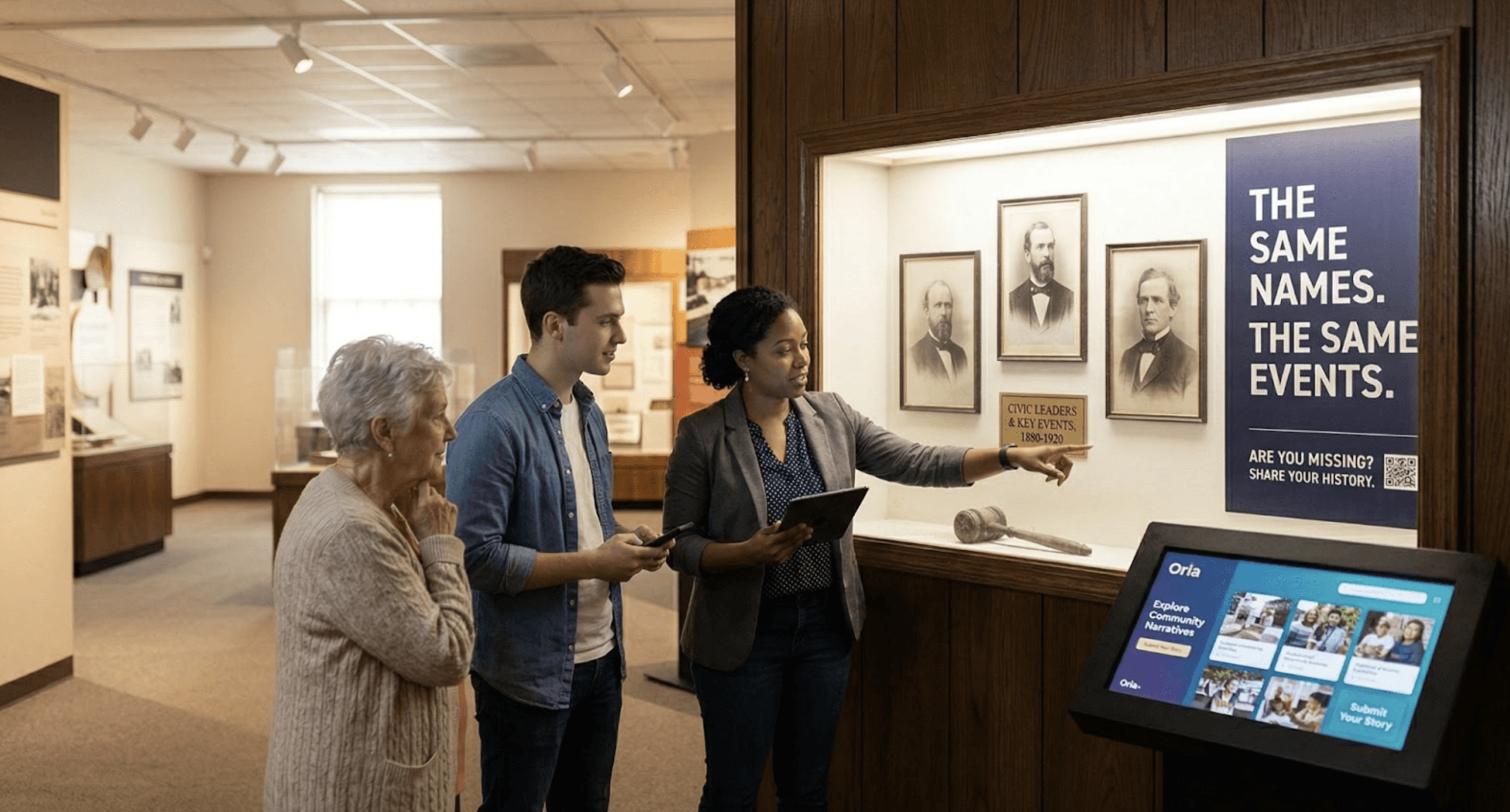
Most people encounter the same narrow slice of history thousands of times across their education, while the stories of their own communities rarely appear at all. AI tools have made this worse by amplifying whatever is already in the historical record, and communities whose stories were never recorded are being left further behind with every passing year.
What Is the History Silo?
Ask anyone who went through a standard American education to name ten historical figures they studied. The list will look almost identical regardless of where they grew up, what city they were raised in, or whose family they come from.
George Washington. Abraham Lincoln. Benjamin Franklin. Rosa Parks. Martin Luther King Jr. Christopher Columbus. A handful of presidents. A handful of wars. The same photographs. The same speeches. The same timelines.
This isn't an accident. It's the result of decades of standardized curriculum, centralized textbook publishing, and a historical record that was shaped, from the beginning, by who had access to printing presses, universities, and archival institutions. What got written down, indexed, and taught was largely determined by proximity to power. And what got left out, for just as long, was the history of communities that operated outside those institutions.
This is the history silo. A self-reinforcing loop where the same stories get repeated because they're the ones in the record, and the ones in the record are the ones that get repeated.
AI Didn't Create This Problem. It Made It Louder.
For most of the twentieth century, the history silo moved at the pace of textbook publishing cycles and curriculum committee decisions. That was slow enough that communities could, at least in theory, advocate for change, push for inclusion, and work to add their stories to what students were learning.
That pace has changed.
AI tools, the kind students now use daily for research, homework, essay writing, and basic questions about the world, do not generate history from scratch. They reflect what is already in the digital record. They are trained on digitized books, indexed archives, published articles, and online encyclopedias. What is in that corpus gets surfaced constantly. What is not in that corpus simply does not appear.
The result is that a student asking an AI tool about American history in 2025 gets essentially the same answer a student got from an encyclopedia in 1985. The same names. The same events. The same framing. The difference is that the AI delivers those answers instantly, confidently, and at a scale that no textbook ever could. George Washington doesn't appear once in a chapter. He appears in every essay prompt, every research session, every auto-completed answer, thousands of times across a single student's education.
Communities whose stories were never digitized, never indexed, never published in formats that AI systems can read, are not just underrepresented. They are functionally invisible to an entire generation of learners who are now being educated primarily through these tools.
Who Gets Left Out, and What It Costs
The communities most affected by the history silo are not hard to identify. They are the same communities that have always been on the margins of the official record.
Black fraternal organizations with chapters dating back to the late 1800s, whose internal histories, rituals, and community contributions were never the subject of academic study. Faith communities that served as the backbone of neighborhood life for generations, whose records exist in storage rooms and the memories of elders. Indigenous communities whose oral traditions were deliberately excluded from written archives. Immigrant communities whose stories were told in languages and formats that Western archival institutions were not built to preserve. Veterans groups whose service was documented in official military records but whose personal histories, the meaning behind the service, were never collected. Neighborhood associations in communities that were redlined, displaced, or simply overlooked, whose histories are stored nowhere except in the people still living them.
When these stories don't exist in the record, students from those communities spend their entire education learning history that doesn't include them. They learn that history is something that happened to other people, in other places, by other families. The message is not always explicit. But it is consistent.
And that message has a cost that goes well beyond the classroom.
Communities that cannot point to a documented history have a harder time making the case for their own significance, their own contributions, their own right to the resources and recognition that come with institutional acknowledgment. A community whose story has never been told has no leverage with funders, no evidence for grant applications, no record to pass to the next generation. The history silo is not just an educational problem. It is a resource problem, a political problem, and a generational one.
The Window Is Closing
Here is the part that doesn't get said enough: the people who hold these stories are aging. Every year that passes without a structured effort to collect community histories is a year in which irreplaceable knowledge moves closer to being gone forever.
This is not a distant concern. It is happening right now, in every community, in every city. The elders who remember what a neighborhood looked like before it was redeveloped, who know the founding stories of a fraternal organization or a faith community, who carry in their memories the names and faces of people who will never appear in any textbook, are here today. They may not be here in ten years.
The urgency is real. And the history silo makes it more urgent, not less, because it means that even if these stories are collected, they need to be published and made findable in order to matter. A recording that lives on someone's phone is not in the record. A story that sits in a folder on a community leader's computer is not in the record. The silo only breaks when stories are collected, described, and shared in ways that other people can actually find them.
The Record Doesn't Build Itself
The history silo is not permanent. It is a reflection of what has been recorded so far. And recording is something communities can do.
The stories that are missing from the record are missing because no one has collected and published them in a format that can be found, indexed, and shared. That is a problem with a direct solution. Community oral history programs, the kind that collect recorded interviews, attach proper descriptions, and make those stories publicly accessible, are how communities add themselves to the record.
This matters more now than it did ten years ago. The communities that invest in collecting and publishing their histories today are building the record that educators and researchers will draw from in the next decade. The communities that don't will continue to be invisible in that record, not because their stories don't matter, but because no one captured them while the people who hold them were still here.
The good news is that the barrier to acting has dropped significantly. A community oral history program no longer requires an archivist on staff, a university partnership, or significant technical infrastructure. The tools available today make it possible for a community organization to launch a structured, searchable, shareable oral history program without any of the overhead that made this work inaccessible a generation ago.
What Communities Can Do Right Now
The first step is the simplest and the most urgent: identify who in your community holds stories that exist nowhere else, and start recording them.
This doesn't require a grant. It doesn't require professional equipment. It requires a decision that these stories are worth preserving, and a process for collecting them before the window closes.
From there, the work is about making those stories findable. Organizations doing this well share a few things in common:
A clear, ongoing process for collecting stories, not just a one-time event
A way to manage consent so that narrators control how their stories are used
A structure for describing and organizing what they collect so it can be searched and shared
A way to publish that work so it reaches people beyond the organization itself
None of this is technically complicated. It is organizationally intentional. It requires deciding that your community's history is worth the effort, and building a simple system to make that effort sustainable.
The silo grows when communities wait for institutions to include them. It shrinks when communities build their own record.
The Silo Grows When We Don't Act
The history monoculture is not going away on its own. AI tools will continue to surface what is already in the record. Curricula will continue to default to what has always been there. The same names and the same events will continue to be repeated, thousands of times, to students who deserve to see themselves in the history they are asked to learn.
The communities that break out of that pattern will be the ones that build their own record. Not by waiting for institutions to include them, but by collecting, preserving, and sharing their own stories in ways that become part of what the world can actually find.
If your organization is ready to start that work, and you want to see what a structured community oral history program looks like in practice, book a 30-minute conversation here. No sales pressure, just a look at what's possible.
Further Readings

What is Oria?
Oria is an Oral History & Community Storytelling Platform
Oria helps institutions and communities seamlessly collect, archive, and share authentic stories in one trusted space. We provide a complete storytelling engine for focused outreach, guided narrative collection, and long-term digital preservation—making it effortless to safeguard lived experiences at scale.